QUESTION IMAGE
Question
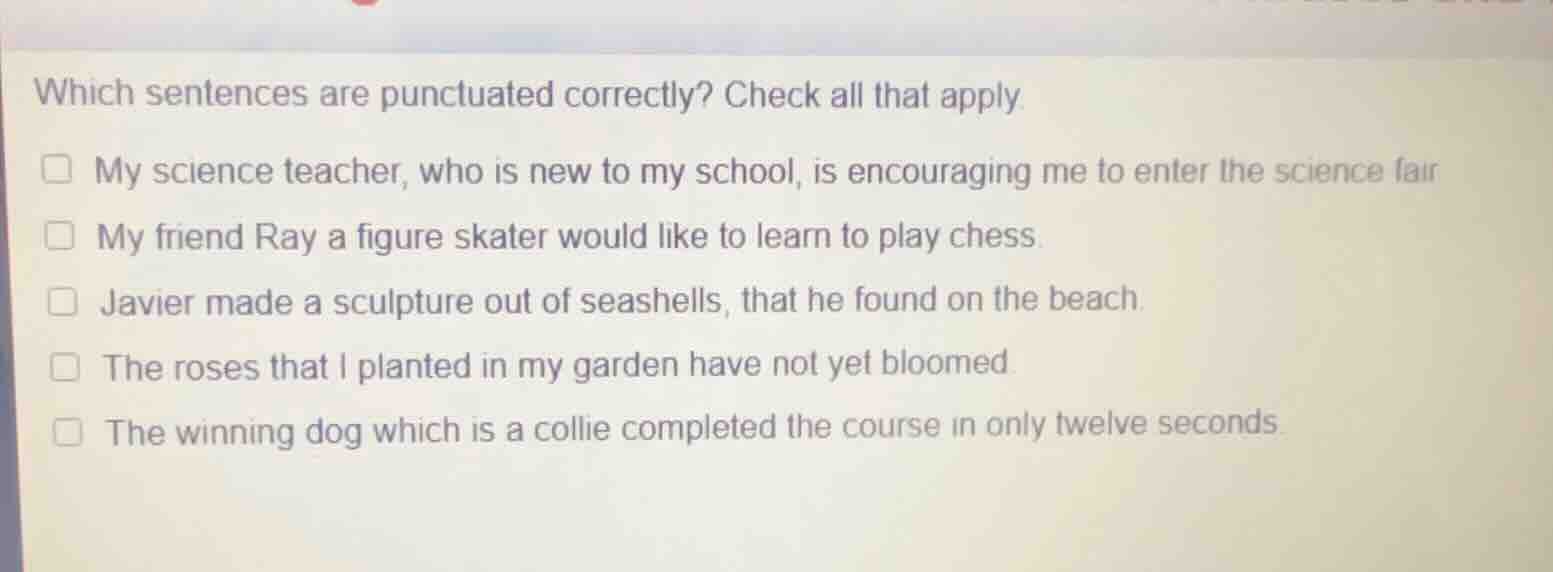
which sentences are punctuated correctly? check all that apply.
my science teacher, who is new to my school, is encouraging me to enter the science fair.
my friend ray a figure skater would like to learn to play chess.
javier made a sculpture out of seashells, that he found on the beach.
the roses that i planted in my garden have not yet bloomed.
the winning dog which is a collie completed the course in only twelve seconds.
<pre_analysis>
{
"quality": "clear",
"question_count": 1,
"skills_matched": [
"direct_cot",
"multiple_choice_formatter",
"explain_then_answer",
"tutor"
],
"needs_drawing": false,
"concepts_used": [
"Nonrestrictive Phrases",
"Restrictive Phrases",
"Appositive Phrases"
],
"new_concepts": [
"Punctuation Rules",
"Relative Clause Punctuation"
],
"current_concepts": [
"Nonrestrictive Phrases",
"Restrictive Phrases",
"Appositive Phrases",
"Punctuation Rules",
"Relative Clause Punctuation"
]
}
</pre_analysis>
<reasoning>
Analyze nonrestrictive relative clauses
Using the Nonrestrictive Phrases knowledge point, we evaluate the first sentence: "My science teacher, who is new to my school, is encouraging me to enter the science fair." The clause "who is new to my school" is nonessential (nonrestrictive) because "My science teacher" is already specific. Nonrestrictive clauses must be set off by commas. Since it has commas both before and after, this sentence is punctuated correctly.
Analyze appositive phrases
Using the Appositive Phrases knowledge point, we evaluate the second sentence: "My friend Ray a figure skater would like to learn to play chess." The phrase "a figure skater" is an appositive renaming "My friend Ray." Because it is nonessential information, it requires commas on both sides: "My friend Ray, a figure skater, would like..." Since these commas are missing, this sentence is punctuated incorrectly.
Analyze restrictive relative clauses
Using the Restrictive Phrases knowledge point, we evaluate the third and fourth sentences.
- In the third sentence: "Javier made a sculpture out of seashells, that he found on the beach." The clause "that he found on the beach" is a restrictive relative clause identifying which seashells. Restrictive clauses starting with "that" should never be preceded by a comma. Thus, this sentence is punctuated incorrectly.
- In the fourth sentence: "The roses that I planted in my garden have not yet blossomed." The clause "that I planted in my garden" is restrictive because it specifies which roses. Restrictive clauses do not take commas. Thus, this sentence is punctuated correctly.
Analyze missing nonrestrictive commas
We evaluate the fifth sentence: "The winning dog which is a collie completed the course in only twelve seconds." The clause "which is a collie" is nonessential (nonrestrictive) because "The winning dog" is already defined. It requires commas on both sides: ", which is a collie,". Since these commas are missing, this sentence is punctuated incorrectly.
</reasoning>
<answer>
<mcq-correct>My science teacher, who is new to my school, is encouraging me to enter the science fair.</mcq-correct>
<mcq-option>My friend Ray a figure skater would like to learn to play chess.</mcq-option>
<mcq-option>Javier made a sculpture out of seashells, that he found on the beach.</mcq-option>
<mcq-correct>The roses that I planted in my garden have not yet blossomed.</mcq-correct>
<mcq-option>The winning dog which is a collie completed the course in only twelve seconds.</mcq-option>
</answer>
<post_analysis>
{
"subject": "Others",
"question_type": "Multiple Choice",
"knowledge_point": [
"Others",
"English Language Arts",
"Punctuation Rules"
]
}
</post_analysis>
Snap & solve any problem in the app
Get step-by-step solutions on Sovi AI
Photo-based solutions with guided steps
Explore more problems and detailed explanations
<pre_analysis>
{
"quality": "clear",
"question_count": 1,
"skills_matched": [
"direct_cot",
"multiple_choice_formatter",
"explain_then_answer",
"tutor"
],
"needs_drawing": false,
"concepts_used": [
"Nonrestrictive Phrases",
"Restrictive Phrases",
"Appositive Phrases"
],
"new_concepts": [
"Punctuation Rules",
"Relative Clause Punctuation"
],
"current_concepts": [
"Nonrestrictive Phrases",
"Restrictive Phrases",
"Appositive Phrases",
"Punctuation Rules",
"Relative Clause Punctuation"
]
}
</pre_analysis>
<reasoning>
Analyze nonrestrictive relative clauses
Using the Nonrestrictive Phrases knowledge point, we evaluate the first sentence: "My science teacher, who is new to my school, is encouraging me to enter the science fair." The clause "who is new to my school" is nonessential (nonrestrictive) because "My science teacher" is already specific. Nonrestrictive clauses must be set off by commas. Since it has commas both before and after, this sentence is punctuated correctly.
Analyze appositive phrases
Using the Appositive Phrases knowledge point, we evaluate the second sentence: "My friend Ray a figure skater would like to learn to play chess." The phrase "a figure skater" is an appositive renaming "My friend Ray." Because it is nonessential information, it requires commas on both sides: "My friend Ray, a figure skater, would like..." Since these commas are missing, this sentence is punctuated incorrectly.
Analyze restrictive relative clauses
Using the Restrictive Phrases knowledge point, we evaluate the third and fourth sentences.
- In the third sentence: "Javier made a sculpture out of seashells, that he found on the beach." The clause "that he found on the beach" is a restrictive relative clause identifying which seashells. Restrictive clauses starting with "that" should never be preceded by a comma. Thus, this sentence is punctuated incorrectly.
- In the fourth sentence: "The roses that I planted in my garden have not yet blossomed." The clause "that I planted in my garden" is restrictive because it specifies which roses. Restrictive clauses do not take commas. Thus, this sentence is punctuated correctly.
Analyze missing nonrestrictive commas
We evaluate the fifth sentence: "The winning dog which is a collie completed the course in only twelve seconds." The clause "which is a collie" is nonessential (nonrestrictive) because "The winning dog" is already defined. It requires commas on both sides: ", which is a collie,". Since these commas are missing, this sentence is punctuated incorrectly.
</reasoning>
<answer>
<mcq-correct>My science teacher, who is new to my school, is encouraging me to enter the science fair.</mcq-correct>
<mcq-option>My friend Ray a figure skater would like to learn to play chess.</mcq-option>
<mcq-option>Javier made a sculpture out of seashells, that he found on the beach.</mcq-option>
<mcq-correct>The roses that I planted in my garden have not yet blossomed.</mcq-correct>
<mcq-option>The winning dog which is a collie completed the course in only twelve seconds.</mcq-option>
</answer>
<post_analysis>
{
"subject": "Others",
"question_type": "Multiple Choice",
"knowledge_point": [
"Others",
"English Language Arts",
"Punctuation Rules"
]
}
</post_analysis>