QUESTION IMAGE
Question
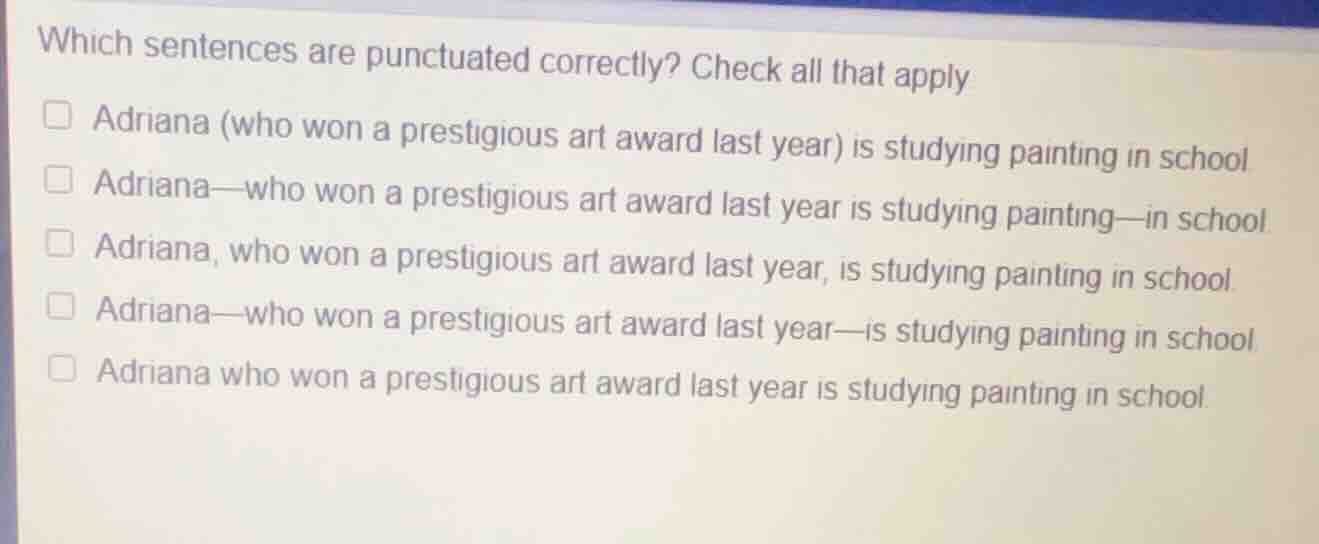
which sentences are punctuated correctly? check all that apply
adriana (who won a prestigious art award last year) is studying painting in school.
adriana-who won a prestigious art award last year is studying painting-in school.
adriana, who won a prestigious art award last year, is studying painting in school.
adriana-who won a prestigious art award last year-is studying painting in school.
adriana who won a prestigious art award last year is studying painting in school.
<pre_analysis>
{
"quality": "clear",
"question_count": 1,
"skills_matched": [
"direct_cot",
"multiple_choice_formatter",
"explain_then_answer",
"tutor"
],
"needs_drawing": false,
"concepts_used": [
"Nonrestrictive Clauses",
"Relative Clause Punctuation"
],
"new_concepts": [],
"current_concepts": [
"Nonrestrictive Clauses",
"Relative Clause Punctuation",
"Punctuation Rules"
]
}
</pre_analysis>
<reasoning>
Identify the nonrestrictive clause
The clause "who won a prestigious art award last year" provides extra, nonessential information about the proper noun "Adriana." Because the sentence remains grammatically complete and retains its core meaning without this clause, it is a nonrestrictive relative clause. Using the Nonrestrictive Clauses knowledge point, we know that nonrestrictive information must be set off from the rest of the sentence using matching punctuation marks on both sides.
Evaluate parentheses punctuation
The first option uses parentheses: "Adriana (who won a prestigious art award last year) is studying painting in school." Parentheses are a correct way to set off nonessential, parenthetical information. The opening and closing parentheses correctly enclose the entire nonrestrictive clause.
Evaluate incorrect dash placement
The second option states: "Adriana—who won a prestigious art award last year is studying painting—in school." This sentence incorrectly places the second em dash after "painting" instead of after "year," which breaks the logical flow and separates the prepositional phrase "in school" instead of the nonessential clause.
Evaluate comma punctuation
The third option uses commas: "Adriana, who won a prestigious art award last year, is studying painting in school." Using the Relative Clause Punctuation knowledge point, commas are the standard punctuation marks used to set off nonrestrictive relative clauses. The commas correctly frame the clause at both the beginning and the end.
Evaluate correct dash placement
The fourth option uses em dashes: "Adriana—who won a prestigious art award last year—is studying painting in school." Em dashes can be used in pairs to set off parenthetical information or emphasize a nonrestrictive clause. The dashes are placed correctly at both boundaries of the clause.
Evaluate missing punctuation
The fifth option states: "Adriana who won a prestigious art award last year is studying painting in school." This option lacks any punctuation to set off the nonrestrictive clause, which is incorrect because nonessential clauses must be separated from the main clause.
</reasoning>
<answer>
<mcq-correct>(A) Adriana (who won a prestigious art award last year) is studying painting in school.</mcq-correct>
<mcq-option>(B) Adriana—who won a prestigious art award last year is studying painting—in school.</mcq-option>
<mcq-correct>(C) Adriana, who won a prestigious art award last year, is studying painting in school.</mcq-correct>
<mcq-correct>(D) Adriana—who won a prestigious art award last year—is studying painting in school.</mcq-correct>
<mcq-option>(E) Adriana who won a prestigious art award last year is studying painting in school.</mcq-option>
</answer>
<post_analysis>
{
"subject": "Others",
"question_type": "Multiple Choice",
"knowledge_point": [
"Others",
"Language Arts",
"Punctuation Rules"
]
}
</post_analysis>
Snap & solve any problem in the app
Get step-by-step solutions on Sovi AI
Photo-based solutions with guided steps
Explore more problems and detailed explanations
<pre_analysis>
{
"quality": "clear",
"question_count": 1,
"skills_matched": [
"direct_cot",
"multiple_choice_formatter",
"explain_then_answer",
"tutor"
],
"needs_drawing": false,
"concepts_used": [
"Nonrestrictive Clauses",
"Relative Clause Punctuation"
],
"new_concepts": [],
"current_concepts": [
"Nonrestrictive Clauses",
"Relative Clause Punctuation",
"Punctuation Rules"
]
}
</pre_analysis>
<reasoning>
Identify the nonrestrictive clause
The clause "who won a prestigious art award last year" provides extra, nonessential information about the proper noun "Adriana." Because the sentence remains grammatically complete and retains its core meaning without this clause, it is a nonrestrictive relative clause. Using the Nonrestrictive Clauses knowledge point, we know that nonrestrictive information must be set off from the rest of the sentence using matching punctuation marks on both sides.
Evaluate parentheses punctuation
The first option uses parentheses: "Adriana (who won a prestigious art award last year) is studying painting in school." Parentheses are a correct way to set off nonessential, parenthetical information. The opening and closing parentheses correctly enclose the entire nonrestrictive clause.
Evaluate incorrect dash placement
The second option states: "Adriana—who won a prestigious art award last year is studying painting—in school." This sentence incorrectly places the second em dash after "painting" instead of after "year," which breaks the logical flow and separates the prepositional phrase "in school" instead of the nonessential clause.
Evaluate comma punctuation
The third option uses commas: "Adriana, who won a prestigious art award last year, is studying painting in school." Using the Relative Clause Punctuation knowledge point, commas are the standard punctuation marks used to set off nonrestrictive relative clauses. The commas correctly frame the clause at both the beginning and the end.
Evaluate correct dash placement
The fourth option uses em dashes: "Adriana—who won a prestigious art award last year—is studying painting in school." Em dashes can be used in pairs to set off parenthetical information or emphasize a nonrestrictive clause. The dashes are placed correctly at both boundaries of the clause.
Evaluate missing punctuation
The fifth option states: "Adriana who won a prestigious art award last year is studying painting in school." This option lacks any punctuation to set off the nonrestrictive clause, which is incorrect because nonessential clauses must be separated from the main clause.
</reasoning>
<answer>
<mcq-correct>(A) Adriana (who won a prestigious art award last year) is studying painting in school.</mcq-correct>
<mcq-option>(B) Adriana—who won a prestigious art award last year is studying painting—in school.</mcq-option>
<mcq-correct>(C) Adriana, who won a prestigious art award last year, is studying painting in school.</mcq-correct>
<mcq-correct>(D) Adriana—who won a prestigious art award last year—is studying painting in school.</mcq-correct>
<mcq-option>(E) Adriana who won a prestigious art award last year is studying painting in school.</mcq-option>
</answer>
<post_analysis>
{
"subject": "Others",
"question_type": "Multiple Choice",
"knowledge_point": [
"Others",
"Language Arts",
"Punctuation Rules"
]
}
</post_analysis>