Sovi.AI - AI Math Tutor

Scan to solve math questions

QUESTION IMAGE

which sentences contain relative clauses? check all that apply palm tre…

Question

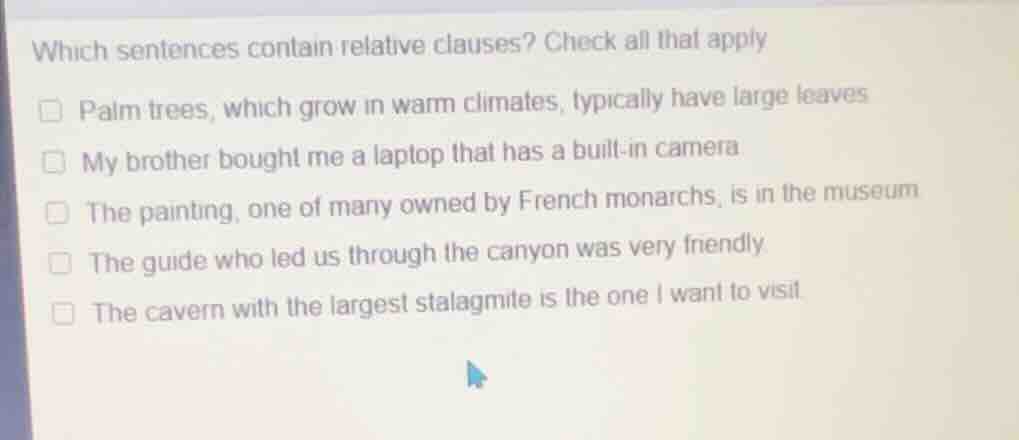
which sentences contain relative clauses? check all that apply

palm trees, which grow in warm climates, typically have large leaves
my brother bought me a laptop that has a built-in camera
the painting, one of many owned by french monarchs, is in the museum
the guide who led us through the canyon was very friendly
the cavern with the largest stalagmite is the one i want to visit

Explanation:

Response

<pre_analysis>
{
"quality": "clear",
"question_count": 1,
"skills_matched": [
"direct_cot",
"multiple_choice_formatter",
"explain_then_answer",
"tutor"
],
"needs_drawing": false,
"concepts_used": [
"Clauses vs Phrases",
"Restrictive Phrases",
"Nonrestrictive Phrases"
],
"new_concepts": [
"Relative Clauses",
"Relative Pronouns"
],
"current_concepts": [
"Clauses vs Phrases",
"Restrictive Phrases",
"Nonrestrictive Phrases",
"Relative Clauses",
"Relative Pronouns"
]
}
</pre_analysis>

<reasoning>

Define relative clauses

A relative clause (or adjective clause) is a dependent clause that modifies a noun or pronoun. It typically begins with a relative pronoun (such as who, whom, whose, which, or that) or a relative adverb (such as where, when, or why). It must contain both a subject and a verb.

Analyze the first sentence

"Palm trees, which grow in warm climates, typically have large leaves."

  • This sentence contains the clause "which grow in warm climates".
  • It begins with the relative pronoun which and contains the verb grow.
  • It modifies the noun "Palm trees".
  • This is a nonrestrictive relative clause, relating to your understanding of Nonrestrictive Phrases.
  • Therefore, this sentence contains a relative clause.

Analyze the second sentence

"My brother bought me a laptop that has a built-in camera."

  • This sentence contains the clause "that has a built-in camera".
  • It begins with the relative pronoun that (acting as the subject) and contains the verb has.
  • It modifies the noun "laptop".
  • This is a restrictive relative clause, relating to your understanding of Restrictive Phrases.
  • Therefore, this sentence contains a relative clause.

Analyze the third sentence

"The painting, one of many owned by French monarchs, is in the museum."

  • The phrase "one of many owned by French monarchs" modifies "The painting".
  • However, this phrase does not contain a finite verb or a relative pronoun. It is an appositive phrase, not a clause.
  • Therefore, this sentence does not contain a relative clause.

Analyze the fourth and fifth sentences

"The guide who led us through the canyon was very friendly."

  • This sentence contains the clause "who led us through the canyon".
  • It begins with the relative pronoun who and contains the verb led.
  • It modifies the noun "guide".
  • Therefore, this sentence contains a relative clause.

"The cavern with the largest stalagmite is the one I want to visit."

  • The phrase "with the largest stalagmite" is a prepositional phrase, not a clause.
  • However, look at the second part: "the one [that] I want to visit."
  • The clause "I want to visit" modifies the pronoun "one". The relative pronoun that or which is omitted but understood ("the one that I want to visit").
  • This is a contact relative clause (an elliptical relative clause) where the relative pronoun is omitted. It contains a subject "I" and a verb phrase "want to visit".
  • Therefore, this sentence also contains a relative clause.

</reasoning>

<answer>
<mcq-correct>Palm trees, which grow in warm climates, typically have large leaves</mcq-correct>
<mcq-correct>My brother bought me a laptop that has a built-in camera</mcq-correct>
<mcq-option>The painting, one of many owned by French monarchs, is in the museum</mcq-option>
<mcq-correct>The guide who led us through the canyon was very friendly</mcq-correct>
<mcq-correct>The cavern with the largest stalagmite is the one I want to visit</mcq-correct>
</answer>

<post_analysis>
{
"sub…

Answer:

<pre_analysis>
{
"quality": "clear",
"question_count": 1,
"skills_matched": [
"direct_cot",
"multiple_choice_formatter",
"explain_then_answer",
"tutor"
],
"needs_drawing": false,
"concepts_used": [
"Clauses vs Phrases",
"Restrictive Phrases",
"Nonrestrictive Phrases"
],
"new_concepts": [
"Relative Clauses",
"Relative Pronouns"
],
"current_concepts": [
"Clauses vs Phrases",
"Restrictive Phrases",
"Nonrestrictive Phrases",
"Relative Clauses",
"Relative Pronouns"
]
}
</pre_analysis>

<reasoning>

Define relative clauses

A relative clause (or adjective clause) is a dependent clause that modifies a noun or pronoun. It typically begins with a relative pronoun (such as who, whom, whose, which, or that) or a relative adverb (such as where, when, or why). It must contain both a subject and a verb.

Analyze the first sentence

"Palm trees, which grow in warm climates, typically have large leaves."

  • This sentence contains the clause "which grow in warm climates".
  • It begins with the relative pronoun which and contains the verb grow.
  • It modifies the noun "Palm trees".
  • This is a nonrestrictive relative clause, relating to your understanding of Nonrestrictive Phrases.
  • Therefore, this sentence contains a relative clause.

Analyze the second sentence

"My brother bought me a laptop that has a built-in camera."

  • This sentence contains the clause "that has a built-in camera".
  • It begins with the relative pronoun that (acting as the subject) and contains the verb has.
  • It modifies the noun "laptop".
  • This is a restrictive relative clause, relating to your understanding of Restrictive Phrases.
  • Therefore, this sentence contains a relative clause.

Analyze the third sentence

"The painting, one of many owned by French monarchs, is in the museum."

  • The phrase "one of many owned by French monarchs" modifies "The painting".
  • However, this phrase does not contain a finite verb or a relative pronoun. It is an appositive phrase, not a clause.
  • Therefore, this sentence does not contain a relative clause.

Analyze the fourth and fifth sentences

"The guide who led us through the canyon was very friendly."

  • This sentence contains the clause "who led us through the canyon".
  • It begins with the relative pronoun who and contains the verb led.
  • It modifies the noun "guide".
  • Therefore, this sentence contains a relative clause.

"The cavern with the largest stalagmite is the one I want to visit."

  • The phrase "with the largest stalagmite" is a prepositional phrase, not a clause.
  • However, look at the second part: "the one [that] I want to visit."
  • The clause "I want to visit" modifies the pronoun "one". The relative pronoun that or which is omitted but understood ("the one that I want to visit").
  • This is a contact relative clause (an elliptical relative clause) where the relative pronoun is omitted. It contains a subject "I" and a verb phrase "want to visit".
  • Therefore, this sentence also contains a relative clause.

</reasoning>

<answer>
<mcq-correct>Palm trees, which grow in warm climates, typically have large leaves</mcq-correct>
<mcq-correct>My brother bought me a laptop that has a built-in camera</mcq-correct>
<mcq-option>The painting, one of many owned by French monarchs, is in the museum</mcq-option>
<mcq-correct>The guide who led us through the canyon was very friendly</mcq-correct>
<mcq-correct>The cavern with the largest stalagmite is the one I want to visit</mcq-correct>
</answer>

<post_analysis>
{
"subject": "Others",
"question_type": "Multiple Choice",
"knowledge_point": [
"Others",
"Grammar",
"Relative Clauses"
]
}
</post_analysis>