QUESTION IMAGE
Question
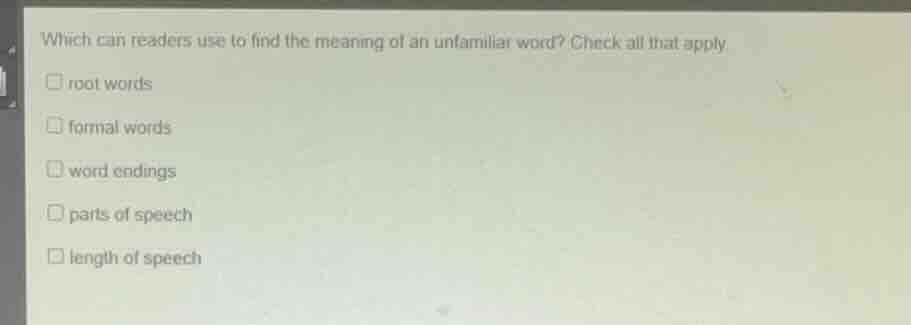
which can readers use to find the meaning of an unfamiliar word? check all that apply.
root words
formal words
word endings
parts of speech
length of speech
<pre_analysis>
{
"quality": "clear",
"question_count": 1,
"skills_matched": [
"direct_cot",
"multiple_choice_formatter",
"explain_then_answer",
"tutor"
],
"needs_drawing": false,
"concepts_used": [
"Parts of Speech",
"Word Suffixes"
],
"new_concepts": [
"Context Clues",
"Word Analysis"
],
"current_concepts": [
"Parts of Speech",
"Word Suffixes",
"Context Clues",
"Word Analysis"
]
}
</pre_analysis>
<reasoning>
Analyze the question prompt
The question asks which tools or strategies readers can use to determine the meaning of an unfamiliar word. This is a "check all that apply" multiple-choice question.
Evaluate "root words"
Root words are the base form of a word. Understanding the root word helps a reader deduce the core meaning of a larger, unfamiliar word. Thus, this is a correct strategy.
Evaluate "formal words"
"Formal words" refers to the register or tone of vocabulary. Knowing whether a word is formal does not directly help a reader decode its specific semantic meaning. Thus, this is incorrect.
Evaluate "word endings"
Word endings, such as suffixes, modify the meaning or grammatical function of a base word. Using Word Suffixes allows readers to determine how a word is used and helps reveal its meaning. Thus, this is a correct strategy.
Evaluate "parts of speech"
Identifying Parts of Speech (such as nouns, verbs, or adjectives) helps readers understand the syntactic role of an unfamiliar word in a sentence, which provides crucial context clues to its meaning. Thus, this is a correct strategy.
Evaluate "length of speech"
The physical length of a speech or a word does not provide semantic clues to determine what an unfamiliar word means. Thus, this is incorrect.
</reasoning>
<answer>
<mcq-correct>root words</mcq-correct>
<mcq-option>formal words</mcq-option>
<mcq-correct>word endings</mcq-correct>
<mcq-correct>parts of speech</mcq-correct>
<mcq-option>length of speech</mcq-option>
</answer>
<post_analysis>
{
"subject": "Others",
"question_type": "Multiple Choice",
"knowledge_point": [
"Others",
"English Language Arts",
"Vocabulary Acquisition"
]
}
</post_analysis>
Snap & solve any problem in the app
Get step-by-step solutions on Sovi AI
Photo-based solutions with guided steps
Explore more problems and detailed explanations
<pre_analysis>
{
"quality": "clear",
"question_count": 1,
"skills_matched": [
"direct_cot",
"multiple_choice_formatter",
"explain_then_answer",
"tutor"
],
"needs_drawing": false,
"concepts_used": [
"Parts of Speech",
"Word Suffixes"
],
"new_concepts": [
"Context Clues",
"Word Analysis"
],
"current_concepts": [
"Parts of Speech",
"Word Suffixes",
"Context Clues",
"Word Analysis"
]
}
</pre_analysis>
<reasoning>
Analyze the question prompt
The question asks which tools or strategies readers can use to determine the meaning of an unfamiliar word. This is a "check all that apply" multiple-choice question.
Evaluate "root words"
Root words are the base form of a word. Understanding the root word helps a reader deduce the core meaning of a larger, unfamiliar word. Thus, this is a correct strategy.
Evaluate "formal words"
"Formal words" refers to the register or tone of vocabulary. Knowing whether a word is formal does not directly help a reader decode its specific semantic meaning. Thus, this is incorrect.
Evaluate "word endings"
Word endings, such as suffixes, modify the meaning or grammatical function of a base word. Using Word Suffixes allows readers to determine how a word is used and helps reveal its meaning. Thus, this is a correct strategy.
Evaluate "parts of speech"
Identifying Parts of Speech (such as nouns, verbs, or adjectives) helps readers understand the syntactic role of an unfamiliar word in a sentence, which provides crucial context clues to its meaning. Thus, this is a correct strategy.
Evaluate "length of speech"
The physical length of a speech or a word does not provide semantic clues to determine what an unfamiliar word means. Thus, this is incorrect.
</reasoning>
<answer>
<mcq-correct>root words</mcq-correct>
<mcq-option>formal words</mcq-option>
<mcq-correct>word endings</mcq-correct>
<mcq-correct>parts of speech</mcq-correct>
<mcq-option>length of speech</mcq-option>
</answer>
<post_analysis>
{
"subject": "Others",
"question_type": "Multiple Choice",
"knowledge_point": [
"Others",
"English Language Arts",
"Vocabulary Acquisition"
]
}
</post_analysis>