Sovi.AI - AI Math Tutor

Scan to solve math questions

QUESTION IMAGE

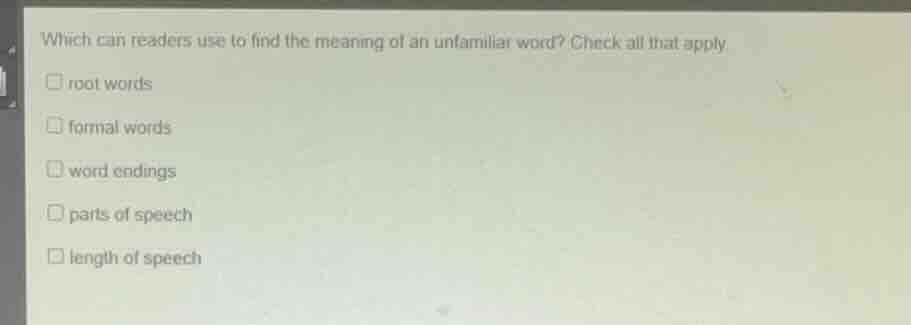
which can readers use to find the meaning of an unfamiliar word? check …

Question

which can readers use to find the meaning of an unfamiliar word? check all that apply.

root words
formal words
word endings
parts of speech
length of speech

Explanation:

Response

<pre_analysis>
{
"quality": "clear",
"question_count": 1,
"skills_matched": [
"direct_cot",
"multiple_choice_formatter",
"explain_then_answer",
"tutor"
],
"needs_drawing": false,
"concepts_used": [
"Parts of Speech",
"Word Suffixes"
],
"new_concepts": [
"Context Clues",
"Word Analysis"
],
"current_concepts": [
"Parts of Speech",
"Word Suffixes",
"Context Clues",
"Word Analysis"
]
}
</pre_analysis>

<reasoning>

Analyze the question prompt

The question asks which tools or strategies readers can use to determine the meaning of an unfamiliar word. This is a "check all that apply" multiple-choice question.

Evaluate "root words"

Root words are the base form of a word. Understanding the root word helps a reader deduce the core meaning of a larger, unfamiliar word. Thus, this is a correct strategy.

Evaluate "formal words"

"Formal words" refers to the register or tone of vocabulary. Knowing whether a word is formal does not directly help a reader decode its specific semantic meaning. Thus, this is incorrect.

Evaluate "word endings"

Word endings, such as suffixes, modify the meaning or grammatical function of a base word. Using Word Suffixes allows readers to determine how a word is used and helps reveal its meaning. Thus, this is a correct strategy.

Evaluate "parts of speech"

Identifying Parts of Speech (such as nouns, verbs, or adjectives) helps readers understand the syntactic role of an unfamiliar word in a sentence, which provides crucial context clues to its meaning. Thus, this is a correct strategy.

Evaluate "length of speech"

The physical length of a speech or a word does not provide semantic clues to determine what an unfamiliar word means. Thus, this is incorrect.
</reasoning>

<answer>
<mcq-correct>root words</mcq-correct>
<mcq-option>formal words</mcq-option>
<mcq-correct>word endings</mcq-correct>
<mcq-correct>parts of speech</mcq-correct>
<mcq-option>length of speech</mcq-option>
</answer>

<post_analysis>
{
"subject": "Others",
"question_type": "Multiple Choice",
"knowledge_point": [
"Others",
"English Language Arts",
"Vocabulary Acquisition"
]
}
</post_analysis>

Answer:

<pre_analysis>
{
"quality": "clear",
"question_count": 1,
"skills_matched": [
"direct_cot",
"multiple_choice_formatter",
"explain_then_answer",
"tutor"
],
"needs_drawing": false,
"concepts_used": [
"Parts of Speech",
"Word Suffixes"
],
"new_concepts": [
"Context Clues",
"Word Analysis"
],
"current_concepts": [
"Parts of Speech",
"Word Suffixes",
"Context Clues",
"Word Analysis"
]
}
</pre_analysis>

<reasoning>

Analyze the question prompt

The question asks which tools or strategies readers can use to determine the meaning of an unfamiliar word. This is a "check all that apply" multiple-choice question.

Evaluate "root words"

Root words are the base form of a word. Understanding the root word helps a reader deduce the core meaning of a larger, unfamiliar word. Thus, this is a correct strategy.

Evaluate "formal words"

"Formal words" refers to the register or tone of vocabulary. Knowing whether a word is formal does not directly help a reader decode its specific semantic meaning. Thus, this is incorrect.

Evaluate "word endings"

Word endings, such as suffixes, modify the meaning or grammatical function of a base word. Using Word Suffixes allows readers to determine how a word is used and helps reveal its meaning. Thus, this is a correct strategy.

Evaluate "parts of speech"

Identifying Parts of Speech (such as nouns, verbs, or adjectives) helps readers understand the syntactic role of an unfamiliar word in a sentence, which provides crucial context clues to its meaning. Thus, this is a correct strategy.

Evaluate "length of speech"

The physical length of a speech or a word does not provide semantic clues to determine what an unfamiliar word means. Thus, this is incorrect.
</reasoning>

<answer>
<mcq-correct>root words</mcq-correct>
<mcq-option>formal words</mcq-option>
<mcq-correct>word endings</mcq-correct>
<mcq-correct>parts of speech</mcq-correct>
<mcq-option>length of speech</mcq-option>
</answer>

<post_analysis>
{
"subject": "Others",
"question_type": "Multiple Choice",
"knowledge_point": [
"Others",
"English Language Arts",
"Vocabulary Acquisition"
]
}
</post_analysis>