QUESTION IMAGE
Question
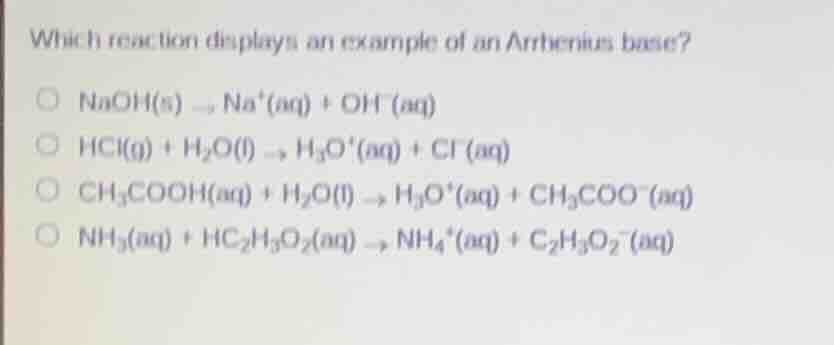
which reaction displays an example of an arrhenius base?
\\(\text{naoh(s)} \
ightarrow \text{na}^+\text{(aq)} + \text{oh}^-\text{(aq)}\\)
\\(\text{hcl(g)} + \text{h}_2\text{o(l)} \
ightarrow \text{h}_3\text{o}^+\text{(aq)} + \text{cl}^-\text{(aq)}\\)
\\(\text{ch}_3\text{cooh(aq)} + \text{h}_2\text{o(l)} \
ightarrow \text{h}_3\text{o}^+\text{(aq)} + \text{ch}_3\text{coo}^-\text{(aq)}\\)
\\(\text{nh}_3\text{(aq)} + \text{hc}_2\text{h}_3\text{o}_2\text{(aq)} \
ightarrow \text{nh}_4^+\text{(aq)} + \text{c}_2\text{h}_3\text{o}_2^-\text{(aq)}\\)
Define Arrhenius base criteria
Using the Arrhenius Theory and Properties of Bases knowledge points
An Arrhenius base is defined as a substance that dissociates in water to increase the concentration of hydroxide ions \(\text{OH}^-\) in the aqueous solution.
Analyze the first reaction
Using the Arrhenius Theory knowledge point
Sodium hydroxide dissociates in water to produce hydroxide ions \(\text{OH}^-(aq)\), which directly fits the definition of an Arrhenius base.
Analyze the remaining reactions
Using the Arrhenius Theory and Brønsted-Lowry Theory knowledge points
- \(\text{HCl}(g) + \text{H}_2\text{O}(l)
ightarrow \text{H}_3\text{O}^+(aq) + \text{Cl}^-(aq)\): This produces hydronium ions, representing an Arrhenius acid.
- \(\text{CH}_3\text{COOH}(aq) + \text{H}_2\text{O}(l)
ightarrow \text{H}_3\text{O}^+(aq) + \text{CH}_3\text{COO}^-(aq)\): This produces hydronium ions, representing an Arrhenius acid.
- \(\text{NH}_3(aq) + \text{HC}_2\text{H}_3\text{O}_2(aq)
ightarrow \text{NH}_4^+(aq) + \text{C}_2\text{H}_3\text{O}_2^-(aq)\): This is a Brønsted-Lowry acid-base proton transfer reaction.

Snap & solve any problem in the app
Get step-by-step solutions on Sovi AI
Photo-based solutions with guided steps
Explore more problems and detailed explanations
- **(A) \(\text{NaOH}(s)
ightarrow \text{Na}^+(aq) + \text{OH}^-(aq)\) (Correct answer)**
- (B) \(\text{HCl}(g) + \text{H}_2\text{O}(l)
ightarrow \text{H}_3\text{O}^+(aq) + \text{Cl}^-(aq)\)
- (C) \(\text{CH}_3\text{COOH}(aq) + \text{H}_2\text{O}(l)
ightarrow \text{H}_3\text{O}^+(aq) + \text{CH}_3\text{COO}^-(aq)\)
- (D) \(\text{NH}_3(aq) + \text{HC}_2\text{H}_3\text{O}_2(aq)
ightarrow \text{NH}_4^+(aq) + \text{C}_2\text{H}_3\text{O}_2^-(aq)\)