QUESTION IMAGE
Question
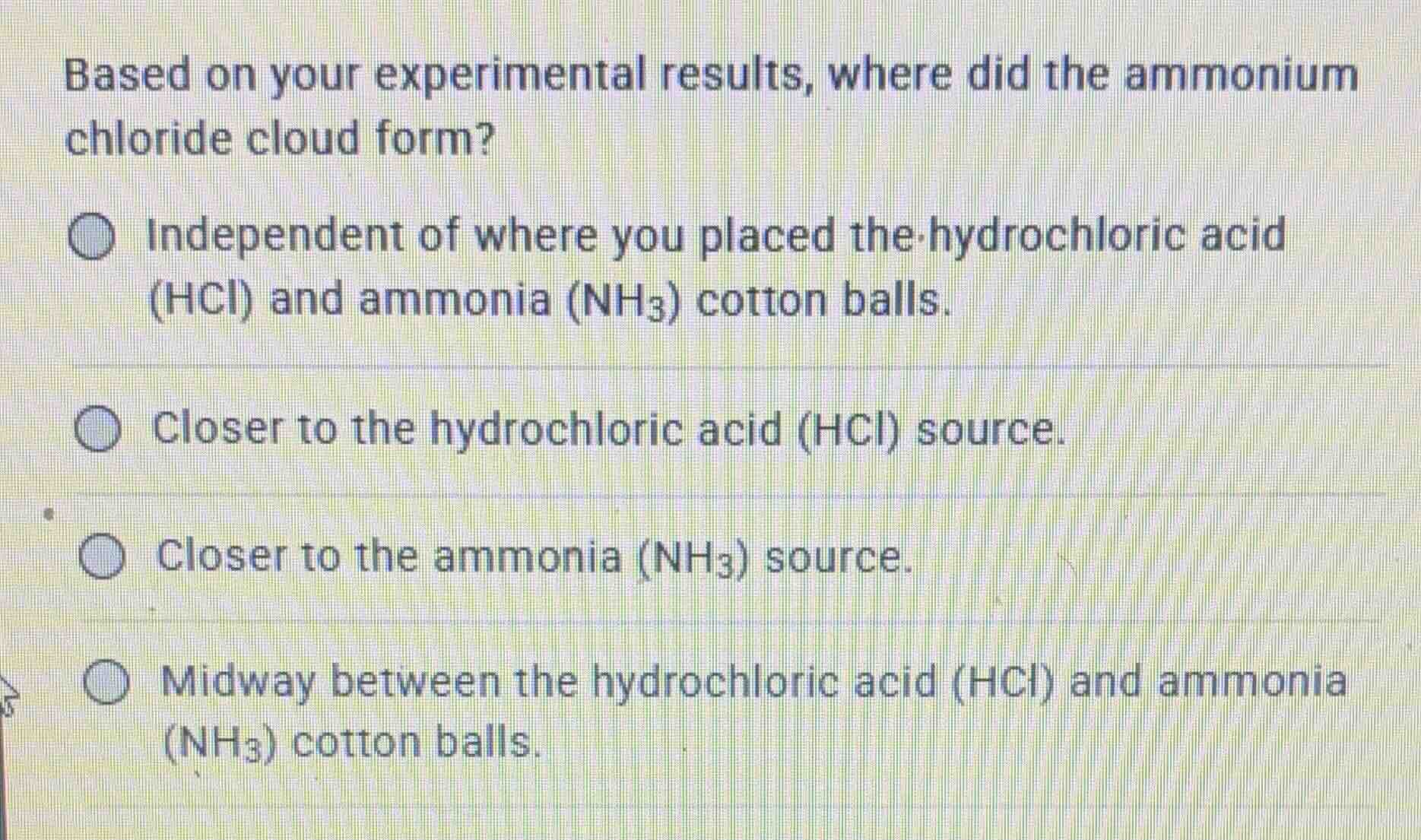
based on your experimental results, where did the ammonium chloride cloud form?
independent of where you placed the hydrochloric acid (hcl) and ammonia (\text{nh}_3) cotton balls.
closer to the hydrochloric acid (hcl) source.
closer to the ammonia (\text{nh}_3) source.
midway between the hydrochloric acid (hcl) and ammonia (\text{nh}_3) cotton balls.
Identify the reacting gases and their molar masses
Using the Grahams Law of Effusion and Gas Diffusion Experiment knowledge points
The reaction involves hydrochloric acid vapor (\(\text{HCl}\)) and ammonia gas (\(\text{NH}_3\)) diffusing from opposite ends of a tube to form solid ammonium chloride (\(\text{NH}_4\text{Cl}\)) as a white cloud:
Molar masses:
Compare diffusion rates using Graham's Law
Using the Grahams Law of Effusion and Gas Diffusion Experiment knowledge points
The rate of diffusion of a gas is inversely proportional to the square root of its molar mass:
Since \(\text{NH}_3\) has a smaller molar mass, it diffuses approximately 1.46 times faster than \(\text{HCl}\).
Determine the location of the reaction product
Using the Gas Diffusion Experiment knowledge points
Because the lighter \(\text{NH}_3\) molecules travel faster and cover a greater distance in the same amount of time than the heavier \(\text{HCl}\) molecules, they meet and react at a position closer to the source of the slower-moving gas, which is the hydrochloric acid (\(\text{HCl}\)) source.

Snap & solve any problem in the app
Get step-by-step solutions on Sovi AI
Photo-based solutions with guided steps
Explore more problems and detailed explanations
- Independent of where you placed the hydrochloric acid (HCl) and ammonia (\(\text{NH}_3\)) cotton balls.
- Closer to the hydrochloric acid (HCl) source. (Correct answer)
- Closer to the ammonia (\(\text{NH}_3\)) source.
- Midway between the hydrochloric acid (HCl) and ammonia (\(\text{NH}_3\)) cotton balls.