QUESTION IMAGE
Question
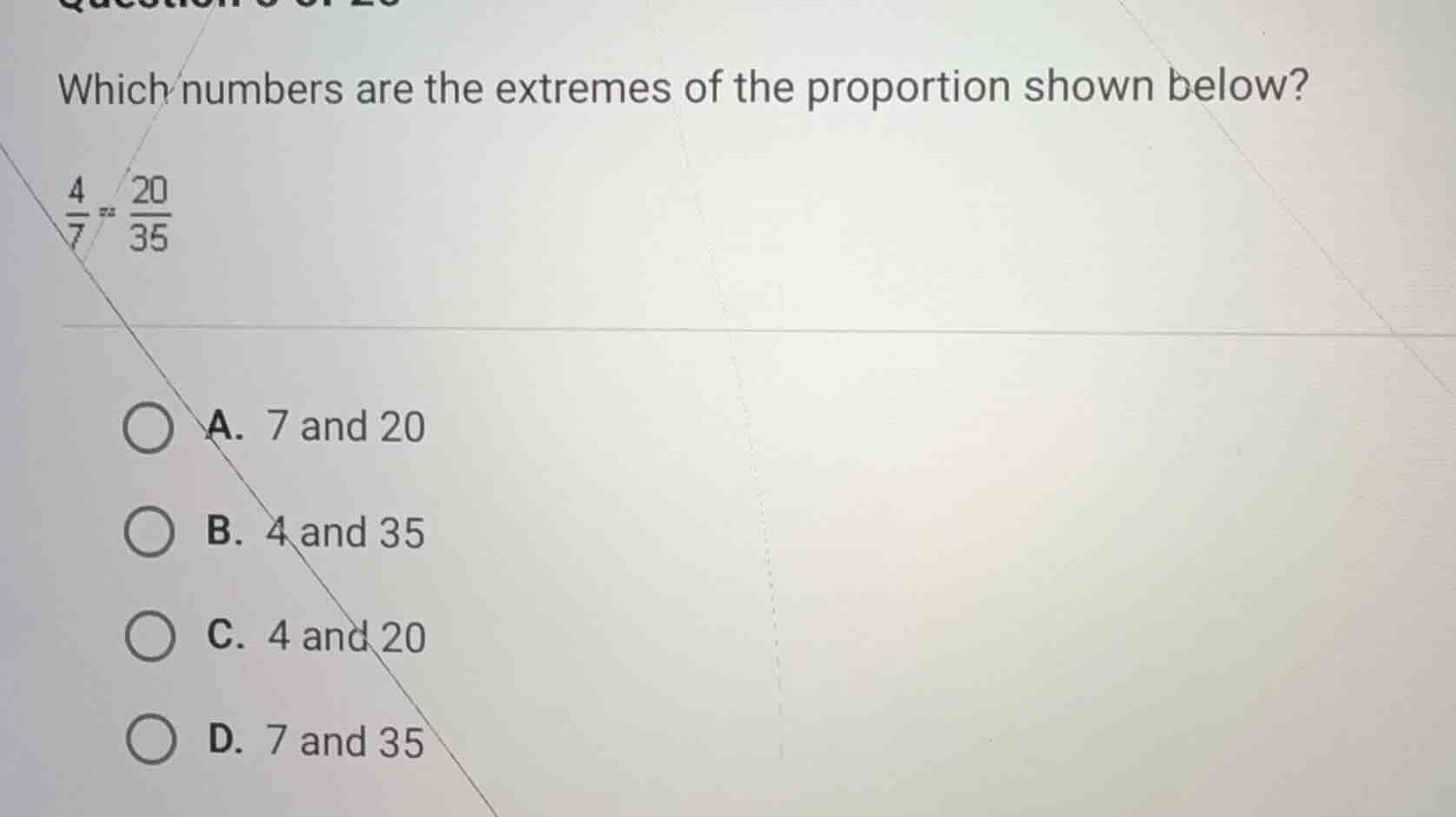
which numbers are the extremes of the proportion shown below?
\\(\frac{4}{7} = \frac{20}{35}\\)
a. 7 and 20
b. 4 and 35
c. 4 and 20
d. 7 and 35
<pre_analysis>
{
"quality": "clear",
"question_count": 1,
"skills_matched": [
"step_cot",
"multiple_choice_formatter",
"explain_then_answer",
"tutor"
],
"needs_drawing": false,
"concepts_used": [],
"new_concepts": [
"Extremes of a Proportion",
"Means of a Proportion"
],
"current_concepts": [
"Ratios and Proportions",
"Extremes of a Proportion",
"Means of a Proportion"
]
}
</pre_analysis>
<reasoning>
Define a proportion and its terms
A proportion is an equation stating that two ratios are equal. It can be written in two common forms:
- As fraction ratios:
\[\frac{a}{b} = \frac{c}{d}\]
- As colon ratios:
\[a : b = c : d\]
Identify the means and extremes
In the colon representation \(a : b = c : d\):
- The outer terms, \(a\) and \(d\), are called the extremes.
- The inner terms, \(b\) and \(c\), are called the means.
When translated back to the fractional form \(\frac{a}{b} = \frac{c}{d}\):
- The numerator of the first fraction (\(a\)) and the denominator of the second fraction (\(d\)) are the extremes.
- The denominator of the first fraction (\(b\)) and the numerator of the second fraction (\(c\)) are the means.
Apply to the given proportion
The given proportion is:
\[\frac{4}{7} = \frac{20}{35}\]
Writing this in colon form gives:
\[4 : 7 = 20 : 35\]
From this form, we identify:
- The extremes (outer numbers) are \(4\) and \(35\).
- The means (inner numbers) are \(7\) and \(20\).
Therefore, the extremes of the proportion are \(4\) and \(35\).
</reasoning>
<answer>
<mcq-option>A. 7 and 20</mcq-option>
<mcq-correct>B. 4 and 35</mcq-correct>
<mcq-option>C. 4 and 20</mcq-option>
<mcq-option>D. 7 and 35</mcq-option>
</answer>
<post_analysis>
{
"subject": "Mathematics",
"question_type": "Multiple Choice",
"knowledge_point": [
"Mathematics",
"Algebra",
"Ratios and Proportions"
]
}
</post_analysis>
Snap & solve any problem in the app
Get step-by-step solutions on Sovi AI
Photo-based solutions with guided steps
Explore more problems and detailed explanations
<pre_analysis>
{
"quality": "clear",
"question_count": 1,
"skills_matched": [
"step_cot",
"multiple_choice_formatter",
"explain_then_answer",
"tutor"
],
"needs_drawing": false,
"concepts_used": [],
"new_concepts": [
"Extremes of a Proportion",
"Means of a Proportion"
],
"current_concepts": [
"Ratios and Proportions",
"Extremes of a Proportion",
"Means of a Proportion"
]
}
</pre_analysis>
<reasoning>
Define a proportion and its terms
A proportion is an equation stating that two ratios are equal. It can be written in two common forms:
- As fraction ratios:
\[\frac{a}{b} = \frac{c}{d}\]
- As colon ratios:
\[a : b = c : d\]
Identify the means and extremes
In the colon representation \(a : b = c : d\):
- The outer terms, \(a\) and \(d\), are called the extremes.
- The inner terms, \(b\) and \(c\), are called the means.
When translated back to the fractional form \(\frac{a}{b} = \frac{c}{d}\):
- The numerator of the first fraction (\(a\)) and the denominator of the second fraction (\(d\)) are the extremes.
- The denominator of the first fraction (\(b\)) and the numerator of the second fraction (\(c\)) are the means.
Apply to the given proportion
The given proportion is:
\[\frac{4}{7} = \frac{20}{35}\]
Writing this in colon form gives:
\[4 : 7 = 20 : 35\]
From this form, we identify:
- The extremes (outer numbers) are \(4\) and \(35\).
- The means (inner numbers) are \(7\) and \(20\).
Therefore, the extremes of the proportion are \(4\) and \(35\).
</reasoning>
<answer>
<mcq-option>A. 7 and 20</mcq-option>
<mcq-correct>B. 4 and 35</mcq-correct>
<mcq-option>C. 4 and 20</mcq-option>
<mcq-option>D. 7 and 35</mcq-option>
</answer>
<post_analysis>
{
"subject": "Mathematics",
"question_type": "Multiple Choice",
"knowledge_point": [
"Mathematics",
"Algebra",
"Ratios and Proportions"
]
}
</post_analysis>