QUESTION IMAGE
Question
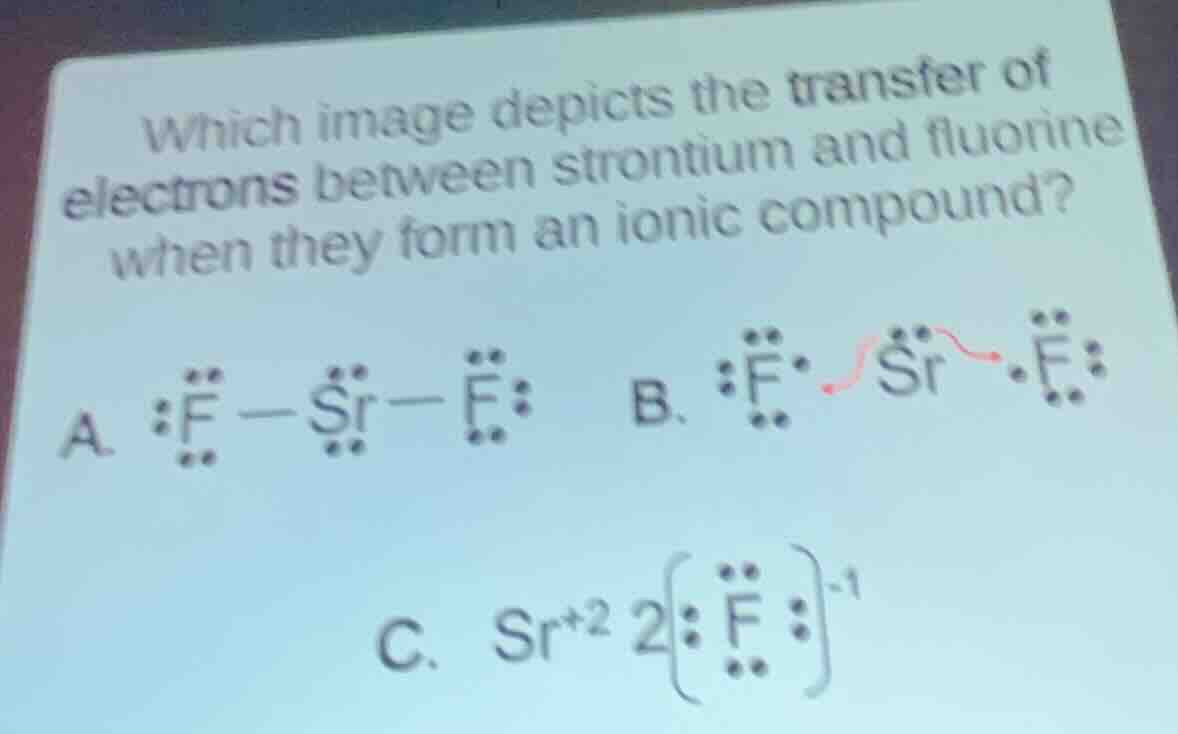
which image depicts the transfer of electrons between strontium and fluorine when they form an ionic compound?
a. \\(:\ddot{\text{f}}-\ddot{\text{sr}}-\ddot{\text{f}}:\\)
b. \\(:\ddot{\text{f}}\cdot \curvearrowleft \cdot\text{sr}\cdot \curvearrowright \cdot\ddot{\text{f}}:\\)
c. \\(\text{sr}^{+2} \\ 2\left :\ddot{\text{f}}: \
ight^{-1}\\)
Determine the valence electrons of strontium and fluorine
Strontium (\(\text{Sr}\)) is an alkaline earth metal in Group 2, meaning it has 2 valence electrons. Fluorine (\(\text{F}\)) is a halogen in Group 17, meaning each fluorine atom has 7 valence electrons.
Analyze the process of ionic bond formation
To achieve a stable octet, the metal strontium needs to lose its 2 valence electrons to become a \(\text{Sr}^{2+}\) cation. Each nonmetal fluorine atom needs to gain 1 electron to complete its octet and become a \(\text{F}^-\) anion. Therefore, one strontium atom transfers 1 electron to each of the two fluorine atoms.
Evaluate the given options
- Option A shows covalent bonds (represented by lines) between fluorine and strontium, which is incorrect because strontium and fluorine form an ionic compound, not a covalent one.
- Option B depicts the transfer of electrons using arrows. It shows a strontium atom with 2 valence electrons transferring one electron to each of the two fluorine atoms (each starting with 7 valence electrons). This correctly illustrates the electron transfer process.
- Option C shows the final Lewis structure of the ionic compound after the transfer has occurred, rather than the active transfer process itself.

Snap & solve any problem in the app
Get step-by-step solutions on Sovi AI
Photo-based solutions with guided steps
Explore more problems and detailed explanations
- (A) covalent representation with single bonds
- (B) electron transfer shown with arrows (Correct answer)
- (C) final ionic compound Lewis structure