QUESTION IMAGE
Question
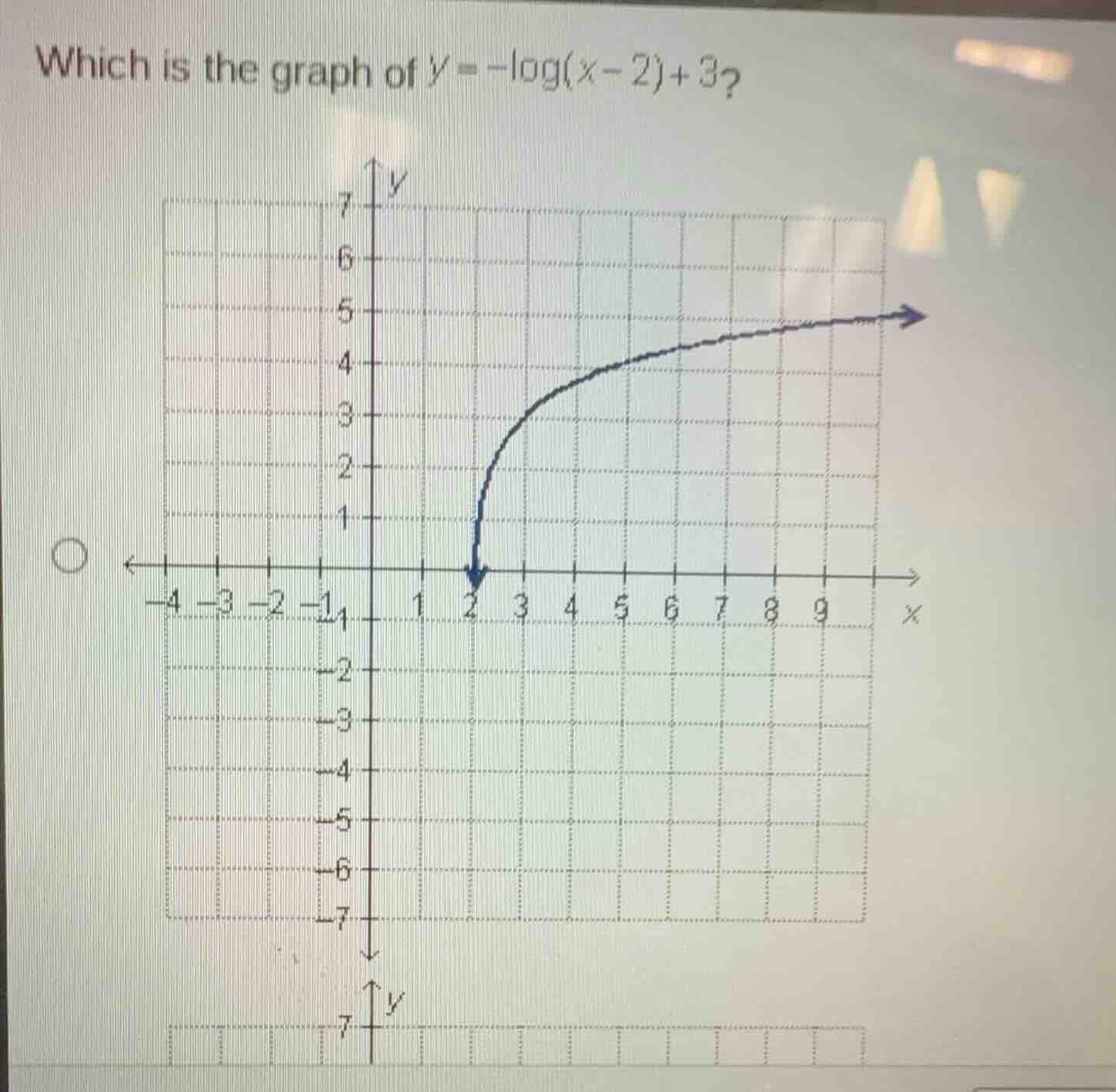
which is the graph of \\(y = -\log(x - 2) + 3\\)?
Identify the vertical asymptote
Using the Logarithmic Domain knowledge point, the argument of the logarithm must be strictly positive:
$$
x - 2 > 0 \implies x > 2
$$
This means there is a vertical asymptote at \(x = 2\).
Analyze transformations
Using the Logarithmic Transformations knowledge point, we analyze the parent function \(y = \log(x)\):
- Horizontal shift: \(x \to x - 2\) shifts the graph right by 2 units.
- Vertical reflection: The negative sign in \(-\log(x-2)\) reflects the graph vertically across the horizontal line of translation.
- Vertical shift: The \(+3\) shifts the graph upward by 3 units.
Evaluate key points
We calculate specific coordinate points to identify the correct graph:
- For \(x = 3\):
$$
y = -\log_{10}(3 - 2) + 3 = -\log_{10}(1) + 3 = 0 + 3 = 3
$$
So, the point \((3, 3)\) must lie on the graph.
- For \(x = 12\) (assuming base 10):
$$
y = -\log_{10}(12 - 2) + 3 = -\log_{10}(10) + 3 = -1 + 3 = 2
$$
So, the point \((12, 2)\) lies on the graph.
Compare with the given image
The graph shown in the image has:
- A vertical asymptote at \(x = 2\).
- A point at \((3, 3)\).
- A point at \((12, 2)\) (the curve decreases slowly as \(x\) increases).
- As \(x \to 2^+\), \(y \to \infty\) because \(-\log(x-2) \to \infty\).
The graph in the image matches all these characteristics.

Snap & solve any problem in the app
Get step-by-step solutions on Sovi AI
Photo-based solutions with guided steps
Explore more problems and detailed explanations
- (A) The graph shown in the image, which has a vertical asymptote at \(x = 2\), passes through \((3, 3)\), and decreases as \(x\) increases. (Correct answer)
- (B) A graph with a vertical asymptote at \(x = -2\).
- (C) A graph that increases as \(x\) increases from the asymptote \(x = 2\).
- (D) A graph with a vertical asymptote at \(x = 3\).