Sovi.AI - AI Math Tutor

Scan to solve math questions

QUESTION IMAGE

which of the following scenarios would be most likely to cause a small …

Question

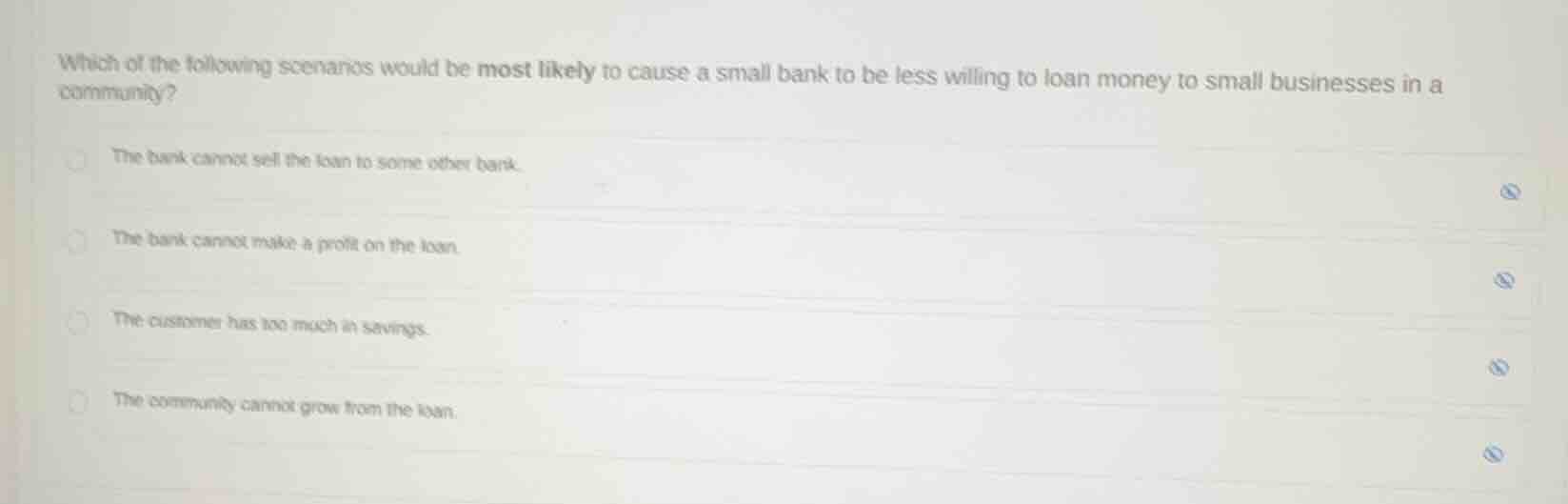
which of the following scenarios would be most likely to cause a small bank to be less willing to loan money to small businesses in a community?

the bank cannot sell the loan to some other bank.
the bank cannot make a profit on the loan.
the customer has too much in savings.
the community cannot grow from the loan.

Explanation:

Response

<pre_analysis>
{
"quality": "clear",
"question_count": 1,
"skills_matched": [
"direct_cot",
"multiple_choice_formatter",
"explain_then_answer",
"quick"
],
"needs_drawing": false,
"concepts_used": [
"Banking Operations"
],
"new_concepts": [],
"current_concepts": [
"Banking Operations",
"Financial Intermediation"
]
}
</pre_analysis>

<reasoning>

Analyze the bank's primary incentive

Banks operate as profit-seeking financial institutions. Their primary incentive for lending money to individuals or businesses is to earn a return on that capital, primarily through interest payments that exceed their cost of funds and operational expenses.

Evaluate the impact of each scenario

  • The bank cannot sell the loan to some other bank: While loan liquidity is important, banks (especially small community banks) frequently hold loans to maturity on their books. This would not be the most direct or strongest deterrent to lending.
  • The bank cannot make a profit on the loan: If a bank cannot generate a profit from a transaction, it has no economic incentive to take on the default risk associated with lending. This directly undermines the core business model of banking.
  • The customer has too much in savings: High savings generally indicate lower default risk and stronger financial health, making a bank more willing, not less willing, to lend.
  • The community cannot grow from the loan: While community development is a positive externality, a bank's primary lending decision is based on financial viability and profitability rather than community growth metrics.

Determine the most likely cause

The inability to make a profit is the most fundamental barrier to lending, making it the scenario most likely to cause a bank to be unwilling to issue a loan.
</reasoning>

<answer>
<mcq-option>(A) The bank cannot sell the loan to some other bank.</mcq-option>
<mcq-correct>(B) The bank cannot make a profit on the loan.</mcq-correct>
<mcq-option>(C) The customer has too much in savings.</mcq-option>
<mcq-option>(D) The community cannot grow from the loan.</mcq-option>
</answer>

<post_analysis>
{
"subject": "Business",
"question_type": "Multiple Choice",
"knowledge_point": [
"Business",
"Banking Operations",
"Financial Intermediation"
]
}
</post_analysis>

Answer:

<pre_analysis>
{
"quality": "clear",
"question_count": 1,
"skills_matched": [
"direct_cot",
"multiple_choice_formatter",
"explain_then_answer",
"quick"
],
"needs_drawing": false,
"concepts_used": [
"Banking Operations"
],
"new_concepts": [],
"current_concepts": [
"Banking Operations",
"Financial Intermediation"
]
}
</pre_analysis>

<reasoning>

Analyze the bank's primary incentive

Banks operate as profit-seeking financial institutions. Their primary incentive for lending money to individuals or businesses is to earn a return on that capital, primarily through interest payments that exceed their cost of funds and operational expenses.

Evaluate the impact of each scenario

  • The bank cannot sell the loan to some other bank: While loan liquidity is important, banks (especially small community banks) frequently hold loans to maturity on their books. This would not be the most direct or strongest deterrent to lending.
  • The bank cannot make a profit on the loan: If a bank cannot generate a profit from a transaction, it has no economic incentive to take on the default risk associated with lending. This directly undermines the core business model of banking.
  • The customer has too much in savings: High savings generally indicate lower default risk and stronger financial health, making a bank more willing, not less willing, to lend.
  • The community cannot grow from the loan: While community development is a positive externality, a bank's primary lending decision is based on financial viability and profitability rather than community growth metrics.

Determine the most likely cause

The inability to make a profit is the most fundamental barrier to lending, making it the scenario most likely to cause a bank to be unwilling to issue a loan.
</reasoning>

<answer>
<mcq-option>(A) The bank cannot sell the loan to some other bank.</mcq-option>
<mcq-correct>(B) The bank cannot make a profit on the loan.</mcq-correct>
<mcq-option>(C) The customer has too much in savings.</mcq-option>
<mcq-option>(D) The community cannot grow from the loan.</mcq-option>
</answer>

<post_analysis>
{
"subject": "Business",
"question_type": "Multiple Choice",
"knowledge_point": [
"Business",
"Banking Operations",
"Financial Intermediation"
]
}
</post_analysis>