QUESTION IMAGE
Question
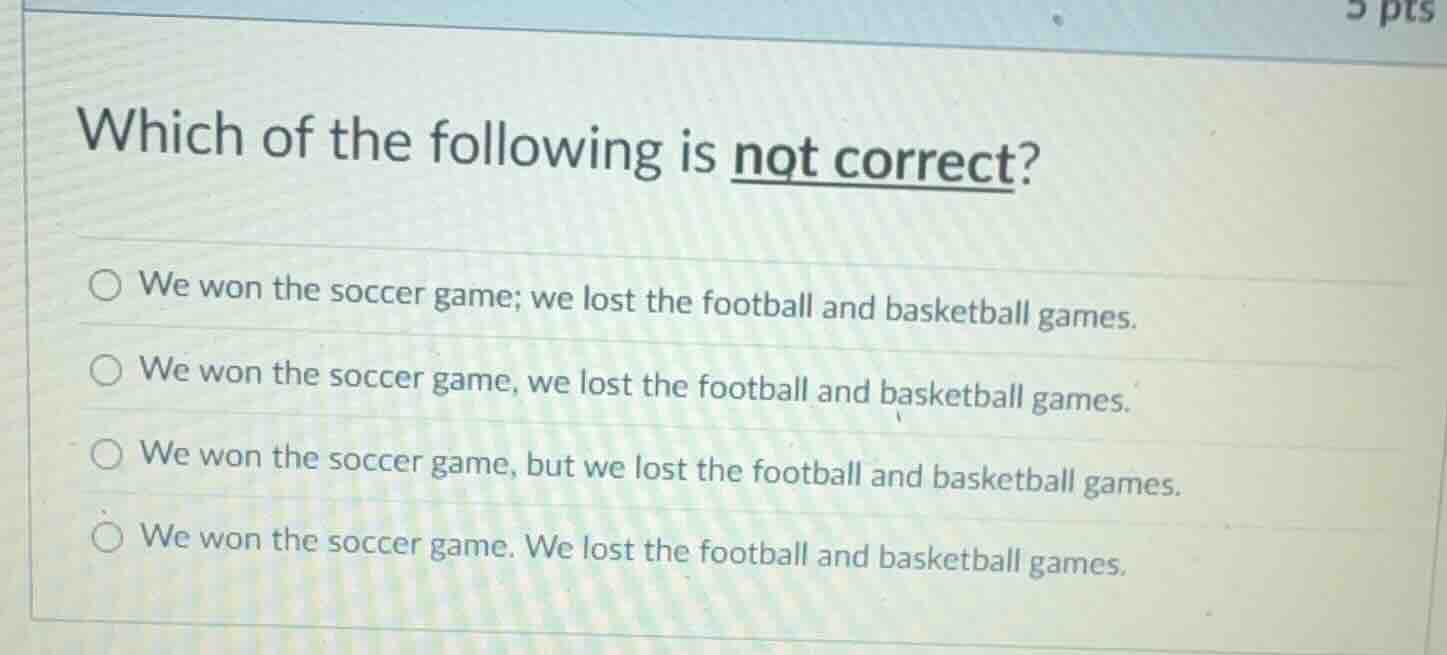
which of the following is not correct?
we won the soccer game; we lost the football and basketball games.
we won the soccer game, we lost the football and basketball games.
we won the soccer game, but we lost the football and basketball games.
we won the soccer game. we lost the football and basketball games.
<pre_analysis>
{
"quality": "clear",
"question_count": 1,
"skills_matched": [
"direct_cot",
"multiple_choice_formatter",
"explain_then_answer",
"quick"
],
"needs_drawing": false,
"concepts_used": [
"Punctuation Rules"
],
"new_concepts": [
"Comma Splice",
"Run-on Sentences"
],
"current_concepts": [
"Punctuation Rules",
"Comma Splice",
"Run-on Sentences"
]
}
</pre_analysis>
<reasoning>
Identify independent clauses
The sentence consists of two independent clauses:
- "We won the soccer game"
- "we lost the football and basketball games"
Analyze punctuation rules for joining independent clauses
- Option 1 uses a semicolon (\(;\)), which is grammatically correct to join two independent clauses.
- Option 2 uses only a comma (\(,\)), which creates an incorrect comma splice.
- Option 3 uses a comma followed by a coordinating conjunction (\(,\text{ but}\)), which is grammatically correct.
- Option 4 separates them into two distinct sentences using a period (\(.\)), which is grammatically correct.
Determine the incorrect option
Option 2 is incorrect because it joins two independent clauses with only a comma, resulting in a comma splice.
</reasoning>
<answer>
<mcq-option>(A) We won the soccer game; we lost the football and basketball games.</mcq-option>
<mcq-correct>(B) We won the soccer game, we lost the football and basketball games.</mcq-correct>
<mcq-option>(C) We won the soccer game, but we lost the football and basketball games.</mcq-option>
<mcq-option>(D) We won the soccer game. We lost the football and basketball games.</mcq-option>
</answer>
<post_analysis>
{
"subject": "Others",
"question_type": "Multiple Choice",
"knowledge_point": [
"Others",
"English Grammar",
"Punctuation and Sentence Structure"
]
}
</post_analysis>
Snap & solve any problem in the app
Get step-by-step solutions on Sovi AI
Photo-based solutions with guided steps
Explore more problems and detailed explanations
<pre_analysis>
{
"quality": "clear",
"question_count": 1,
"skills_matched": [
"direct_cot",
"multiple_choice_formatter",
"explain_then_answer",
"quick"
],
"needs_drawing": false,
"concepts_used": [
"Punctuation Rules"
],
"new_concepts": [
"Comma Splice",
"Run-on Sentences"
],
"current_concepts": [
"Punctuation Rules",
"Comma Splice",
"Run-on Sentences"
]
}
</pre_analysis>
<reasoning>
Identify independent clauses
The sentence consists of two independent clauses:
- "We won the soccer game"
- "we lost the football and basketball games"
Analyze punctuation rules for joining independent clauses
- Option 1 uses a semicolon (\(;\)), which is grammatically correct to join two independent clauses.
- Option 2 uses only a comma (\(,\)), which creates an incorrect comma splice.
- Option 3 uses a comma followed by a coordinating conjunction (\(,\text{ but}\)), which is grammatically correct.
- Option 4 separates them into two distinct sentences using a period (\(.\)), which is grammatically correct.
Determine the incorrect option
Option 2 is incorrect because it joins two independent clauses with only a comma, resulting in a comma splice.
</reasoning>
<answer>
<mcq-option>(A) We won the soccer game; we lost the football and basketball games.</mcq-option>
<mcq-correct>(B) We won the soccer game, we lost the football and basketball games.</mcq-correct>
<mcq-option>(C) We won the soccer game, but we lost the football and basketball games.</mcq-option>
<mcq-option>(D) We won the soccer game. We lost the football and basketball games.</mcq-option>
</answer>
<post_analysis>
{
"subject": "Others",
"question_type": "Multiple Choice",
"knowledge_point": [
"Others",
"English Grammar",
"Punctuation and Sentence Structure"
]
}
</post_analysis>