QUESTION IMAGE
Question
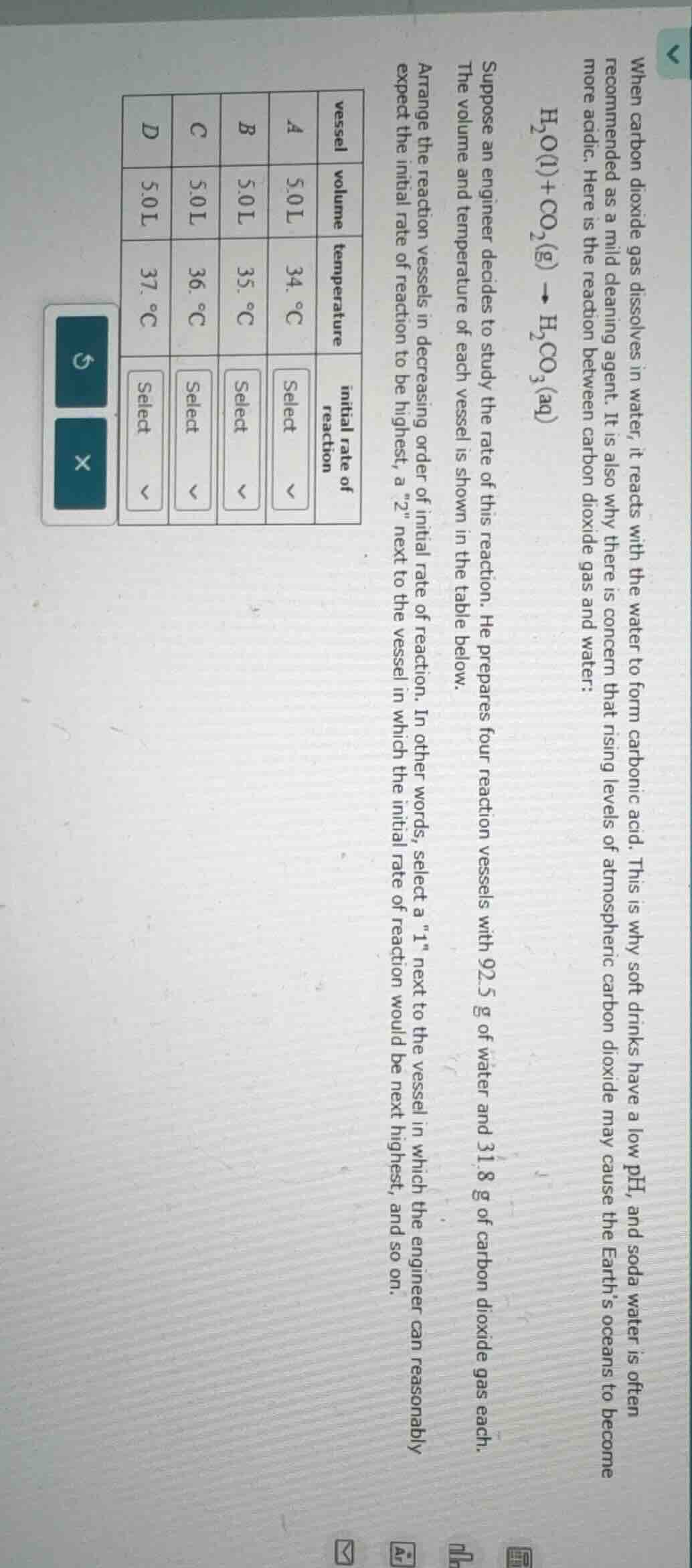
when carbon dioxide gas dissolves in water, it reacts with the water to form carbonic acid. this is why soft drinks have a low ph, and soda water is often recommended as a mild cleaning agent. it is also why there is concern that rising levels of atmospheric carbon dioxide may cause the earths oceans to become more acidic. here is the reaction between carbon dioxide gas and water:
\\\text{h}_2\text{o}(\text{l}) + \text{co}_2(\text{g}) \
ightarrow \text{h}_2\text{co}_3(\text{aq})\\
suppose an engineer decides to study the rate of this reaction. he prepares four reaction vessels with \\(92.5\text{ g}\\) of water and \\(31.8\text{ g}\\) of carbon dioxide gas each. the volume and temperature of each vessel is shown in the table below.
arrange the reaction vessels in decreasing order of initial rate of reaction. in other words, select a \1\ next to the vessel in which the engineer can reasonably expect the initial rate of reaction to be highest, a \2\ next to the vessel in which the initial rate of reaction would be next highest, and so on.
| vessel | volume | temperature | initial rate of reaction |
|---|---|---|---|
| b | \\(5.0\text{ l}\\) | \\(35.^{\circ}\text{c}\\) | select |
| c | \\(5.0\text{ l}\\) | \\(36.^{\circ}\text{c}\\) | select |
| d | \\(5.0\text{ l}\\) | \\(37.^{\circ}\text{c}\\) | select |
🆕 New Concept Discovered: Factors Affecting Reaction Rates
How temperature changes the speed of a chemical reaction.
Step 1: Analyze the reaction conditions
The reaction is:
We are given four reaction vessels (A, B, C, and D) with the following parameters:
- Volume of each vessel: Constant at \( 5.0\text{ L} \)
- Mass of reactants: Constant at \( 92.5\text{ g} \) of \( \text{H}_2\text{O} \) and \( 31.8\text{ g} \) of \( \text{CO}_2 \) gas
- Temperatures:
- Vessel A: \( 34\text{ }^{\circ}\text{C} \)
- Vessel B: \( 35\text{ }^{\circ}\text{C} \)
- Vessel C: \( 36\text{ }^{\circ}\text{C} \)
- Vessel D: \( 37\text{ }^{\circ}\text{C} \)
Step 2: Determine the effect of temperature on reaction rate
According to collision theory, increasing the temperature increases the average kinetic energy of the reactant molecules. This leads to:
- More frequent collisions between reactant molecules.
- A higher fraction of collisions having energy greater than or equal to the activation energy (\(E_a\)).
Therefore, higher temperatures result in a higher initial rate of reaction.
Step 3: Arrange the vessels in decreasing order of initial rate
We need to arrange the vessels from the highest initial rate of reaction (rank "1") to the lowest initial rate of reaction (rank "4"):
- Highest temperature: Vessel D (\( 37\text{ }^{\circ}\text{C} \)) \(
ightarrow\) Rank 1
- Second highest temperature: Vessel C (\( 36\text{ }^{\circ}\text{C} \)) \(
ightarrow\) Rank 2
- Third highest temperature: Vessel B (\( 35\text{ }^{\circ}\text{C} \)) \(
ightarrow\) Rank 3
- Lowest temperature: Vessel A (\( 34\text{ }^{\circ}\text{C} \)) \(
ightarrow\) Rank 4

Snap & solve any problem in the app
Get step-by-step solutions on Sovi AI
Photo-based solutions with guided steps
Explore more problems and detailed explanations
- Vessel A (\( 34\text{ }^{\circ}\text{C} \)): 4 (lowest rate)
- Vessel B (\( 35\text{ }^{\circ}\text{C} \)): 3
- Vessel C (\( 36\text{ }^{\circ}\text{C} \)): 2
- Vessel D (\( 37\text{ }^{\circ}\text{C} \)): 1 (highest rate)