QUESTION IMAGE
Question
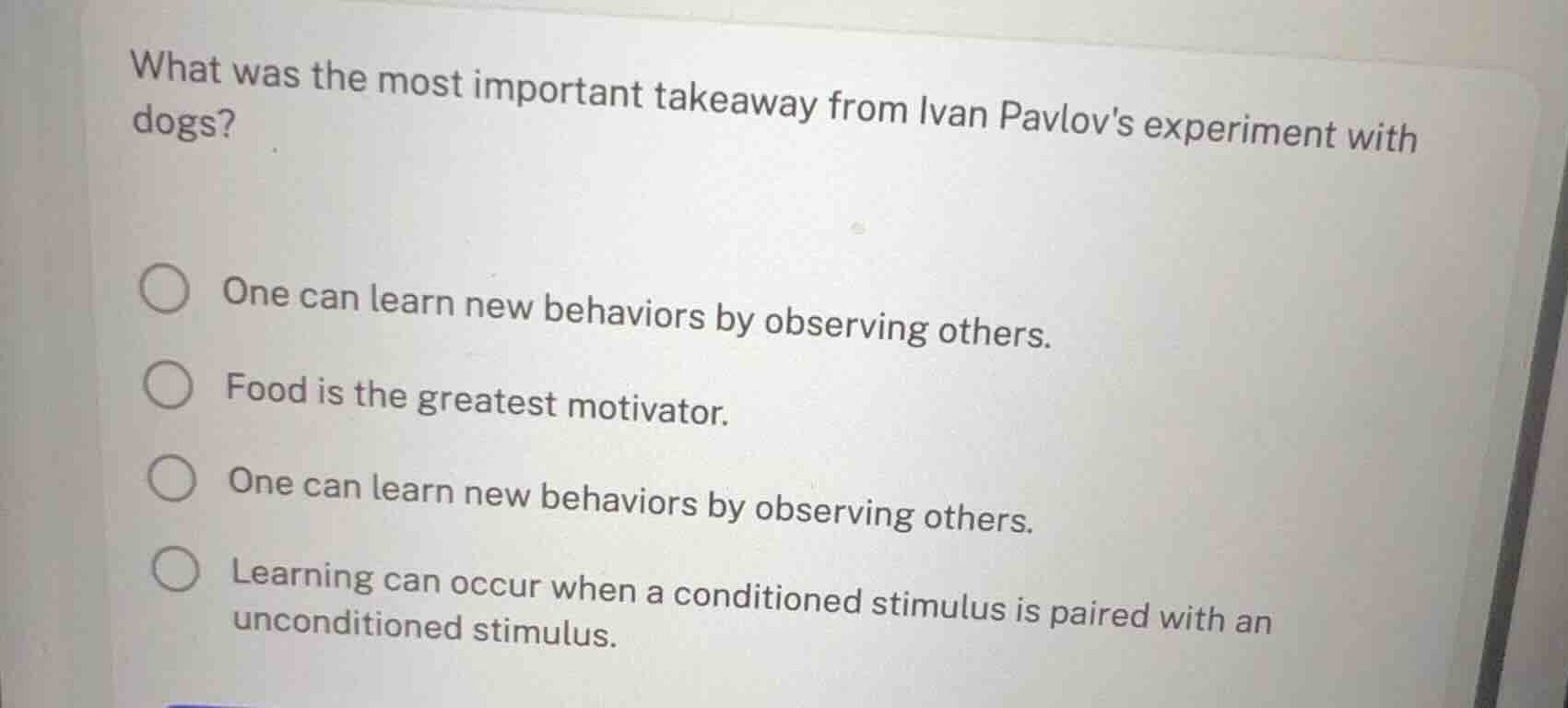
what was the most important takeaway from ivan pavlovs experiment with dogs?
one can learn new behaviors by observing others.
food is the greatest motivator.
one can learn new behaviors by observing others.
learning can occur when a conditioned stimulus is paired with an unconditioned stimulus.
<pre_analysis>
{
"quality": "clear",
"question_count": 1,
"skills_matched": [
"direct_cot",
"multiple_choice_formatter",
"explain_then_answer",
"tutor"
],
"needs_drawing": false,
"concepts_used": [
"Classical Conditioning"
],
"new_concepts": [
"Ivan Pavlov Experiment",
"Conditioned vs Unconditioned Stimulus"
],
"current_concepts": [
"Classical Conditioning",
"Ivan Pavlov Experiment",
"Conditioned vs Unconditioned Stimulus"
]
}
</pre_analysis>
<reasoning>
Identify the core concept of Pavlov's experiment
Ivan Pavlov's famous experiments with dogs laid the foundation for Classical Conditioning. He observed that dogs began to salivate not only when tasting food, but also in response to associated triggers like the sound of a metronome or bell.
Analyze the mechanism of classical conditioning
In classical conditioning, learning occurs by associating a neutral stimulus with a stimulus that naturally produces a behavior.
- The natural trigger (food) is the unconditioned stimulus.
- The neutral trigger (bell/metronome) becomes the conditioned stimulus after repeated pairings.
Evaluate the given options
- "One can learn new behaviors by observing others" refers to observational learning (modeling), associated with Albert Bandura.
- "Food is the greatest motivator" is a broad statement not representative of the scientific takeaway of classical conditioning.
- "Learning can occur when a conditioned stimulus is paired with an unconditioned stimulus" directly describes the mechanism of classical conditioning discovered by Pavlov.
</reasoning>
<answer>
<mcq-option>(A) One can learn new behaviors by observing others.</mcq-option>
<mcq-option>(B) Food is the greatest motivator.</mcq-option>
<mcq-option>(C) One can learn new behaviors by observing others.</mcq-option>
<mcq-correct>(D) Learning can occur when a conditioned stimulus is paired with an unconditioned stimulus.</mcq-correct>
</answer>
<post_analysis>
{
"subject": "Natural Science",
"question_type": "Multiple Choice",
"knowledge_point": [
"Natural Science",
"Psychology",
"Classical Conditioning"
]
}
</post_analysis>
Snap & solve any problem in the app
Get step-by-step solutions on Sovi AI
Photo-based solutions with guided steps
Explore more problems and detailed explanations
<pre_analysis>
{
"quality": "clear",
"question_count": 1,
"skills_matched": [
"direct_cot",
"multiple_choice_formatter",
"explain_then_answer",
"tutor"
],
"needs_drawing": false,
"concepts_used": [
"Classical Conditioning"
],
"new_concepts": [
"Ivan Pavlov Experiment",
"Conditioned vs Unconditioned Stimulus"
],
"current_concepts": [
"Classical Conditioning",
"Ivan Pavlov Experiment",
"Conditioned vs Unconditioned Stimulus"
]
}
</pre_analysis>
<reasoning>
Identify the core concept of Pavlov's experiment
Ivan Pavlov's famous experiments with dogs laid the foundation for Classical Conditioning. He observed that dogs began to salivate not only when tasting food, but also in response to associated triggers like the sound of a metronome or bell.
Analyze the mechanism of classical conditioning
In classical conditioning, learning occurs by associating a neutral stimulus with a stimulus that naturally produces a behavior.
- The natural trigger (food) is the unconditioned stimulus.
- The neutral trigger (bell/metronome) becomes the conditioned stimulus after repeated pairings.
Evaluate the given options
- "One can learn new behaviors by observing others" refers to observational learning (modeling), associated with Albert Bandura.
- "Food is the greatest motivator" is a broad statement not representative of the scientific takeaway of classical conditioning.
- "Learning can occur when a conditioned stimulus is paired with an unconditioned stimulus" directly describes the mechanism of classical conditioning discovered by Pavlov.
</reasoning>
<answer>
<mcq-option>(A) One can learn new behaviors by observing others.</mcq-option>
<mcq-option>(B) Food is the greatest motivator.</mcq-option>
<mcq-option>(C) One can learn new behaviors by observing others.</mcq-option>
<mcq-correct>(D) Learning can occur when a conditioned stimulus is paired with an unconditioned stimulus.</mcq-correct>
</answer>
<post_analysis>
{
"subject": "Natural Science",
"question_type": "Multiple Choice",
"knowledge_point": [
"Natural Science",
"Psychology",
"Classical Conditioning"
]
}
</post_analysis>