QUESTION IMAGE
Question
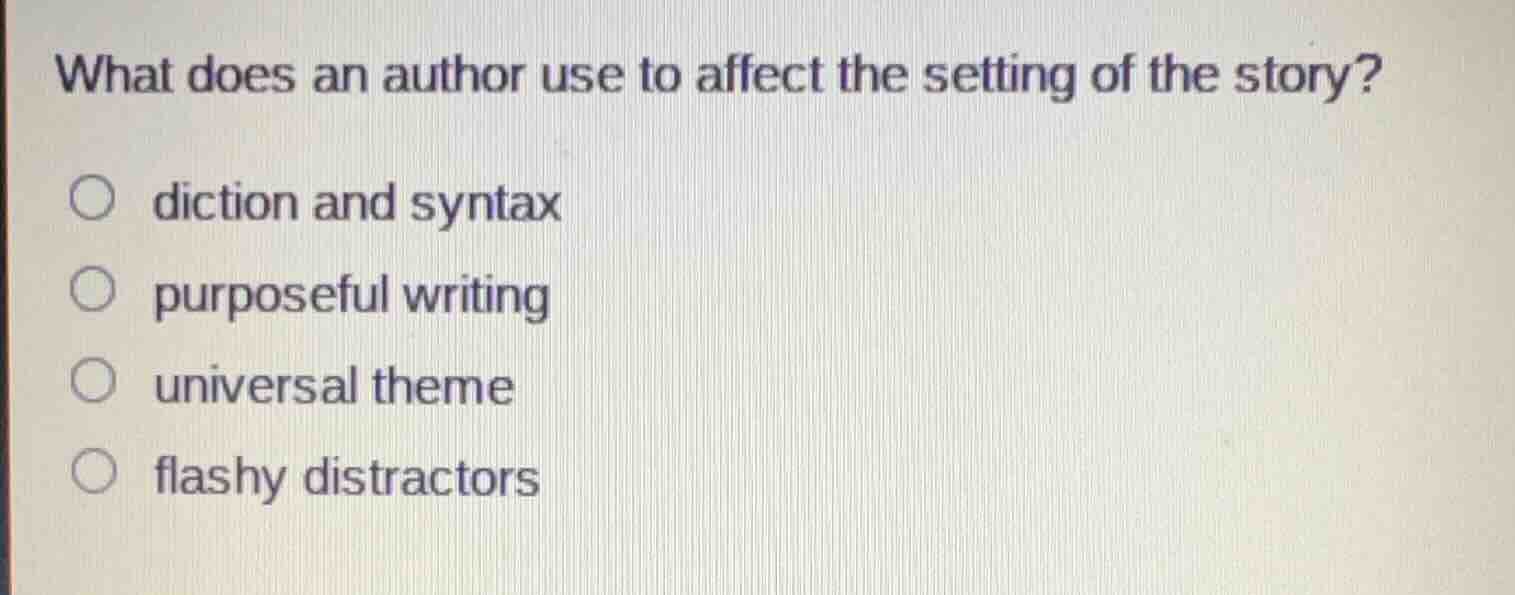
what does an author use to affect the setting of the story?
diction and syntax
purposeful writing
universal theme
flashy distractors
<pre_analysis>
{
"quality": "clear",
"question_count": 1,
"skills_matched": [
"direct_cot",
"multiple_choice_formatter",
"explain_then_answer",
"tutor",
"mastery_adaptive_brevity"
],
"needs_drawing": false,
"concepts_used": [
"Diction",
"Setting Analysis",
"Syntax Analysis"
],
"new_concepts": [],
"current_concepts": [
"Diction",
"Setting Analysis",
"Syntax Analysis"
]
}
</pre_analysis>
<reasoning>
Analyze the relationship between literary elements and setting
Using the Setting Analysis knowledge point
An author establishes and shapes the setting—the time, place, and social context of a story—through specific linguistic choices. The setting is not merely a physical backdrop; it is constructed and colored by the words chosen to describe it and the way those sentences are structured to build atmosphere.
Evaluate the role of word choice and sentence structure
Using the Diction and Syntax Analysis knowledge points
- Diction (word choice) allows an author to evoke specific sensory details, historical periods, or cultural atmospheres (e.g., using archaic words for a historical setting).
- Syntax (sentence structure) controls the pacing, rhythm, and mood of the description (e.g., short, choppy sentences to create a tense, claustrophobic setting versus long, flowing sentences for a peaceful landscape).
Therefore, authors use diction and syntax to directly affect and construct the setting of a story.
Assess the remaining options
Using the Setting Analysis knowledge point
- "Purposeful writing" is too broad of a concept, as all deliberate writing is purposeful.
- "Universal theme" refers to the central message or deeper meaning of a text, not the tool used to construct the physical or temporal setting.
- "Flashy distractors" is a meta-term or test-taking concept rather than a literary device used by authors to build a narrative world.
</reasoning>
<answer>
<mcq-correct>(A) diction and syntax</mcq-correct>
<mcq-option>(B) purposeful writing</mcq-option>
<mcq-option>(C) universal theme</mcq-option>
<mcq-option>(D) flashy distractors</mcq-option>
</answer>
<post_analysis>
{
"subject": "Arts",
"question_type": "Multiple Choice",
"knowledge_point": [
"Arts",
"Literary Analysis",
"Setting Analysis"
]
}
</post_analysis>
Snap & solve any problem in the app
Get step-by-step solutions on Sovi AI
Photo-based solutions with guided steps
Explore more problems and detailed explanations
<pre_analysis>
{
"quality": "clear",
"question_count": 1,
"skills_matched": [
"direct_cot",
"multiple_choice_formatter",
"explain_then_answer",
"tutor",
"mastery_adaptive_brevity"
],
"needs_drawing": false,
"concepts_used": [
"Diction",
"Setting Analysis",
"Syntax Analysis"
],
"new_concepts": [],
"current_concepts": [
"Diction",
"Setting Analysis",
"Syntax Analysis"
]
}
</pre_analysis>
<reasoning>
Analyze the relationship between literary elements and setting
Using the Setting Analysis knowledge point
An author establishes and shapes the setting—the time, place, and social context of a story—through specific linguistic choices. The setting is not merely a physical backdrop; it is constructed and colored by the words chosen to describe it and the way those sentences are structured to build atmosphere.
Evaluate the role of word choice and sentence structure
Using the Diction and Syntax Analysis knowledge points
- Diction (word choice) allows an author to evoke specific sensory details, historical periods, or cultural atmospheres (e.g., using archaic words for a historical setting).
- Syntax (sentence structure) controls the pacing, rhythm, and mood of the description (e.g., short, choppy sentences to create a tense, claustrophobic setting versus long, flowing sentences for a peaceful landscape).
Therefore, authors use diction and syntax to directly affect and construct the setting of a story.
Assess the remaining options
Using the Setting Analysis knowledge point
- "Purposeful writing" is too broad of a concept, as all deliberate writing is purposeful.
- "Universal theme" refers to the central message or deeper meaning of a text, not the tool used to construct the physical or temporal setting.
- "Flashy distractors" is a meta-term or test-taking concept rather than a literary device used by authors to build a narrative world.
</reasoning>
<answer>
<mcq-correct>(A) diction and syntax</mcq-correct>
<mcq-option>(B) purposeful writing</mcq-option>
<mcq-option>(C) universal theme</mcq-option>
<mcq-option>(D) flashy distractors</mcq-option>
</answer>
<post_analysis>
{
"subject": "Arts",
"question_type": "Multiple Choice",
"knowledge_point": [
"Arts",
"Literary Analysis",
"Setting Analysis"
]
}
</post_analysis>