QUESTION IMAGE
Question
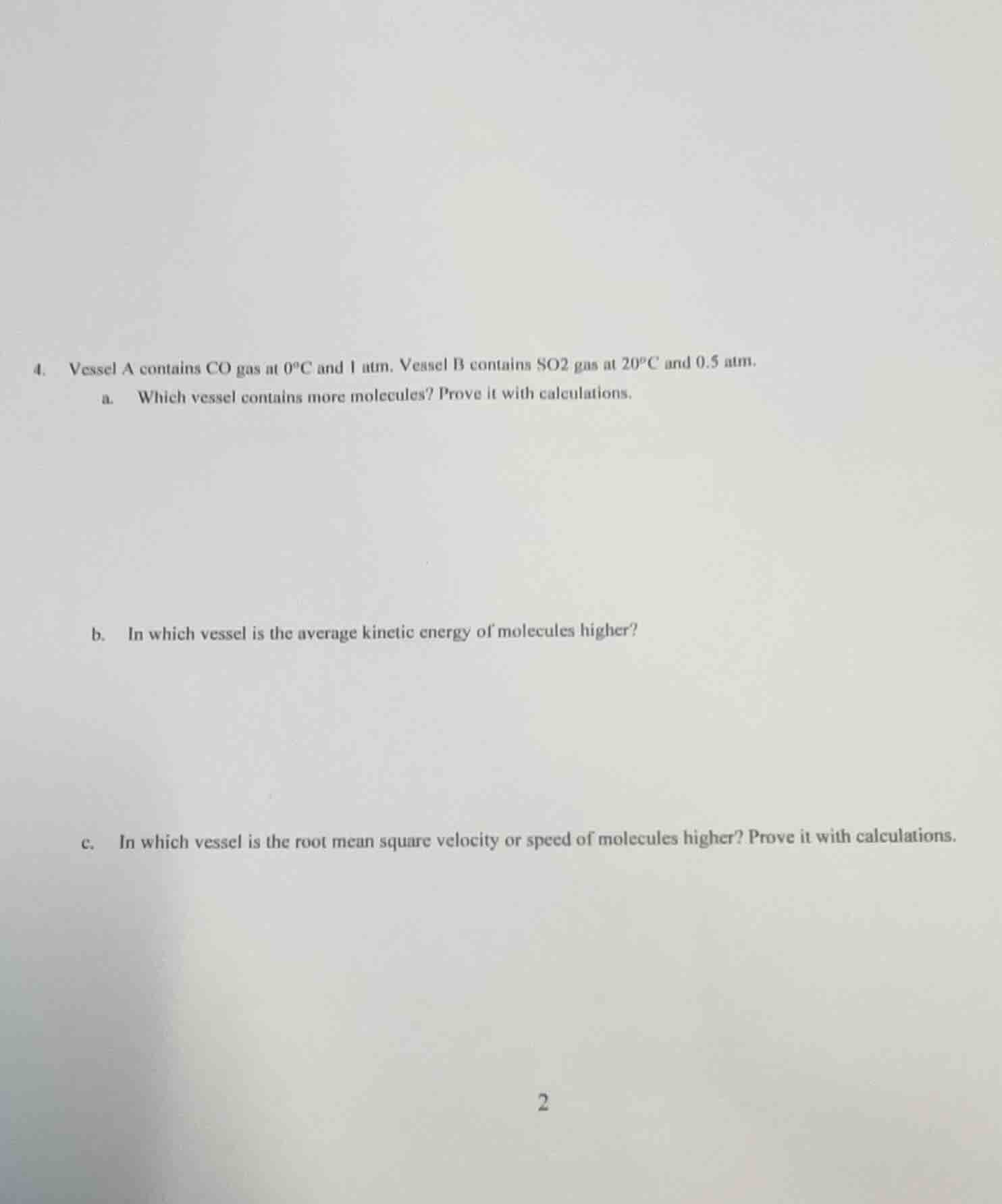
- vessel a contains co gas at 0°c and 1 atm. vessel b contains so2 gas at 20°c and 0.5 atm.
a. which vessel contains more molecules? prove it with calculations.
b. in which vessel is the average kinetic energy of molecules higher?
c. in which vessel is the root mean square velocity or speed of molecules higher? prove it with calculations.
Compare the number of molecules in each vessel
To find which vessel contains more molecules, we use the Ideal Gas Law Calculations to find the number of moles \(n\), which is directly proportional to the number of molecules \(N\) via Avogadro's number.
Assuming equal volume \(V\) for both vessels:
For Vessel A (\(\text{CO}\)):
\(P_A = 1\text{ atm}\)
\(T_A = 0^\circ\text{C} = 273.15\text{ K}\)
For Vessel B (\(\text{SO}_2\)):
\(P_B = 0.5\text{ atm}\)
\(T_B = 20^\circ\text{C} = 293.15\text{ K}\)
Comparing the ratios:
Thus, Vessel A contains more molecules.
Determine the average kinetic energy
According to the Kinetic Molecular Theory, the average translational kinetic energy of gas molecules depends solely on the absolute temperature \(T\):
Since \(T_B = 293.15\text{ K}\) is greater than \(T_A = 273.15\text{ K}\), the average kinetic energy of the molecules in Vessel B is higher.
Compare the root-mean-square velocity
The Root-Mean-Square Velocity is given by the formula:
where \(M\) is the molar mass in \(\text{kg/mol}\).
For Vessel A (\(\text{CO}\)):
\(M_A = 28.01\text{ g/mol} = 0.02801\text{ kg/mol}\)
\(T_A = 273.15\text{ K}\)
For Vessel B (\(\text{SO}_2\)):
\(M_B = 64.07\text{ g/mol} = 0.06407\text{ kg/mol}\)
\(T_B = 293.15\text{ K}\)
Comparing the values:
Thus, the root-mean-square velocity is higher in Vessel A.

Snap & solve any problem in the app
Get step-by-step solutions on Sovi AI
Photo-based solutions with guided steps
Explore more problems and detailed explanations
Question 4a
Vessel A contains more molecules.
Assuming equal volume \(V\), the number of moles is proportional to \(\frac{P}{T}\):
- For Vessel A: \(\frac{n_A}{V} = \frac{1\text{ atm}}{R \cdot 273.15\text{ K}} \approx \frac{0.00366}{R}\)
- For Vessel B: \(\frac{n_B}{V} = \frac{0.5\text{ atm}}{R \cdot 293.15\text{ K}} \approx \frac{0.00171}{R}\)
Since \(\frac{n_A}{V} > \frac{n_B}{V}\), Vessel A has more molecules.
Question 4b
Vessel B has a higher average kinetic energy because average kinetic energy is directly proportional to absolute temperature, and Vessel B is at a higher temperature (\(293.15\text{ K}\) vs \(273.15\text{ K}\)).
Question 4c
Vessel A has a higher root-mean-square velocity.
Using \(u_{\text{rms}} = \sqrt{\frac{3RT}{M}}\):
- For Vessel A (\(\text{CO}\)): \(u_{\text{rms, A}} = \sqrt{\frac{3 \cdot R \cdot 273.15}{0.02801}} \approx \sqrt{29255.6 \cdot R}\)
- For Vessel B (\(\text{SO}_2\)): \(u_{\text{rms, B}} = \sqrt{\frac{3 \cdot R \cdot 293.15}{0.06407}} \approx \sqrt{13726.4 \cdot R}\)
Since \(u_{\text{rms, A}} > u_{\text{rms, B}}\), the molecules in Vessel A have a higher root-mean-square velocity.