Sovi.AI - AI Math Tutor

Scan to solve math questions

QUESTION IMAGE

use a truth table to determine whether or not the argument given in sym…

Question

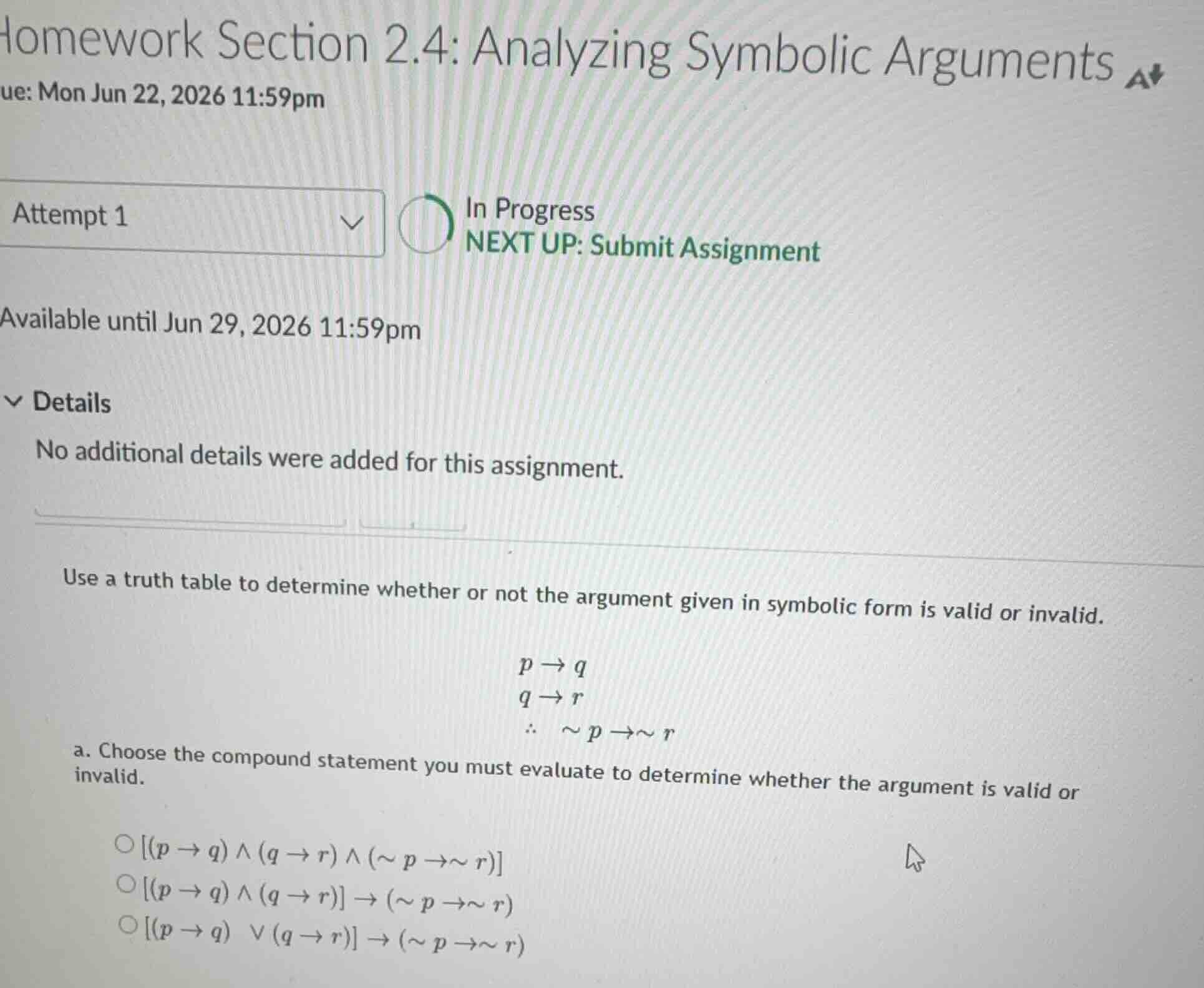
use a truth table to determine whether or not the argument given in symbolic form is valid or invalid.

premise 1: \\(p \
ightarrow \sim q\\)
premise 2: \\(q\\)
conclusion: \\(\therefore \sim p\\)

a. choose the compound statement you must evaluate to determine whether the argument is valid or invalid.

\\(\bigcirc (p \
ightarrow \sim q) \wedge q \
ightarrow \sim p\\)
\\(\bigcirc (p \
ightarrow \sim q) \vee q \
ightarrow \sim p\\)
\\(\bigcirc (p \
ightarrow \sim q) \wedge q \wedge \sim p\\)

Explanation:

Response

<pre_analysis>
{
"quality": "clear",
"question_count": 1,
"skills_matched": [
"step_cot",
"multiple_choice_formatter",
"explain_then_answer",
"quick"
],
"needs_drawing": false,
"concepts_used": [
"Logical Operators",
"Conditional Statements"
],
"new_concepts": [
"Argument Validity",
"Symbolic Arguments"
],
"current_concepts": [
"Logical Operators",
"Conditional Statements",
"Argument Validity",
"Symbolic Arguments"
]
}
</pre_analysis>

<reasoning>

Identify the premises and conclusion

\[

$$\begin{aligned} &\text{Premise 1: } p ightarrow \sim q \\ &\text{Premise 2: } q \\ &\text{Conclusion: } \sim p \end{aligned}$$

\]

Construct the conditional statement for argument validity

\[
[(\text{Premise 1}) \wedge (\text{Premise 2})]
ightarrow \text{Conclusion}
\]

Substitute the symbolic expressions

\[
[(p
ightarrow \sim q) \wedge q]
ightarrow \sim p
\]
</reasoning>

<answer>
<mcq-correct>[(p
ightarrow \sim q) \wedge q]
ightarrow \sim p</mcq-correct>
<mcq-option>[(p
ightarrow \sim q) \vee q]
ightarrow \sim p</mcq-option>
<mcq-option>[(p
ightarrow \sim q) \wedge q] \wedge \sim p</mcq-option>
</answer>

<post_analysis>
{
"subject": "Mathematics",
"question_type": "Multiple Choice",
"knowledge_point": [
"Mathematics",
"Algebra",
"Symbolic Logic"
]
}
</post_analysis>

Answer:

<pre_analysis>
{
"quality": "clear",
"question_count": 1,
"skills_matched": [
"step_cot",
"multiple_choice_formatter",
"explain_then_answer",
"quick"
],
"needs_drawing": false,
"concepts_used": [
"Logical Operators",
"Conditional Statements"
],
"new_concepts": [
"Argument Validity",
"Symbolic Arguments"
],
"current_concepts": [
"Logical Operators",
"Conditional Statements",
"Argument Validity",
"Symbolic Arguments"
]
}
</pre_analysis>

<reasoning>

Identify the premises and conclusion

\[

$$\begin{aligned} &\text{Premise 1: } p ightarrow \sim q \\ &\text{Premise 2: } q \\ &\text{Conclusion: } \sim p \end{aligned}$$

\]

Construct the conditional statement for argument validity

\[
[(\text{Premise 1}) \wedge (\text{Premise 2})]
ightarrow \text{Conclusion}
\]

Substitute the symbolic expressions

\[
[(p
ightarrow \sim q) \wedge q]
ightarrow \sim p
\]
</reasoning>

<answer>
<mcq-correct>[(p
ightarrow \sim q) \wedge q]
ightarrow \sim p</mcq-correct>
<mcq-option>[(p
ightarrow \sim q) \vee q]
ightarrow \sim p</mcq-option>
<mcq-option>[(p
ightarrow \sim q) \wedge q] \wedge \sim p</mcq-option>
</answer>

<post_analysis>
{
"subject": "Mathematics",
"question_type": "Multiple Choice",
"knowledge_point": [
"Mathematics",
"Algebra",
"Symbolic Logic"
]
}
</post_analysis>