QUESTION IMAGE
Question
two systems of equations are given below.
for each system, choose the best description of its solution.
if applicable, give the solution.
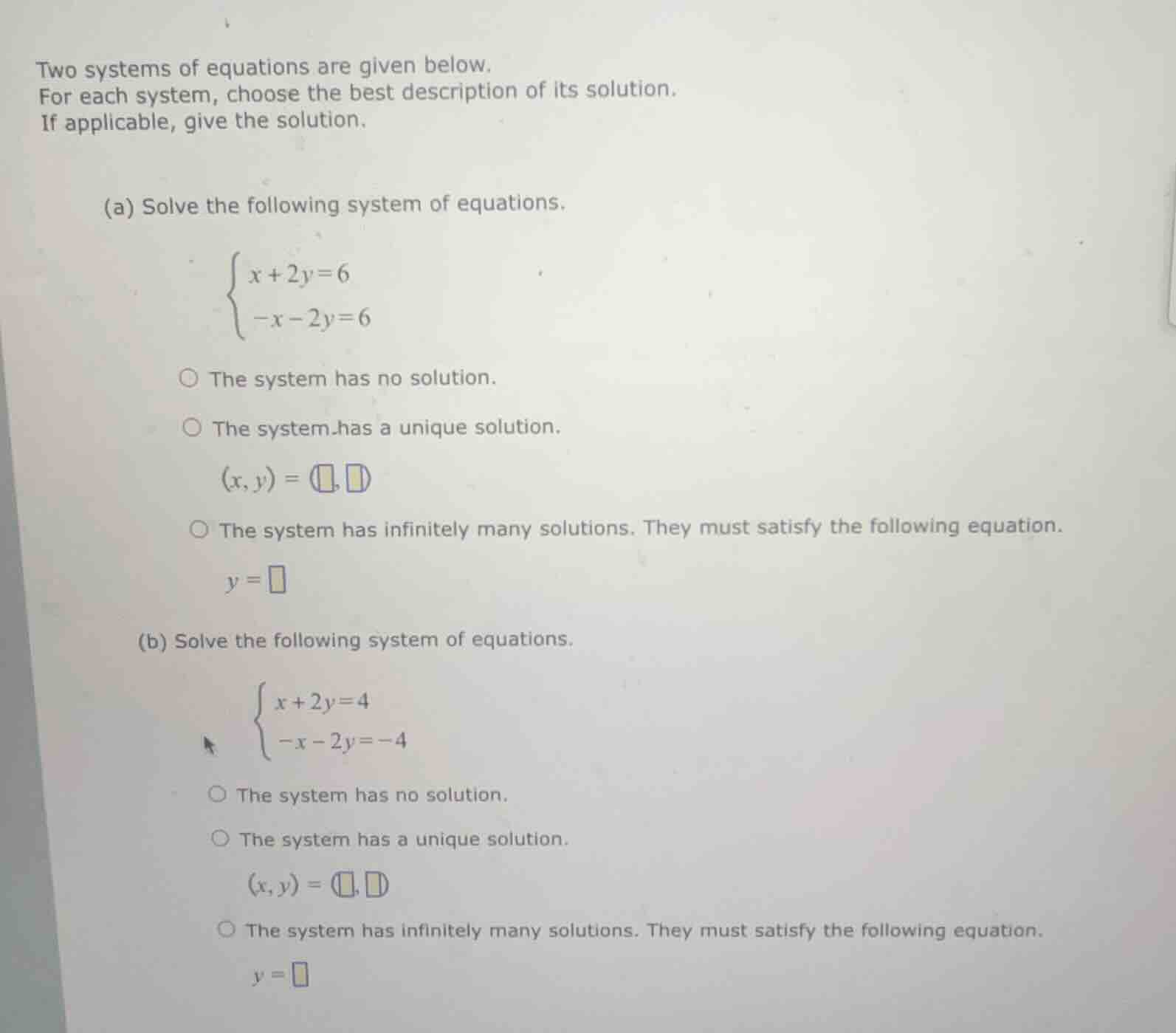
(a) solve the following system of equations.
\\\
\\
- the system has no solution.
- the system has a unique solution.
\\((x, y) = (\square, \square)\\)
- the system has infinitely many solutions. they must satisfy the following equation.
\\(y = \square\\)
(b) solve the following system of equations.
\\\
\\
- the system has no solution.
- the system has a unique solution.
\\((x, y) = (\square, \square)\\)
- the system has infinitely many solutions. they must satisfy the following equation.
\\(y = \square\\)
Analyze system (a)
We are given the system of equations:
Adding the two equations together:
Since \(0 = 12\) is a contradiction, system (a) has no solution.
Analyze system (b)
We are given the system of equations:
Adding the two equations together:
Since \(0 = 0\) is always true, the equations are dependent, meaning there are infinitely many solutions.
To find the equation they must satisfy, we solve for \(y\) in terms of \(x\) using the first equation:

Snap & solve any problem in the app
Get step-by-step solutions on Sovi AI
Photo-based solutions with guided steps
Explore more problems and detailed explanations
Question 1
- The system has no solution. (Correct answer)
- The system has a unique solution. (x, y) = ( , )
- The system has infinitely many solutions. They must satisfy the following equation. y =
Question 2
- The system has no solution.
- The system has a unique solution. (x, y) = ( , )
- The system has infinitely many solutions. They must satisfy the following equation. \(y = -\frac{1}{2}x + 2\) (Correct answer)