Sovi.AI - AI Math Tutor

Scan to solve math questions

QUESTION IMAGE

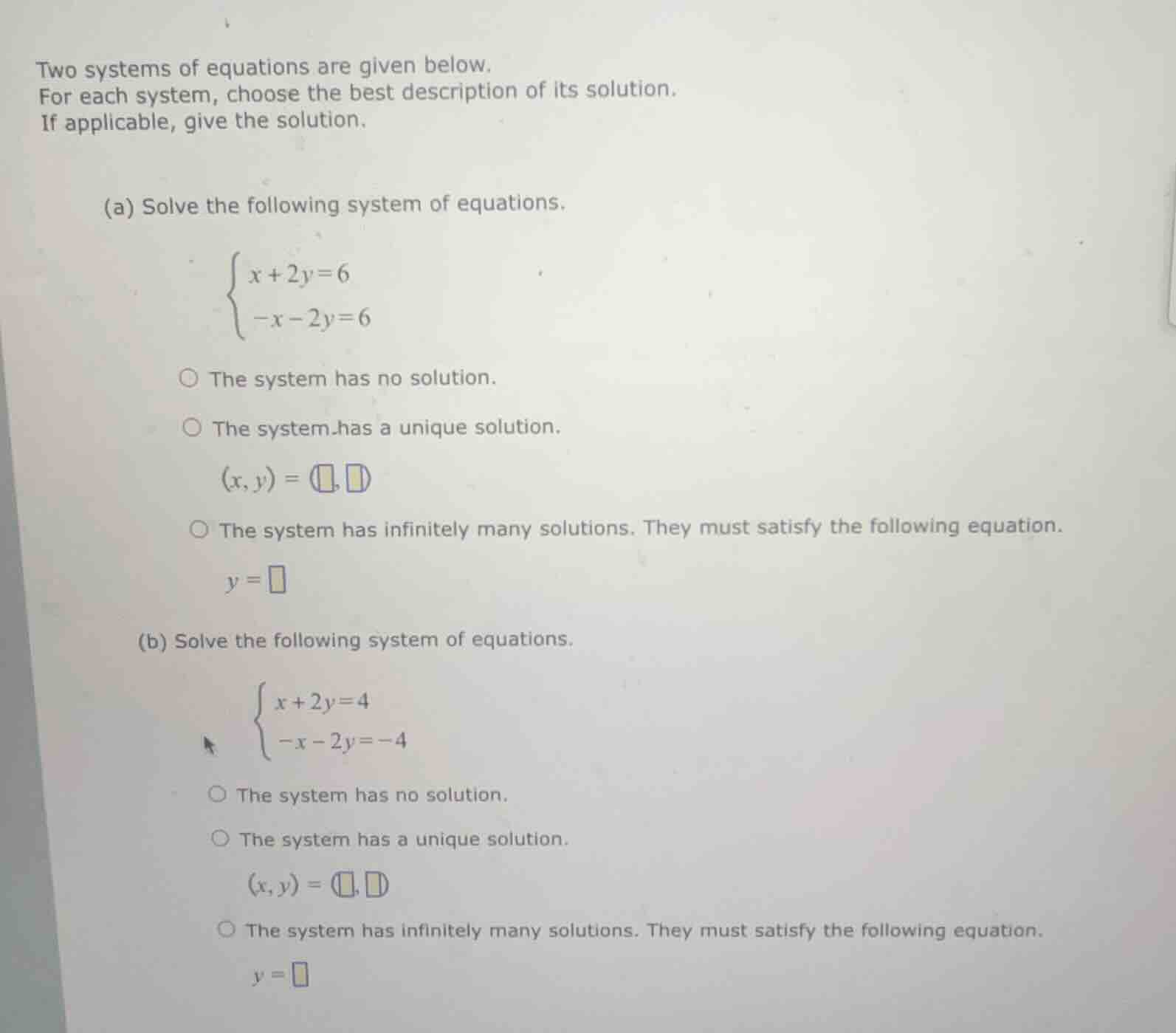
two systems of equations are given below. for each system, choose the b…

Question

two systems of equations are given below.
for each system, choose the best description of its solution.
if applicable, give the solution.

(a) solve the following system of equations.
\\\

$$\begin{cases} x + 2y = 6 \\\\ -x - 2y = 6 \\end{cases}$$

\\

  • the system has no solution.
  • the system has a unique solution.

\\((x, y) = (\square, \square)\\)

  • the system has infinitely many solutions. they must satisfy the following equation.

\\(y = \square\\)

(b) solve the following system of equations.
\\\

$$\begin{cases} x + 2y = 4 \\\\ -x - 2y = -4 \\end{cases}$$

\\

  • the system has no solution.
  • the system has a unique solution.

\\((x, y) = (\square, \square)\\)

  • the system has infinitely many solutions. they must satisfy the following equation.

\\(y = \square\\)

Explanation:

Response

<pre_analysis>
{
"quality": "clear",
"question_count": 2,
"skills_matched": [
"step_cot",
"multiple_choice_formatter",
"explain_then_answer",
"tutor"
],
"needs_drawing": false,
"concepts_used": [],
"new_concepts": [
"Systems of Linear Equations",
"Inconsistent Systems",
"Dependent Systems"
],
"current_concepts": [
"Systems of Linear Equations",
"Inconsistent Systems",
"Dependent Systems"
]
}
</pre_analysis>

<reasoning>

Analyze system (a)

We are given the system of equations:
\[

$$\begin{cases} x + 2y = 6 \\ -x - 2y = 6 \end{cases}$$

\]
Adding the two equations together:
\[
(x - x) + (2y - 2y) = 6 + 6 \implies 0 = 12
\]
Since \(0 = 12\) is a contradiction, system (a) has no solution.

Analyze system (b)

We are given the system of equations:
\[

$$\begin{cases} x + 2y = 4 \\ -x - 2y = -4 \end{cases}$$

\]
Adding the two equations together:
\[
(x - x) + (2y - 2y) = 4 - 4 \implies 0 = 0
\]
Since \(0 = 0\) is always true, the equations are dependent, meaning there are infinitely many solutions.
To find the equation they must satisfy, we solve for \(y\) in terms of \(x\) using the first equation:
\[
2y = -x + 4 \implies y = -\frac{1}{2}x + 2
\]
</reasoning>

<answer>

Question 1

<mcq-correct>The system has no solution.</mcq-correct>
<mcq-option>The system has a unique solution. (x, y) = ( , )</mcq-option>
<mcq-option>The system has infinitely many solutions. They must satisfy the following equation. y = </mcq-option>

Question 2

<mcq-option>The system has no solution.</mcq-option>
<mcq-option>The system has a unique solution. (x, y) = ( , )</mcq-option>
<mcq-correct>The system has infinitely many solutions. They must satisfy the following equation. \(y = -\frac{1}{2}x + 2\)</mcq-correct>
</answer>

<post_analysis>
{
"subject": "Mathematics",
"question_type": "Multiple Choice",
"knowledge_point": [
"Mathematics",
"Algebra",
"Systems of Linear Equations"
]
}
</post_analysis>

Answer:

<pre_analysis>
{
"quality": "clear",
"question_count": 2,
"skills_matched": [
"step_cot",
"multiple_choice_formatter",
"explain_then_answer",
"tutor"
],
"needs_drawing": false,
"concepts_used": [],
"new_concepts": [
"Systems of Linear Equations",
"Inconsistent Systems",
"Dependent Systems"
],
"current_concepts": [
"Systems of Linear Equations",
"Inconsistent Systems",
"Dependent Systems"
]
}
</pre_analysis>

<reasoning>

Analyze system (a)

We are given the system of equations:
\[

$$\begin{cases} x + 2y = 6 \\ -x - 2y = 6 \end{cases}$$

\]
Adding the two equations together:
\[
(x - x) + (2y - 2y) = 6 + 6 \implies 0 = 12
\]
Since \(0 = 12\) is a contradiction, system (a) has no solution.

Analyze system (b)

We are given the system of equations:
\[

$$\begin{cases} x + 2y = 4 \\ -x - 2y = -4 \end{cases}$$

\]
Adding the two equations together:
\[
(x - x) + (2y - 2y) = 4 - 4 \implies 0 = 0
\]
Since \(0 = 0\) is always true, the equations are dependent, meaning there are infinitely many solutions.
To find the equation they must satisfy, we solve for \(y\) in terms of \(x\) using the first equation:
\[
2y = -x + 4 \implies y = -\frac{1}{2}x + 2
\]
</reasoning>

<answer>

Question 1

<mcq-correct>The system has no solution.</mcq-correct>
<mcq-option>The system has a unique solution. (x, y) = ( , )</mcq-option>
<mcq-option>The system has infinitely many solutions. They must satisfy the following equation. y = </mcq-option>

Question 2

<mcq-option>The system has no solution.</mcq-option>
<mcq-option>The system has a unique solution. (x, y) = ( , )</mcq-option>
<mcq-correct>The system has infinitely many solutions. They must satisfy the following equation. \(y = -\frac{1}{2}x + 2\)</mcq-correct>
</answer>

<post_analysis>
{
"subject": "Mathematics",
"question_type": "Multiple Choice",
"knowledge_point": [
"Mathematics",
"Algebra",
"Systems of Linear Equations"
]
}
</post_analysis>