QUESTION IMAGE
Question
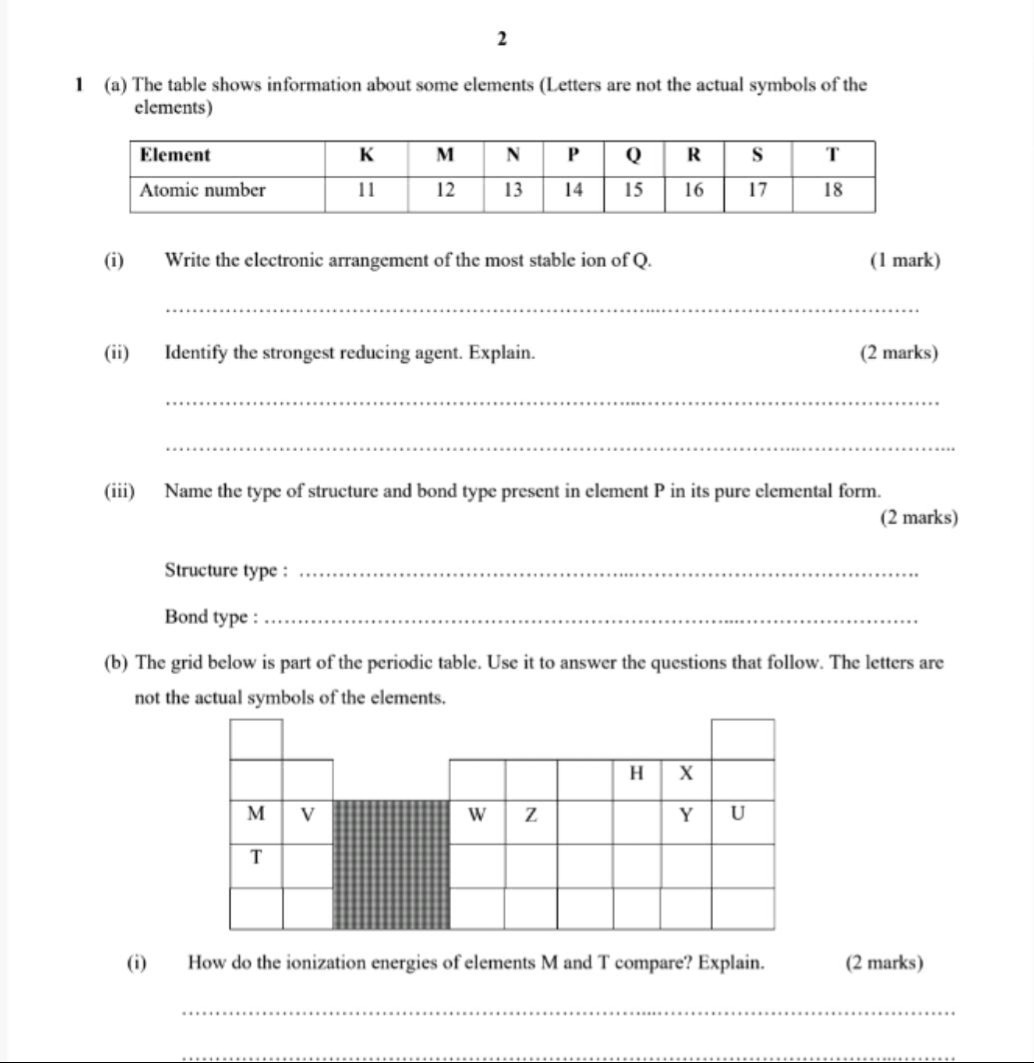
1 (a) the table shows information about some elements (letters are not the actual symbols of the elements)
\
(i) write the electronic arrangement of the most stable ion of q. (1 mark)
(ii) identify the strongest reducing agent. explain. (2 marks)
(iii) name the type of structure and bond type present in element p in its pure elemental form. (2 marks)
structure type:
bond type:
(b) the grid below is part of the periodic table. use it to answer the questions that follow. the letters are not the actual symbols of the elements.
(i) how do the ionization energies of elements m and t compare? explain. (2 marks)
🆕 New Concept Discovered: Periodic Trends and Chemical Bonding
How atomic structure determines bonding, reactivity, and periodic properties.
Step 1: Electronic arrangement of the most stable ion of Q
Element Q has an atomic number of 15.
- The neutral atom has 15 electrons, with the configuration \(2.8.5\).
- To achieve a stable octet (a full outer shell of 8 electrons), it gains 3 electrons to form the phosphide-like ion \(Q^{3-}\).
- Adding 3 electrons to the outer shell gives a stable electronic arrangement of \(2.8.8\).
Step 2: Identify and explain the strongest reducing agent
A reducing agent is a substance that loses electrons easily (undergoes oxidation).
- Across Period 3 (from K to T), the atomic radius decreases and the effective nuclear charge increases, meaning electrons are held more tightly.
- Element K (atomic number 11, configuration \(2.8.1\)) has the largest atomic radius and the lowest ionization energy in this period.
- Therefore, K loses its single outer electron most readily, making it the strongest reducing agent.
Step 3: Structure and bond type of element P
Element P has an atomic number of 14, which corresponds to Silicon (Si).
- In its pure elemental form, it forms a giant network of covalent bonds where each atom is tetrahedrally bonded to four other atoms.
- Structure type: Giant covalent structure (or macromolecular structure).
- Bond type: Covalent bond.
Step 4: Compare and explain the ionization energies of M and T
Looking at the periodic table grid:
- Element M and Element T are in the same group (Group 2), with T positioned directly below M.
- Going down a group, the number of occupied energy levels (electron shells) increases, which increases the atomic radius and the shielding effect.
- Because the outermost electrons in T are further from the nucleus and more shielded, the electrostatic attraction between the nucleus and the outer electrons is weaker.
- Consequently, less energy is required to remove an electron from T than from M. Thus, M has a higher ionization energy than T (or T has a lower ionization energy than M).
** K has the largest atomic radius and the lowest nuclear attraction on its outermost electron among the elements in the period, allowing it to lose its outer electron most readily.
- (iii)
Structure type: Giant covalent (macromolecular)
Bond type: Covalent
Part (b)
- (i) Comparison: M has a higher ionization energy than T (or T has a lower ionization energy than M).
** T has more electron shells than M, resulting in a larger atomic radius and greater shielding. The outermost electrons in T are less strongly attracted to the nucleus, making them easier to remove.

Snap & solve any problem in the app
Get step-by-step solutions on Sovi AI
Photo-based solutions with guided steps
Explore more problems and detailed explanations
Part (a)
- (i) \(2.8.8\)
- (ii) Strongest reducing agent: K