QUESTION IMAGE
Question
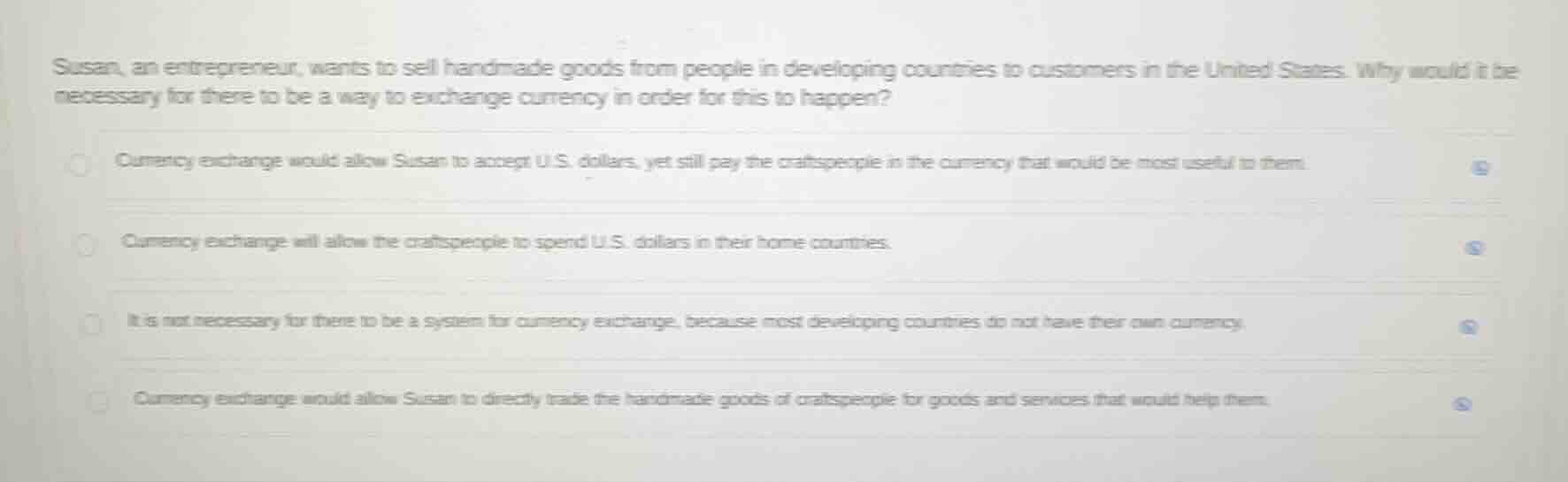
susan, an entrepreneur, wants to sell handmade goods from people in developing countries to customers in the united states. why would it be necessary for there to be a way to exchange currency in order for this to happen?
- currency exchange would allow susan to accept u.s. dollars, yet still pay the craftspeople in the currency that would be most useful to them.
- currency exchange will allow the craftspeople to spend u.s. dollars in their home countries.
- it is not necessary for there to be a system for currency exchange, because most developing countries do not have their own currency.
- currency exchange would allow susan to directly trade the handmade goods of craftspeople for goods and services that would help them.
<pre_analysis>
{
"quality": "clear",
"question_count": 1,
"skills_matched": [
"direct_cot",
"multiple_choice_formatter",
"explain_then_answer",
"tutor"
],
"needs_drawing": false,
"concepts_used": [
"Economic Interdependence"
],
"new_concepts": [
"Currency Exchange",
"International Trade"
],
"current_concepts": [
"Economic Interdependence",
"Currency Exchange",
"International Trade"
]
}
</pre_analysis>
<reasoning>
Analyze the transaction requirements
The scenario describes Susan, an entrepreneur in the United States, selling handmade goods sourced from craftspeople in developing countries to customers in the U.S.
- U.S. customers pay for goods using U.S. dollars (USD).
- Craftspeople in developing countries require payment in their local currencies to purchase local goods, pay taxes, and conduct daily transactions.
Evaluate the role of currency exchange
Using the Economic Interdependence concept, international trade requires a mechanism to bridge different national monetary systems. Currency exchange allows Susan to receive revenue in USD and convert it to pay the craftspeople in their local currency, which is the most useful currency for them.
Assess the given options
- Option 1: States that currency exchange allows Susan to accept U.S. dollars while paying craftspeople in their local currency. This is correct.
- Option 2: Suggests craftspeople spend U.S. dollars in their home countries, which is generally not possible for daily local transactions.
- Option 3: Claims developing countries do not have their own currency, which is false.
- Option 4: Describes direct barter trade, which is not currency exchange.
</reasoning>
<answer>
<mcq-correct>(A) Currency exchange would allow Susan to accept U.S. dollars, yet still pay the craftspeople in the currency that would be most useful to them.</mcq-correct>
<mcq-option>(B) Currency exchange will allow the craftspeople to spend U.S. dollars in their home countries.</mcq-option>
<mcq-option>(C) It is not necessary for there to be a system for currency exchange, because most developing countries do not have their own currency.</mcq-option>
<mcq-option>(D) Currency exchange would allow Susan to directly trade the handmade goods of craftspeople for goods and services that would help them.</mcq-option>
</answer>
<post_analysis>
{
"subject": "Social Science",
"question_type": "Multiple Choice",
"knowledge_point": [
"Social Science",
"Economics",
"International Trade and Exchange Rates"
]
}
</post_analysis>
Snap & solve any problem in the app
Get step-by-step solutions on Sovi AI
Photo-based solutions with guided steps
Explore more problems and detailed explanations
<pre_analysis>
{
"quality": "clear",
"question_count": 1,
"skills_matched": [
"direct_cot",
"multiple_choice_formatter",
"explain_then_answer",
"tutor"
],
"needs_drawing": false,
"concepts_used": [
"Economic Interdependence"
],
"new_concepts": [
"Currency Exchange",
"International Trade"
],
"current_concepts": [
"Economic Interdependence",
"Currency Exchange",
"International Trade"
]
}
</pre_analysis>
<reasoning>
Analyze the transaction requirements
The scenario describes Susan, an entrepreneur in the United States, selling handmade goods sourced from craftspeople in developing countries to customers in the U.S.
- U.S. customers pay for goods using U.S. dollars (USD).
- Craftspeople in developing countries require payment in their local currencies to purchase local goods, pay taxes, and conduct daily transactions.
Evaluate the role of currency exchange
Using the Economic Interdependence concept, international trade requires a mechanism to bridge different national monetary systems. Currency exchange allows Susan to receive revenue in USD and convert it to pay the craftspeople in their local currency, which is the most useful currency for them.
Assess the given options
- Option 1: States that currency exchange allows Susan to accept U.S. dollars while paying craftspeople in their local currency. This is correct.
- Option 2: Suggests craftspeople spend U.S. dollars in their home countries, which is generally not possible for daily local transactions.
- Option 3: Claims developing countries do not have their own currency, which is false.
- Option 4: Describes direct barter trade, which is not currency exchange.
</reasoning>
<answer>
<mcq-correct>(A) Currency exchange would allow Susan to accept U.S. dollars, yet still pay the craftspeople in the currency that would be most useful to them.</mcq-correct>
<mcq-option>(B) Currency exchange will allow the craftspeople to spend U.S. dollars in their home countries.</mcq-option>
<mcq-option>(C) It is not necessary for there to be a system for currency exchange, because most developing countries do not have their own currency.</mcq-option>
<mcq-option>(D) Currency exchange would allow Susan to directly trade the handmade goods of craftspeople for goods and services that would help them.</mcq-option>
</answer>
<post_analysis>
{
"subject": "Social Science",
"question_type": "Multiple Choice",
"knowledge_point": [
"Social Science",
"Economics",
"International Trade and Exchange Rates"
]
}
</post_analysis>