QUESTION IMAGE
Question
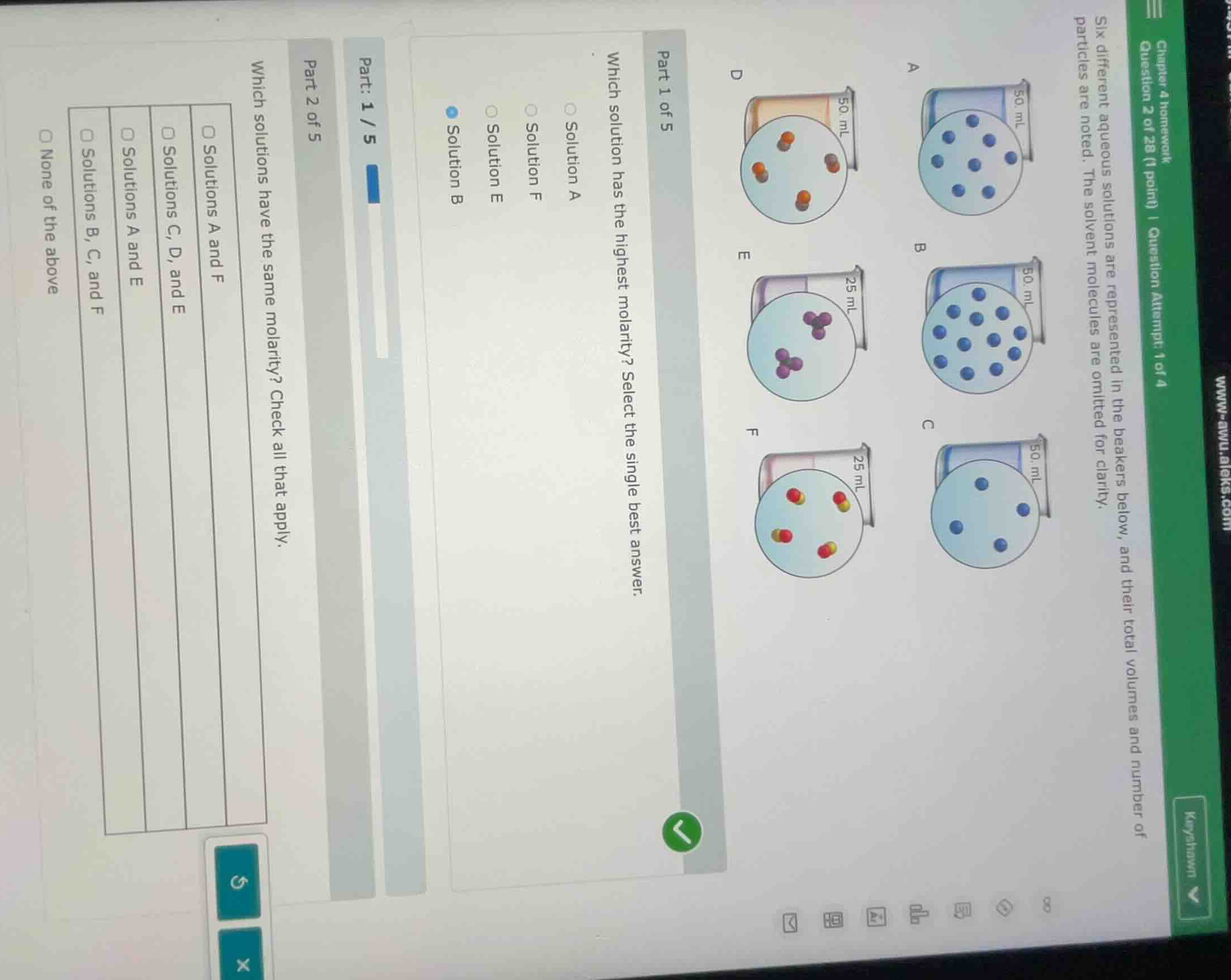
six different aqueous solutions are represented in the beakers below, and their total volumes and number of particles are noted. the solvent molecules are omitted for clarity.
part 1 of 5
which solution has the highest molarity? select the single best answer.
- solution a
- solution f
- solution e
- solution b
part 2 of 5
which solutions have the same molarity? check all that apply.
- solutions a and f
- solutions c, d, and e
- solutions a and e
- solutions b, c, and f
- none of the above
Calculate molarity of each solution
Using the Molarity, Solution Concentration, and Particulate Diagrams knowledge points:
- Solution A: Volume \(V = 50\text{ mL}\), solute particles \(N = 8\).
- Solution B: Volume \(V = 50\text{ mL}\), solute particles \(N = 12\).
- Solution C: Volume \(V = 50\text{ mL}\), solute particles \(N = 4\).
- Solution D: Volume \(V = 50\text{ mL}\), solute particles \(N = 4\).
- Solution E: Volume \(V = 25\text{ mL}\), solute particles \(N = 4\).
- Solution F: Volume \(V = 25\text{ mL}\), solute particles \(N = 4\).
Determine the highest molarity
Comparing the calculated concentration values:
- Solution B has the highest concentration value of \(0.24\text{ particles/mL}\).
Identify solutions with the same molarity
Comparing the calculated concentration values for matches:
- Solutions A, E, and F all have a concentration value of \(0.16\text{ particles/mL}\).
- Solutions C and D both have a concentration value of \(0.08\text{ particles/mL}\).
- Looking at the options for Part 2:
- "Solutions A and F" (A is \(0.16\), F is \(0.16\)) - Same molarity.
- "Solutions C, D, and E" (C and D are \(0.08\), E is \(0.16\)) - Different.
- "Solutions A and E" (A is \(0.16\), E is \(0.16\)) - Same molarity.
- "Solutions B, C, and F" (B is \(0.24\), C is \(0.08\), F is \(0.16\)) - Different.
- "None of the above" - Incorrect because "Solutions A and F" as well as "Solutions A and E" are valid pairs, but we must check the exact options provided. The option "Solutions A and E" is listed. Let's check if there is a combined option. The options are:
- "Solutions A and F"
- "Solutions C, D, and E"
- "Solutions A and E"
- "Solutions B, C, and F"
- "None of the above"
Since both A, E, and F have the same molarity, any pair among them (A and E, A and F, E and F) has the same molarity. Among the choices, "Solutions A and E" is a correct choice.

Snap & solve any problem in the app
Get step-by-step solutions on Sovi AI
Photo-based solutions with guided steps
Explore more problems and detailed explanations
Question 1
- Solution A
- Solution B (Correct answer)
- Solution E
- Solution F
Question 2
- Solutions A and F
- Solutions C, D, and E
- Solutions A and E (Correct answer)
- Solutions B, C, and F
- None of the above