QUESTION IMAGE
Question
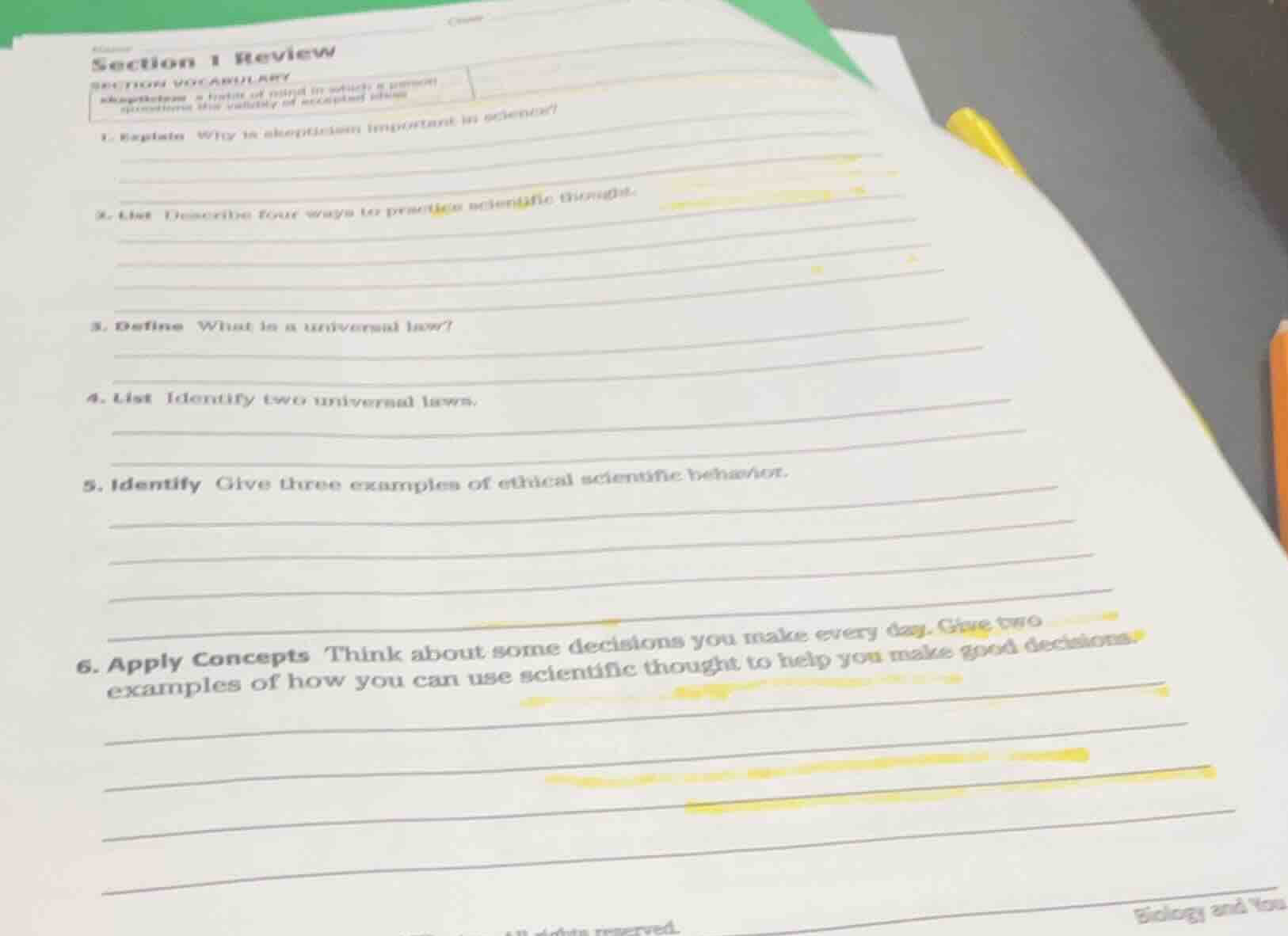
section 1 review
section vocabulary
skepticism a habit of mind in which a person questions the validity of accepted ideas
- explain why is skepticism important in science?
- list describe four ways to practice scientific thought.
- define what is a universal law?
- list identify two universal laws.
- identify give three examples of ethical scientific behavior.
- apply concepts think about some decisions you make every day. give two examples of how you can use scientific thought to help you make good decisions.
<pre_analysis>
{
"quality": "clear",
"question_count": 6,
"skills_matched": [
"direct_cot",
"explain_then_answer",
"quick"
],
"needs_drawing": false,
"concepts_used": [
"Scientific Skepticism",
"Scientific Ethics"
],
"new_concepts": [
"Scientific Thought",
"Universal Laws"
],
"current_concepts": [
"Scientific Skepticism",
"Scientific Thought",
"Universal Laws",
"Scientific Ethics"
]
}
</pre_analysis>
<reasoning>
Importance of skepticism in science
Skepticism prevents the acceptance of unsupported claims, ensuring scientific conclusions are based on verifiable evidence.
Ways to practice scientific thought
- Observing and asking questions.
- Designing experiments to test hypotheses.
- Analyzing data objectively.
- Thinking creatively and critically.
Definition of a universal law
A universal law is a scientific principle or theory that applies everywhere in the universe at all times.
Examples of universal laws
- The law of gravity.
- The law of conservation of energy.
Examples of ethical scientific behavior
- Reporting data honestly and accurately.
- Giving proper credit to other researchers' work.
- Ensuring the safety and well-being of research subjects.
Applying scientific thought to daily decisions
- Evaluating the claims of advertising by looking for objective evidence.
- Analyzing nutritional information to make healthier dietary choices.
</reasoning>
<answer>
Question 1
Skepticism ensures that scientific claims are thoroughly tested and supported by evidence before they are accepted.
Question 2
- Making observations and asking questions.
- Designing experiments to test hypotheses.
- Analyzing data and drawing evidence-based conclusions.
- Thinking critically and remaining open to new ideas.
Question 3
A universal law is a scientific truth or principle that is valid throughout the universe.
Question 4
- Law of Gravity
- Law of Conservation of Energy
Question 5
- Reporting experimental data honestly without fabrication.
- Crediting other scientists for their contributions.
- Obtaining informed consent from human participants.
Question 6
- Using evidence and critical thinking to evaluate the claims of commercial products before buying them.
- Analyzing nutritional data and scientific facts to make informed dietary and health choices.
</answer>
<post_analysis>
{
"subject": "Natural Science",
"question_type": "Multi-part",
"knowledge_point": [
"Natural Science",
"Scientific Method",
"Scientific Thought and Ethics"
]
}
</post_analysis>
Snap & solve any problem in the app
Get step-by-step solutions on Sovi AI
Photo-based solutions with guided steps
Explore more problems and detailed explanations
<pre_analysis>
{
"quality": "clear",
"question_count": 6,
"skills_matched": [
"direct_cot",
"explain_then_answer",
"quick"
],
"needs_drawing": false,
"concepts_used": [
"Scientific Skepticism",
"Scientific Ethics"
],
"new_concepts": [
"Scientific Thought",
"Universal Laws"
],
"current_concepts": [
"Scientific Skepticism",
"Scientific Thought",
"Universal Laws",
"Scientific Ethics"
]
}
</pre_analysis>
<reasoning>
Importance of skepticism in science
Skepticism prevents the acceptance of unsupported claims, ensuring scientific conclusions are based on verifiable evidence.
Ways to practice scientific thought
- Observing and asking questions.
- Designing experiments to test hypotheses.
- Analyzing data objectively.
- Thinking creatively and critically.
Definition of a universal law
A universal law is a scientific principle or theory that applies everywhere in the universe at all times.
Examples of universal laws
- The law of gravity.
- The law of conservation of energy.
Examples of ethical scientific behavior
- Reporting data honestly and accurately.
- Giving proper credit to other researchers' work.
- Ensuring the safety and well-being of research subjects.
Applying scientific thought to daily decisions
- Evaluating the claims of advertising by looking for objective evidence.
- Analyzing nutritional information to make healthier dietary choices.
</reasoning>
<answer>
Question 1
Skepticism ensures that scientific claims are thoroughly tested and supported by evidence before they are accepted.
Question 2
- Making observations and asking questions.
- Designing experiments to test hypotheses.
- Analyzing data and drawing evidence-based conclusions.
- Thinking critically and remaining open to new ideas.
Question 3
A universal law is a scientific truth or principle that is valid throughout the universe.
Question 4
- Law of Gravity
- Law of Conservation of Energy
Question 5
- Reporting experimental data honestly without fabrication.
- Crediting other scientists for their contributions.
- Obtaining informed consent from human participants.
Question 6
- Using evidence and critical thinking to evaluate the claims of commercial products before buying them.
- Analyzing nutritional data and scientific facts to make informed dietary and health choices.
</answer>
<post_analysis>
{
"subject": "Natural Science",
"question_type": "Multi-part",
"knowledge_point": [
"Natural Science",
"Scientific Method",
"Scientific Thought and Ethics"
]
}
</post_analysis>