QUESTION IMAGE
Question
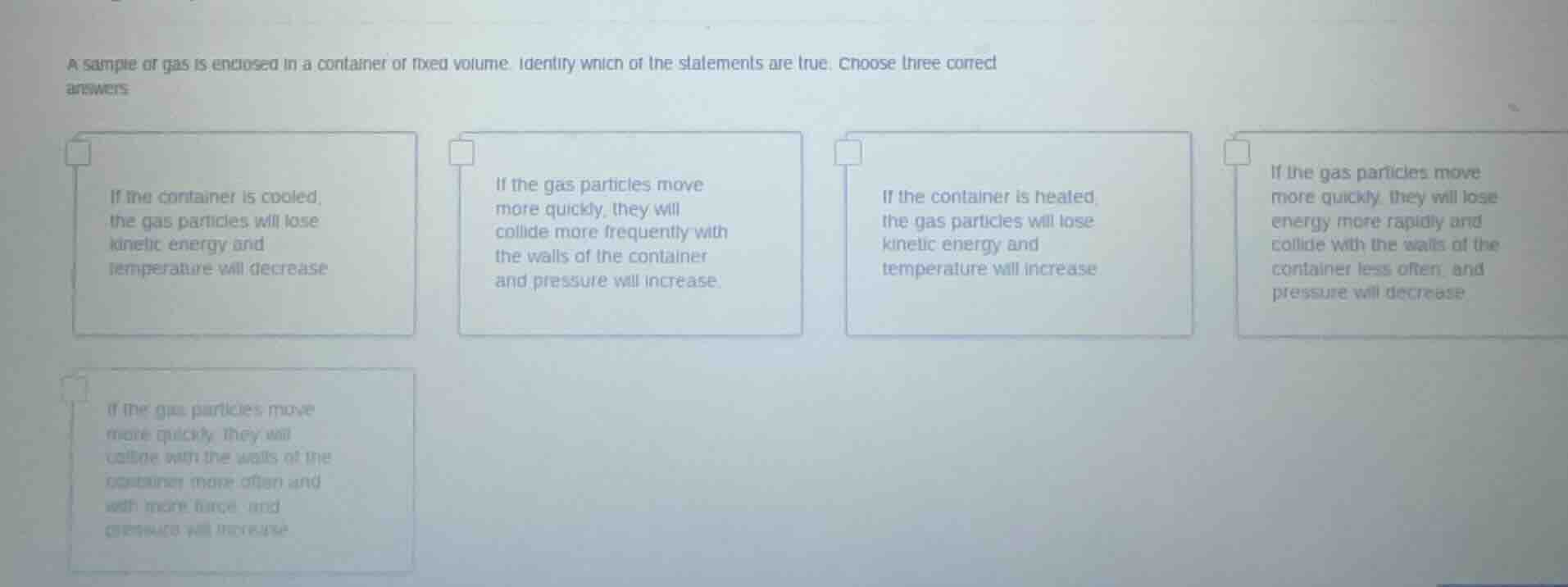
a sample of gas is enclosed in a container of fixed volume. identify which of the statements are true. choose three correct answers:
- if the container is cooled, the gas particles will lose kinetic energy and temperature will decrease
- if the gas particles move more quickly, they will collide more frequently with the walls of the container and pressure will increase
- if the container is heated, the gas particles will lose kinetic energy and temperature will increase
- if the gas particles move more quickly, they will lose energy more rapidly and collide with the walls of the container less often, and pressure will decrease
- if the gas particles move more quickly, they will collide with the walls of the container more often and with more force, and pressure will increase
Analyze cooling effects
Using the Kinetic Molecular Theory knowledge point
Cooling decreases average kinetic energy and temperature.
Analyze heating effects
Using the Kinetic Molecular Theory knowledge point
Heating increases average kinetic energy and temperature, not decreases.
Analyze particle speed and collision frequency
Using the Kinetic Molecular Theory and Gas Laws knowledge points
Faster particles collide more frequently with container walls, increasing pressure.
Analyze particle speed and collision force
Using the Kinetic Molecular Theory and Gas Laws knowledge points
Faster particles collide more frequently and with greater force, increasing pressure.

Snap & solve any problem in the app
Get step-by-step solutions on Sovi AI
Photo-based solutions with guided steps
Explore more problems and detailed explanations
- If the container is cooled, the gas particles will lose kinetic energy and temperature will decrease (Correct answer)
- If the gas particles move more quickly, they will collide more frequently with the walls of the container and pressure will increase. (Correct answer)
- If the container is heated, the gas particles will lose kinetic energy and temperature will increase
- If the gas particles move more quickly, they will lose energy more rapidly and collide with the walls of the container less often, and pressure will decrease
- If the gas particles move more quickly, they will collide with the walls of the container more often and with more force, and pressure will increase. (Correct answer)