QUESTION IMAGE
Question
question 8
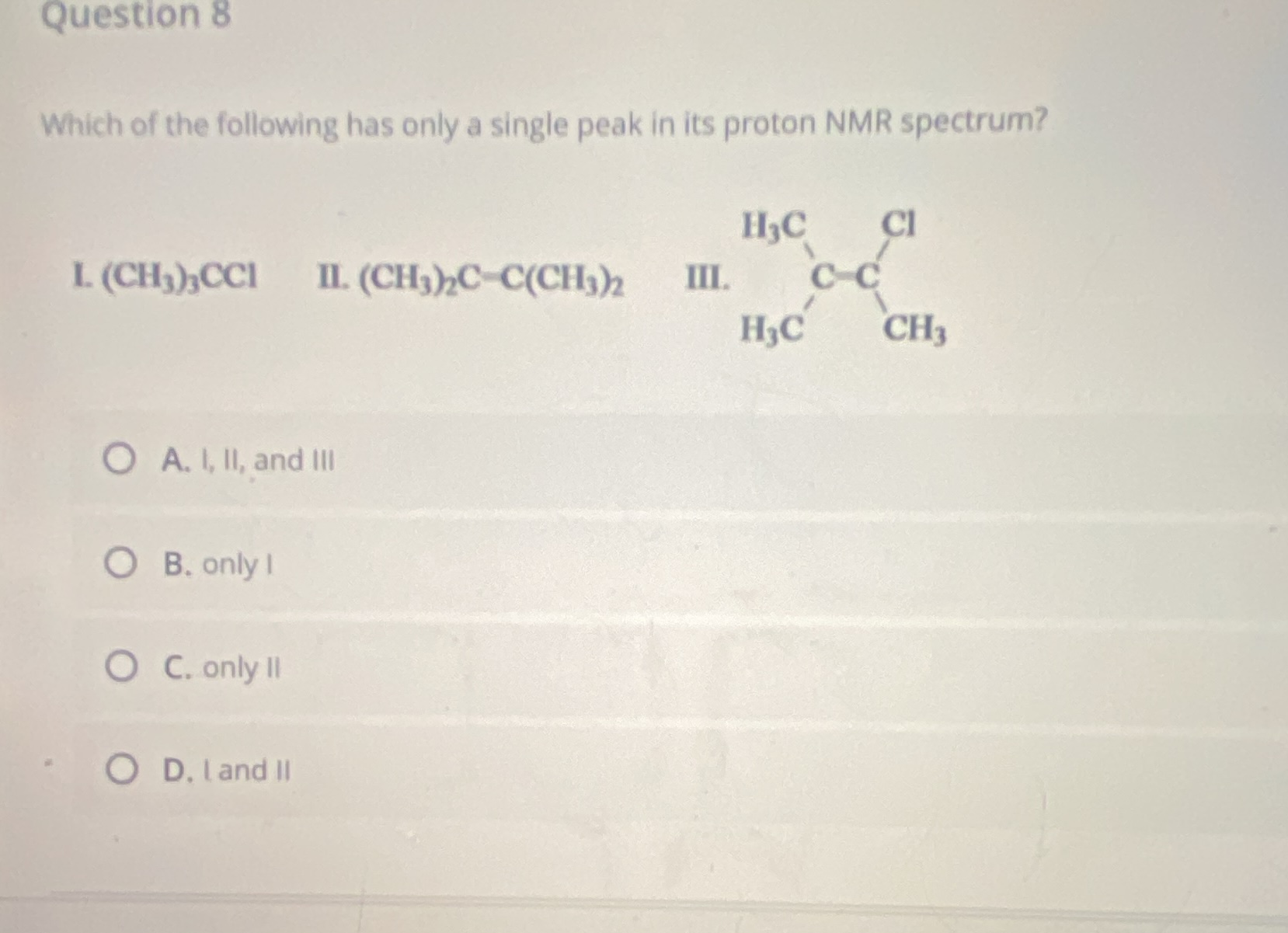
which of the following has only a single peak in its proton nmr spectrum?
i. \\((\text{ch}_3)_3\text{ccl}\\)
ii. \\((\text{ch}_3)_2\text{c}=\text{c}(\text{ch}_3)_2\\)
iii. \\(\
\\)
a. i, ii, and iii
b. only i
c. only ii
d. i and ii
Analyze molecule I
Molecule I is tert-butyl chloride, \(\text{(CH}_3\text{)}_3\text{CCl}\).
The three methyl \(\text{(-CH}_3)\) groups are chemically equivalent due to the symmetry of the tetrahedral carbon center.
All 9 protons are equivalent, yielding a single peak.
Analyze molecule II
Molecule II is 2,3-dimethyl-2-butene, \(\text{(CH}_3\text{)}_2\text{C=C(CH}_3\text{)}_2\).
The molecule has a highly symmetric planar structure with a double bond.
All four methyl groups are chemically equivalent, so all 12 protons yield a single peak.
Analyze molecule III
Molecule III is 1,1,2-trimethylcyclopropane or a similar substituted alkane.
Looking closely at the structure:
It is a substituted ethane derivative: \(\text{(CH}_3\text{)}_2\text{CH-CH(Cl)CH}_3\) or similar, specifically drawn as \(\text{(CH}_3\text{)}_2\text{C(H)-C(Cl)(CH}_3\text{)}_2\) with missing hydrogens, or more precisely 1,2-dichloro/substituted alkane.
Let's trace the drawn structure:
Left carbon is bonded to two \(\text{-CH}_3\) groups and a central carbon.
Right carbon is bonded to a \(\text{-Cl}\) atom, a \(\text{-CH}_3\) group, and the central carbon.
This lack of symmetry means the methyl groups on the left carbon are in a different chemical environment than the methyl group on the right carbon.
Thus, it has multiple non-equivalent proton environments, resulting in multiple peaks.
Compare with options
Since only I and II have a single peak in their proton NMR spectra, the correct option is D.

Snap & solve any problem in the app
Get step-by-step solutions on Sovi AI
Photo-based solutions with guided steps
Explore more problems and detailed explanations
- A. I, II, and III
- B. only I
- C. only II
- D. I and II (Correct answer)