QUESTION IMAGE
Question
question 8
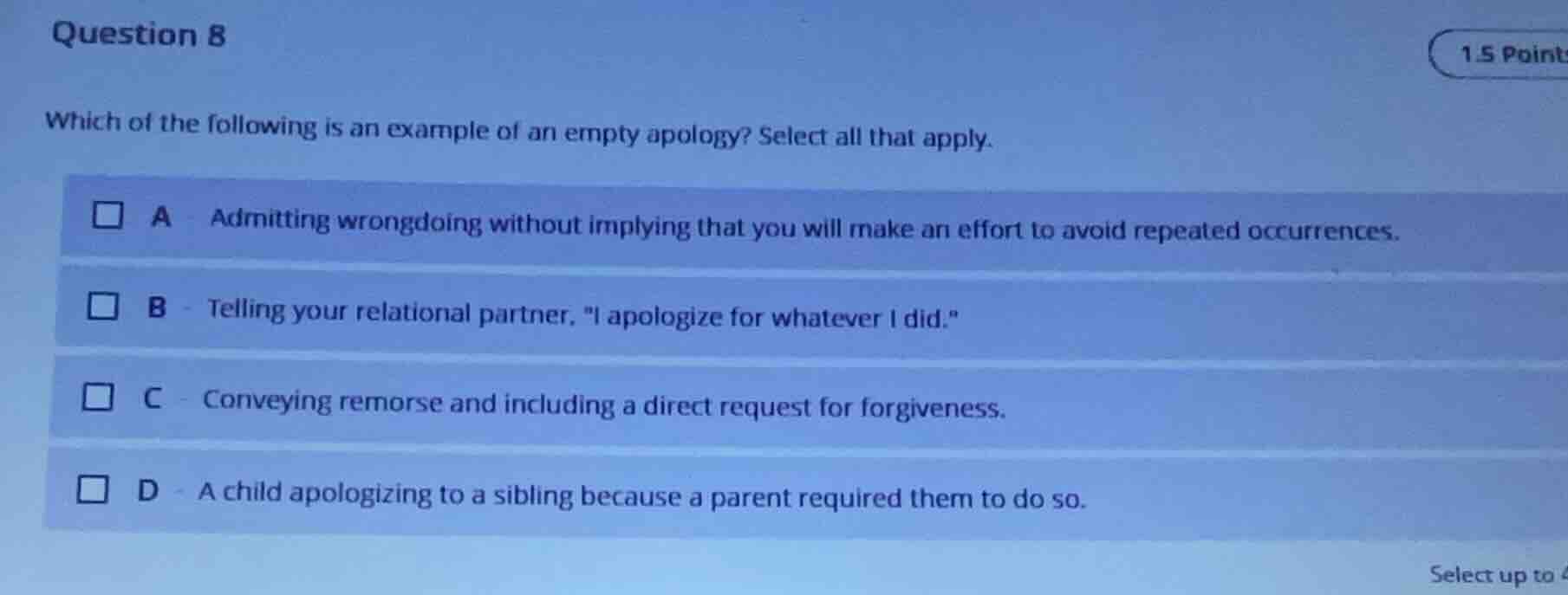
which of the following is an example of an empty apology? select all that apply.
a admitting wrongdoing without implying that you will make an effort to avoid repeated occurrences.
b telling your relational partner, \i apologize for whatever i did.\
c conveying remorse and including a direct request for forgiveness.
d a child apologizing to a sibling because a parent required them to do so.
<pre_analysis>
{
"quality": "clear",
"question_count": 1,
"skills_matched": [
"direct_cot",
"multiple_choice_formatter",
"explain_then_answer",
"tutor"
],
"needs_drawing": false,
"concepts_used": [
"Relational Transgressions"
],
"new_concepts": [
"Empty Apologies",
"Interpersonal Apologies"
],
"current_concepts": [
"Relational Transgressions",
"Empty Apologies",
"Interpersonal Apologies"
]
}
</pre_analysis>
<reasoning>
Define empty apologies
An empty apology is one that lacks sincerity, fails to take genuine responsibility, or is offered purely to escape immediate consequences rather than to repair the relationship. In interpersonal communication and Relational Transgressions, an effective apology typically requires acknowledging responsibility, expressing remorse, and offering a commitment to change behavior.
Analyze Option A
Option A describes admitting wrongdoing without implying an effort to avoid repeated occurrences. Because it lacks a commitment to change or prevent future harm, it fails to fulfill the core components of a complete, sincere apology, making it an example of an empty apology.
Analyze Option B
Option B describes saying, "I apologize for whatever I did." The use of the word "whatever" indicates a lack of specific acknowledgment of the transgression and avoids taking genuine responsibility, which is a classic hallmark of an empty, insincere apology.
Analyze Option C
Option C describes conveying remorse and including a direct request for forgiveness. This contains key elements of a sincere, constructive apology aimed at relational repair, so it is not an empty apology.
Analyze Option D
Option D describes a child apologizing to a sibling because a parent required them to do so. This apology is coerced by an external authority rather than motivated by internal remorse or a genuine desire to repair the bond, making it insincere and empty.
</reasoning>
<answer>
<mcq-correct>(A) Admitting wrongdoing without implying that you will make an effort to avoid repeated occurrences.</mcq-correct>
<mcq-correct>(B) Telling your relational partner, "I apologize for whatever I did."</mcq-correct>
<mcq-option>(C) Conveying remorse and including a direct request for forgiveness.</mcq-option>
<mcq-correct>(D) A child apologizing to a sibling because a parent required them to do so.</mcq-correct>
</answer>
<post_analysis>
{
"subject": "Social Science",
"question_type": "Multiple Choice",
"knowledge_point": [
"Social Science",
"Communication Studies",
"Interpersonal Communication"
]
}
</post_analysis>
Snap & solve any problem in the app
Get step-by-step solutions on Sovi AI
Photo-based solutions with guided steps
Explore more problems and detailed explanations
<pre_analysis>
{
"quality": "clear",
"question_count": 1,
"skills_matched": [
"direct_cot",
"multiple_choice_formatter",
"explain_then_answer",
"tutor"
],
"needs_drawing": false,
"concepts_used": [
"Relational Transgressions"
],
"new_concepts": [
"Empty Apologies",
"Interpersonal Apologies"
],
"current_concepts": [
"Relational Transgressions",
"Empty Apologies",
"Interpersonal Apologies"
]
}
</pre_analysis>
<reasoning>
Define empty apologies
An empty apology is one that lacks sincerity, fails to take genuine responsibility, or is offered purely to escape immediate consequences rather than to repair the relationship. In interpersonal communication and Relational Transgressions, an effective apology typically requires acknowledging responsibility, expressing remorse, and offering a commitment to change behavior.
Analyze Option A
Option A describes admitting wrongdoing without implying an effort to avoid repeated occurrences. Because it lacks a commitment to change or prevent future harm, it fails to fulfill the core components of a complete, sincere apology, making it an example of an empty apology.
Analyze Option B
Option B describes saying, "I apologize for whatever I did." The use of the word "whatever" indicates a lack of specific acknowledgment of the transgression and avoids taking genuine responsibility, which is a classic hallmark of an empty, insincere apology.
Analyze Option C
Option C describes conveying remorse and including a direct request for forgiveness. This contains key elements of a sincere, constructive apology aimed at relational repair, so it is not an empty apology.
Analyze Option D
Option D describes a child apologizing to a sibling because a parent required them to do so. This apology is coerced by an external authority rather than motivated by internal remorse or a genuine desire to repair the bond, making it insincere and empty.
</reasoning>
<answer>
<mcq-correct>(A) Admitting wrongdoing without implying that you will make an effort to avoid repeated occurrences.</mcq-correct>
<mcq-correct>(B) Telling your relational partner, "I apologize for whatever I did."</mcq-correct>
<mcq-option>(C) Conveying remorse and including a direct request for forgiveness.</mcq-option>
<mcq-correct>(D) A child apologizing to a sibling because a parent required them to do so.</mcq-correct>
</answer>
<post_analysis>
{
"subject": "Social Science",
"question_type": "Multiple Choice",
"knowledge_point": [
"Social Science",
"Communication Studies",
"Interpersonal Communication"
]
}
</post_analysis>