Sovi.AI - AI Math Tutor

Scan to solve math questions

QUESTION IMAGE

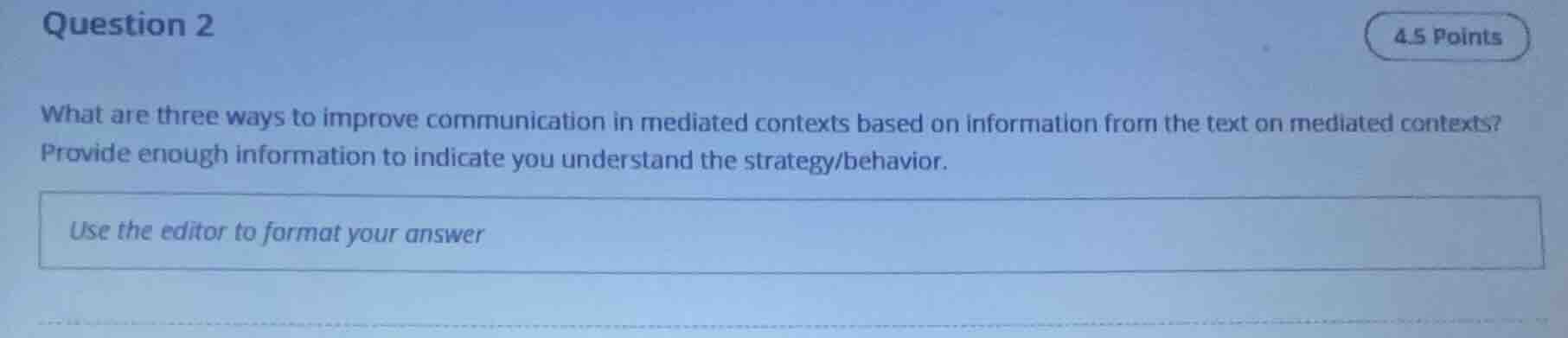
question 2 what are three ways to improve communication in mediated con…

Question

question 2

what are three ways to improve communication in mediated contexts based on information from the text on mediated contexts? provide enough information to indicate you understand the strategy/behavior.

Explanation:

Response

<pre_analysis>
{
"quality": "clear",
"question_count": 1,
"skills_matched": [
"direct_cot",
"explain_then_answer",
"tutor",
"mastery_adaptive_brevity"
],
"needs_drawing": false,
"concepts_used": [
"Computer-Mediated Communication"
],
"new_concepts": [
"Mediated Communication Competence",
"Digital Etiquette"
],
"current_concepts": [
"Computer-Mediated Communication",
"Mediated Communication Competence",
"Digital Etiquette"
]
}
</pre_analysis>

<reasoning>

Analyze the prompt requirements

The question asks for three distinct ways to improve communication in mediated contexts (digital/online communication) based on standard communication studies principles. We must provide enough detail to demonstrate a clear understanding of each strategy.

Apply mastered communication concepts

Using the Computer-Mediated Communication knowledge point

  • Strategy 1: Practice digital mindfulness and delay responses.
  • Explanation: Unlike face-to-face interactions, mediated communication allows for asynchronous exchange. Pausing before sending a message helps prevent emotional, reactive, or poorly drafted responses.
  • Strategy 2: Adapt language and tone to the specific platform.
  • Explanation: Different digital channels (e.g., professional email vs. instant messaging) have distinct norms. Matching the level of formality and clarity to the medium prevents misunderstandings.
  • Strategy 3: Clarify intent and verify understanding explicitly.
  • Explanation: Mediated channels lack nonverbal cues like body language and vocal tone. Explicitly stating your emotional intent (or using tools like emojis when appropriate) and asking clarifying questions helps bridge this gap.

Synthesize the final response

We will structure the final answer to clearly present these three strategies with concise, academic explanations suitable for a college-level communication course.
</reasoning>

<answer>

  1. Practice Digital Mindfulness and Delayed Responding: Take advantage of the asynchronous nature of most computer-mediated communication. By pausing and reviewing messages before sending, you can avoid reactive, emotionally charged responses and ensure your message is clear, professional, and constructive.
  1. Adapt Tone and Formality to the Specific Medium: Recognize that different digital platforms have unique norms and expectations. Adjust your language, formatting, and level of detail to match the channel (e.g., using formal structure and clear subject lines in professional emails, while keeping instant messages concise and direct).
  1. Compensate for the Lack of Nonverbal Cues: Because mediated communication lacks physical cues like eye contact, facial expressions, and vocal tone, you must be more explicit with your language. Clearly state your intent, use appropriate punctuation or formatting to convey tone, and actively ask clarifying questions to verify that the receiver understood your message as intended.

</answer>

<post_analysis>
{
"subject": "Social Science",
"question_type": "Free Response",
"knowledge_point": [
"Social Science",
"Communication Studies",
"Computer-Mediated Communication"
]
}
</post_analysis>

Answer:

<pre_analysis>
{
"quality": "clear",
"question_count": 1,
"skills_matched": [
"direct_cot",
"explain_then_answer",
"tutor",
"mastery_adaptive_brevity"
],
"needs_drawing": false,
"concepts_used": [
"Computer-Mediated Communication"
],
"new_concepts": [
"Mediated Communication Competence",
"Digital Etiquette"
],
"current_concepts": [
"Computer-Mediated Communication",
"Mediated Communication Competence",
"Digital Etiquette"
]
}
</pre_analysis>

<reasoning>

Analyze the prompt requirements

The question asks for three distinct ways to improve communication in mediated contexts (digital/online communication) based on standard communication studies principles. We must provide enough detail to demonstrate a clear understanding of each strategy.

Apply mastered communication concepts

Using the Computer-Mediated Communication knowledge point

  • Strategy 1: Practice digital mindfulness and delay responses.
  • Explanation: Unlike face-to-face interactions, mediated communication allows for asynchronous exchange. Pausing before sending a message helps prevent emotional, reactive, or poorly drafted responses.
  • Strategy 2: Adapt language and tone to the specific platform.
  • Explanation: Different digital channels (e.g., professional email vs. instant messaging) have distinct norms. Matching the level of formality and clarity to the medium prevents misunderstandings.
  • Strategy 3: Clarify intent and verify understanding explicitly.
  • Explanation: Mediated channels lack nonverbal cues like body language and vocal tone. Explicitly stating your emotional intent (or using tools like emojis when appropriate) and asking clarifying questions helps bridge this gap.

Synthesize the final response

We will structure the final answer to clearly present these three strategies with concise, academic explanations suitable for a college-level communication course.
</reasoning>

<answer>

  1. Practice Digital Mindfulness and Delayed Responding: Take advantage of the asynchronous nature of most computer-mediated communication. By pausing and reviewing messages before sending, you can avoid reactive, emotionally charged responses and ensure your message is clear, professional, and constructive.
  1. Adapt Tone and Formality to the Specific Medium: Recognize that different digital platforms have unique norms and expectations. Adjust your language, formatting, and level of detail to match the channel (e.g., using formal structure and clear subject lines in professional emails, while keeping instant messages concise and direct).
  1. Compensate for the Lack of Nonverbal Cues: Because mediated communication lacks physical cues like eye contact, facial expressions, and vocal tone, you must be more explicit with your language. Clearly state your intent, use appropriate punctuation or formatting to convey tone, and actively ask clarifying questions to verify that the receiver understood your message as intended.

</answer>

<post_analysis>
{
"subject": "Social Science",
"question_type": "Free Response",
"knowledge_point": [
"Social Science",
"Communication Studies",
"Computer-Mediated Communication"
]
}
</post_analysis>