QUESTION IMAGE
Question
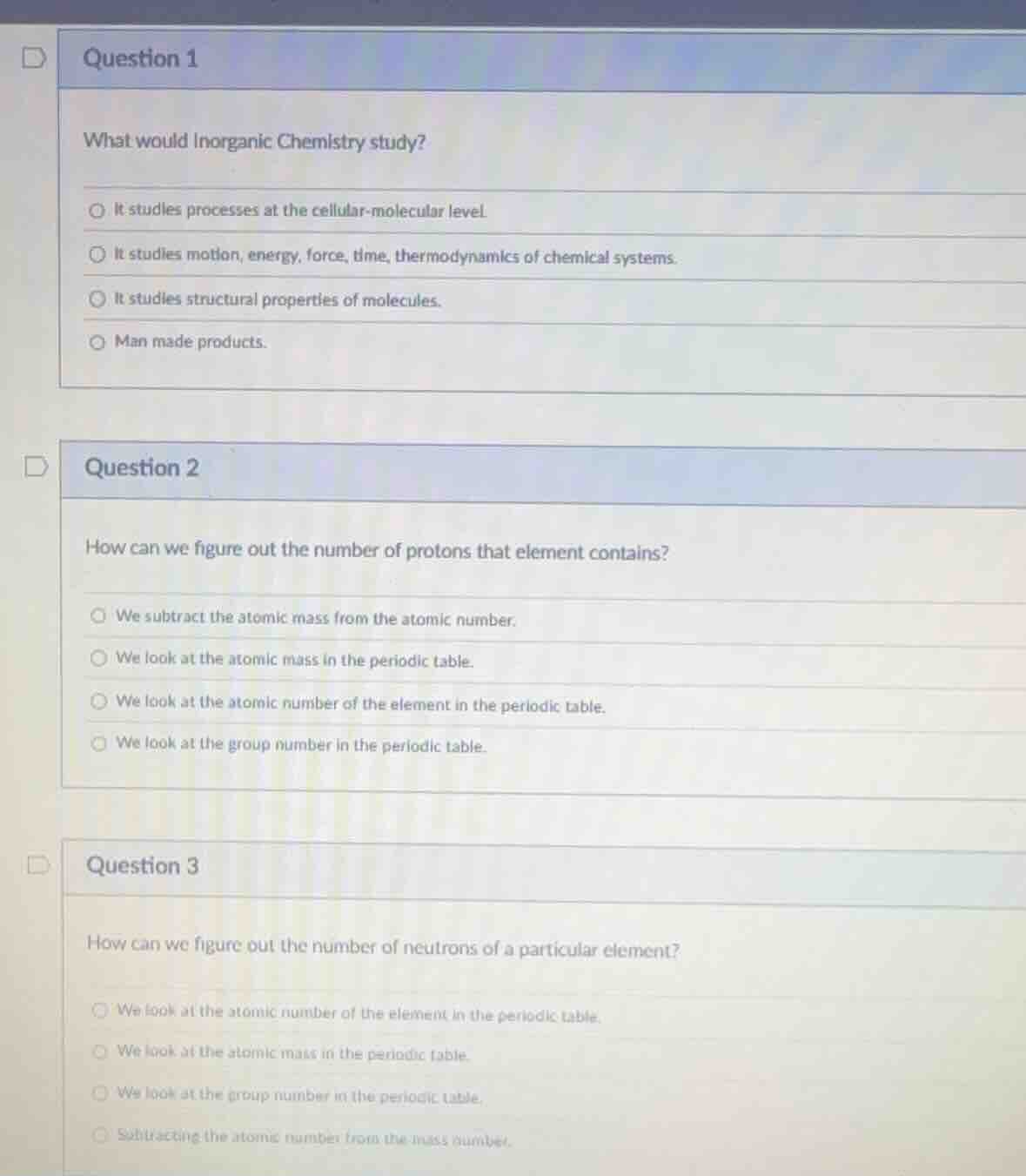
question 1
what would inorganic chemistry study?
it studies processes at the cellular-molecular level.
it studies motion, energy, force, time, thermodynamics of chemical systems.
it studies structural properties of molecules.
man made products.
question 2
how can we figure out the number of protons that element contains?
we subtract the atomic mass from the atomic number.
we look at the atomic mass in the periodic table.
we look at the atomic number of the element in the periodic table.
we look at the group number in the periodic table.
question 3
how can we figure out the number of neutrons of a particular element?
we look at the atomic number of the element in the periodic table.
we look at the atomic mass in the periodic table.
we look at the group number in the periodic table.
subtracting the atomic number from the mass number.
Analyze Inorganic Chemistry study areas
Inorganic chemistry is the branch of chemistry that deals with the synthesis and behavior of inorganic and organometallic compounds. This field covers chemical substances that are not carbon-based (which are covered by organic chemistry), including metals, minerals, and organometallic compounds. Among the options provided:
- "It studies processes at the cellular-molecular level" describes biochemistry.
- "It studies motion, energy, force, time, thermodynamics of chemical systems" describes physical chemistry.
- "It studies structural properties of molecules" is a general description often associated with physical or analytical chemistry, but inorganic chemistry specifically focuses on non-organic substances, including man-made synthetic materials like catalysts, coatings, and materials. Thus, "Man made products" is the most fitting choice among the options provided for what inorganic chemistry studies.
Determine the number of protons
Using the History of Atomic Theory knowledge point, we understand how the structure of an atom is defined. The atomic number of an element is defined specifically as the number of protons found in the nucleus of every atom of that element. Therefore, to find the number of protons, we look at the atomic number of the element in the periodic table.
Determine the number of neutrons
The mass number of an atom is the sum of its protons and neutrons. Since the atomic number represents the number of protons, we can calculate the number of neutrons by subtracting the atomic number (protons) from the mass number (protons + neutrons).

Snap & solve any problem in the app
Get step-by-step solutions on Sovi AI
Photo-based solutions with guided steps
Explore more problems and detailed explanations
Question 1
- (A) It studies processes at the cellular-molecular level.
- (B) It studies motion, energy, force, time, thermodynamics of chemical systems.
- (C) It studies structural properties of molecules.
- (D) Man made products. (Correct answer)
Question 2
- (A) We subtract the atomic mass from the atomic number.
- (B) We look at the atomic mass in the periodic table.
- (C) We look at the atomic number of the element in the periodic table. (Correct answer)
- (D) We look at the group number in the periodic table.
Question 3
- (A) We look at the atomic number of the element in the periodic table.
- (B) We look at the atomic mass in the periodic table.
- (C) We look at the group number in the periodic table.
- (D) Subtracting the atomic number from the mass number. (Correct answer)