QUESTION IMAGE
Question
question 3
1 pts
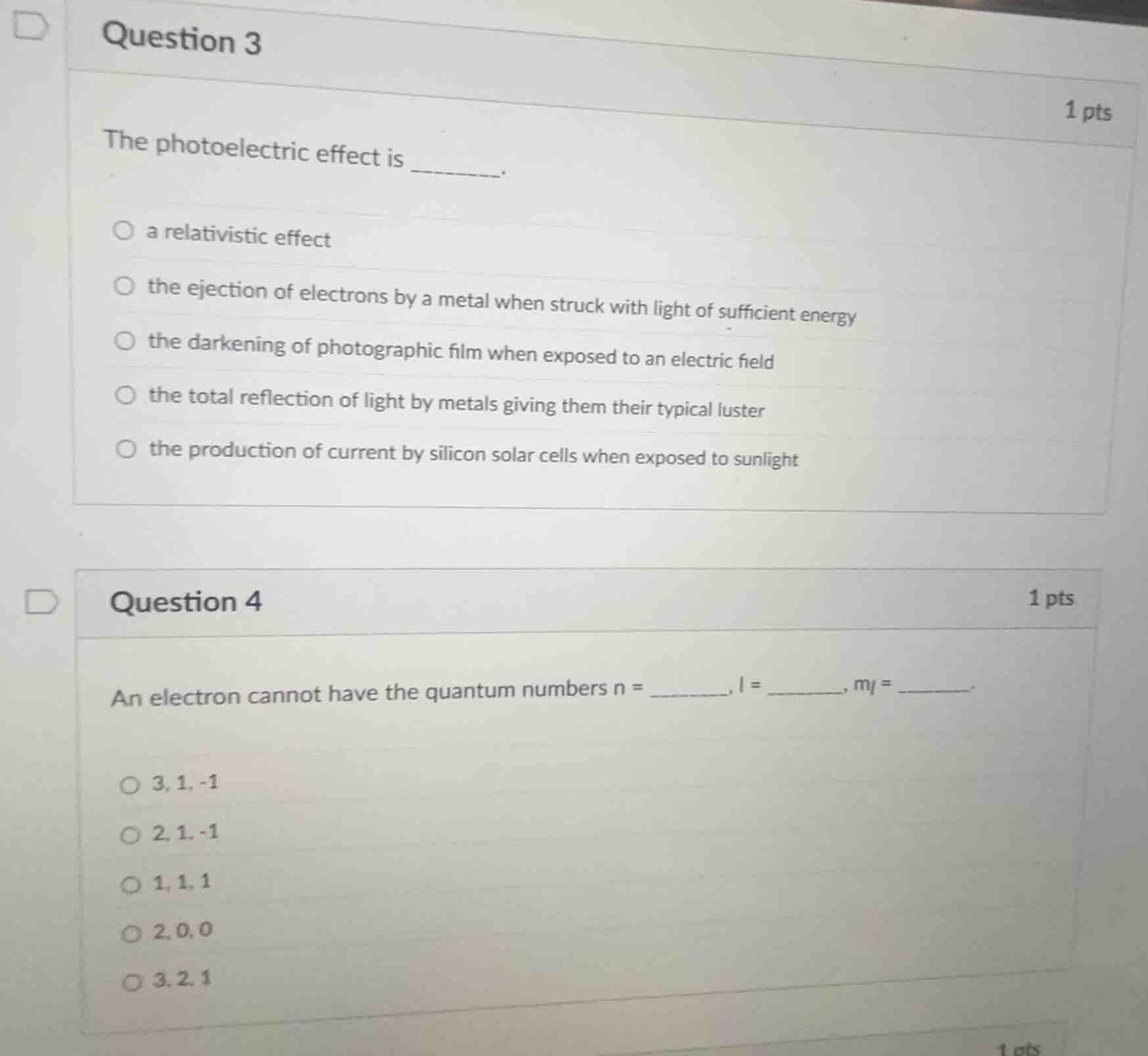
the photoelectric effect is ______.
a relativistic effect
the ejection of electrons by a metal when struck with light of sufficient energy
the darkening of photographic film when exposed to an electric field
the total reflection of light by metals giving them their typical luster
the production of current by silicon solar cells when exposed to sunlight
question 4
1 pts
an electron cannot have the quantum numbers \\(n = \\) ____, \\(l = \\) __, \\(m_l = \\) ____.
3, 1, -1
2, 1, -1
1, 1, 1
2, 0, 0
3, 2, 1
Define the photoelectric effect
The photoelectric effect is a key phenomenon in quantum mechanics where electrons are emitted from the surface of a material (typically a metal) when light of a high enough frequency (or sufficient energy) shines on it. This demonstrates the particle-like behavior of light, where packets of energy called photons transfer energy to individual electrons. Looking at the options for Question 3, the second option directly states: "the ejection of electrons by a metal when struck with light of sufficient energy".
Analyze quantum number rules
To determine which set of quantum numbers is impossible for Question 4, we must apply the fundamental quantum mechanical rules governing atomic orbitals:
- The principal quantum number \(n\) must be a positive integer: \(n = 1, 2, 3, \dots\)
- The angular momentum quantum number \(l\) depends on \(n\) and can be any integer from \(0\) to \(n-1\): \(l \in [0, n-1]\).
- The magnetic quantum number \(m_l\) depends on \(l\) and can be any integer from \(-l\) to \(+l\): \(m_l \in [-l, +l]\).
Evaluate each quantum number set
Let's test each option in Question 4 against these rules:
- Option 1: \(3, 1, -1\)
Here, \(n=3\). Since \(l\) can range from \(0\) to \(2\), \(l=1\) is allowed. Since \(m_l\) can range from \(-1\) to \(+1\), \(m_l=-1\) is allowed. This set is valid.
- Option 2: \(2, 1, -1\)
Here, \(n=2\). Since \(l\) can range from \(0\) to \(1\), \(l=1\) is allowed. Since \(m_l\) can range from \(-1\) to \(+1\), \(m_l=-1\) is allowed. This set is valid.
- Option 3: \(1, 1, 1\)
Here, \(n=1\). The rule states \(l\) must be strictly less than \(n\) (\(l \le n-1\)). Therefore, for \(n=1\), the only allowed value for \(l\) is \(0\). A value of \(l=1\) is impossible. Consequently, \(m_l=1\) is also invalid because \(m_l\) cannot exceed \(l\). This set is invalid.
- Option 4: \(2, 0, 0\)
Here, \(n=2\). Since \(l\) can be \(0\), and \(m_l\) can be \(0\), this set is valid.
- Option 5: \(3, 2, 1\)
Here, \(n=3\). Since \(l\) can range from \(0\) to \(2\), \(l=2\) is allowed. Since \(m_l\) can range from \(-2\) to \(+2\), \(m_l=1\) is allowed. This set is valid.

Snap & solve any problem in the app
Get step-by-step solutions on Sovi AI
Photo-based solutions with guided steps
Explore more problems and detailed explanations
Question 3
- (A) a relativistic effect
- (B) the ejection of electrons by a metal when struck with light of sufficient energy (Correct answer)
- (C) the darkening of photographic film when exposed to an electric field
- (D) the total reflection of light by metals giving them their typical luster
- (E) the production of current by silicon solar cells when exposed to sunlight
Question 4
- (A) 3, 1, -1
- (B) 2, 1, -1
- (C) 1, 1, 1 (Correct answer)
- (D) 2, 0, 0
- (E) 3, 2, 1