QUESTION IMAGE
Question
question 2 (7 points)
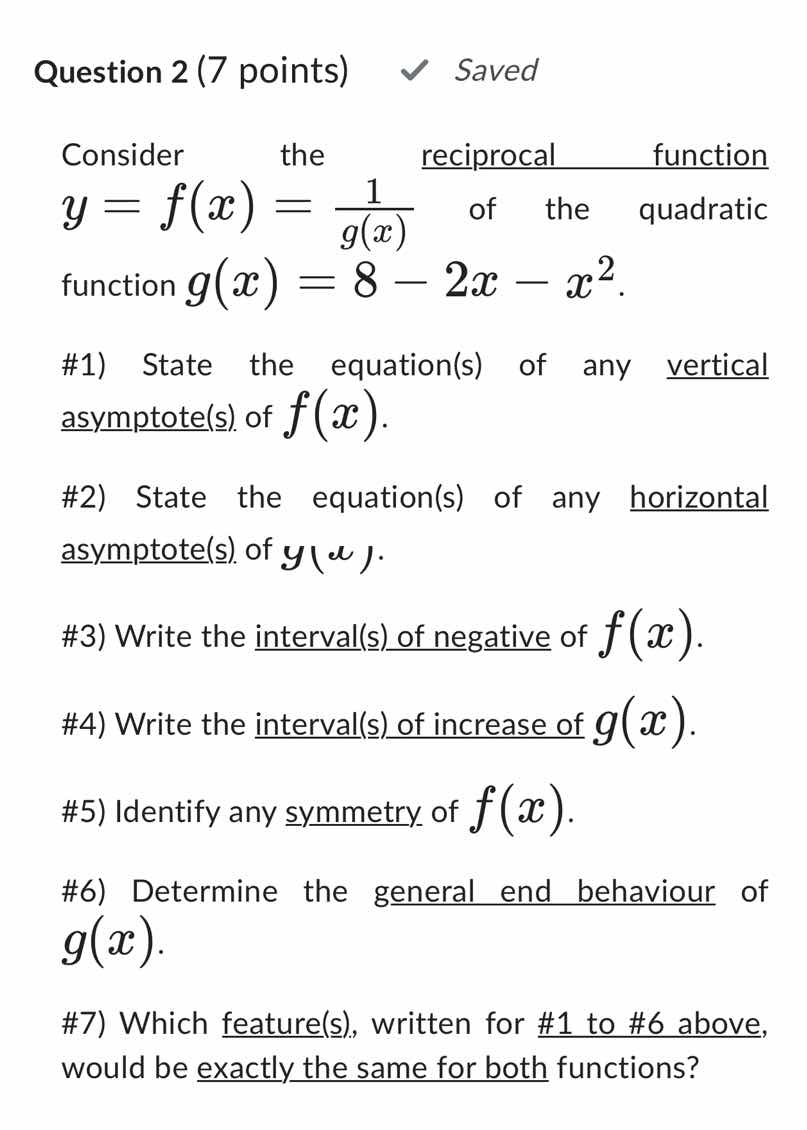
consider the reciprocal function \\(y = f(x) = \frac{1}{g(x)}\\) of the quadratic function \\(g(x) = 8 - 2x - x^2\\).
#1) state the equation(s) of any vertical asymptote(s) of \\(f(x)\\).
#2) state the equation(s) of any horizontal asymptote(s) of \\(f(x)\\).
#3) write the interval(s) of negative of \\(f(x)\\).
#4) write the interval(s) of increase of \\(g(x)\\).
#5) identify any symmetry of \\(f(x)\\).
#6) determine the general end behaviour of \\(g(x)\\).
#7) which feature(s), written for #1 to #6 above, would be exactly the same for both functions?
🆕 New Concept Discovered: Reciprocal Functions
How the features of a function relate to its reciprocal
Step 1: Vertical Asymptotes of \( f(x) \)
Vertical asymptotes of a reciprocal function \( f(x) = \frac{1}{g(x)} \) occur where the denominator is zero, \( g(x) = 0 \).
Multiply by \(-1\):
Factor the quadratic equation:
Thus, the vertical asymptotes are:
Step 2: Horizontal Asymptote of \( f(x) \)
For the reciprocal function \( f(x) = \frac{1}{8 - 2x - x^2} \), as \( x \to \pm\infty \), the denominator \( g(x) \to -\infty \).
Therefore, the function values approach \( 0 \):
Step 3: Intervals of Negativity of \( f(x) \)
The sign of a reciprocal function \( f(x) = \frac{1}{g(x)} \) is identical to the sign of its base function \( g(x) \). We find where \( g(x) < 0 \):
This inequality holds true outside the roots:
Step 4: Interval of Increase of \( g(x) \)
The quadratic function \( g(x) = -x^2 - 2x + 8 \) is a parabola opening downward. The \( x \)-coordinate of its vertex is:
Since the parabola opens downward, it increases on the interval to the left of the vertex:
Step 5: Symmetry of \( f(x) \)
To check for even symmetry (\( f(-x) = f(x) \)) or odd symmetry (\( f(-x) = -f(x) \)):
Since \( f(-x)
eq f(x) \) and \( f(-x)
eq -f(x) \), the function has no even or odd symmetry (neither).
However, it is symmetric about the vertical line passing through the vertex of the quadratic denominator:
Step 6: End Behaviour of \( g(x) \)
Since \( g(x) = -x^2 - 2x + 8 \) is a polynomial with a negative leading coefficient and an even degree:
Step 7: Shared Features Between \( f(x) \) and \( g(x) \)
Let's compare the features of \( g(x) \) and \( f(x) \):
- Vertical Asymptotes: Only \( f(x) \) has them.
- Horizontal Asymptotes: Only \( f(x) \) has them.
- Intervals of Negativity: Since \( f(x) = \frac{1}{g(x)} \), both functions share the exact same sign for any \( x \). Thus, the intervals of negativity are identical.
- Intervals of Increase/Decrease: Reciprocal functions have opposite behaviors; where \( g(x) \) increases, \( f(x) \) decreases.
- Symmetry: Both functions share the same axis of symmetry at \( x = -1 \).
- End Behaviour: \( g(x) \to -\infty \) while \( f(x) \to 0 \).
The features that are exactly the same are the intervals of negativity (and the axis of symmetry).

Snap & solve any problem in the app
Get step-by-step solutions on Sovi AI
Photo-based solutions with guided steps
Explore more problems and detailed explanations
- Vertical Asymptotes of \( f(x) \): \( x = -4 \) and \( x = 2 \)
- Horizontal Asymptote of \( f(x) \): \( y = 0 \)
- Intervals of Negativity of \( f(x) \): \( (-\infty, -4) \cup (2, \infty) \)
- Interval of Increase of \( g(x) \): \( (-\infty, -1) \)
- Symmetry of \( f(x) \): Symmetric about the line \( x = -1 \) (neither even nor odd)
- End Behaviour of \( g(x) \): As \( x \to \pm\infty \), \( g(x) \to -\infty \)
- Identical Features: The intervals of negativity (and the axis of symmetry \( x = -1 \))