Sovi.AI - AI Math Tutor

Scan to solve math questions

QUESTION IMAGE

question 8 cole has put forth the argument that all fires produce smoke…

Question

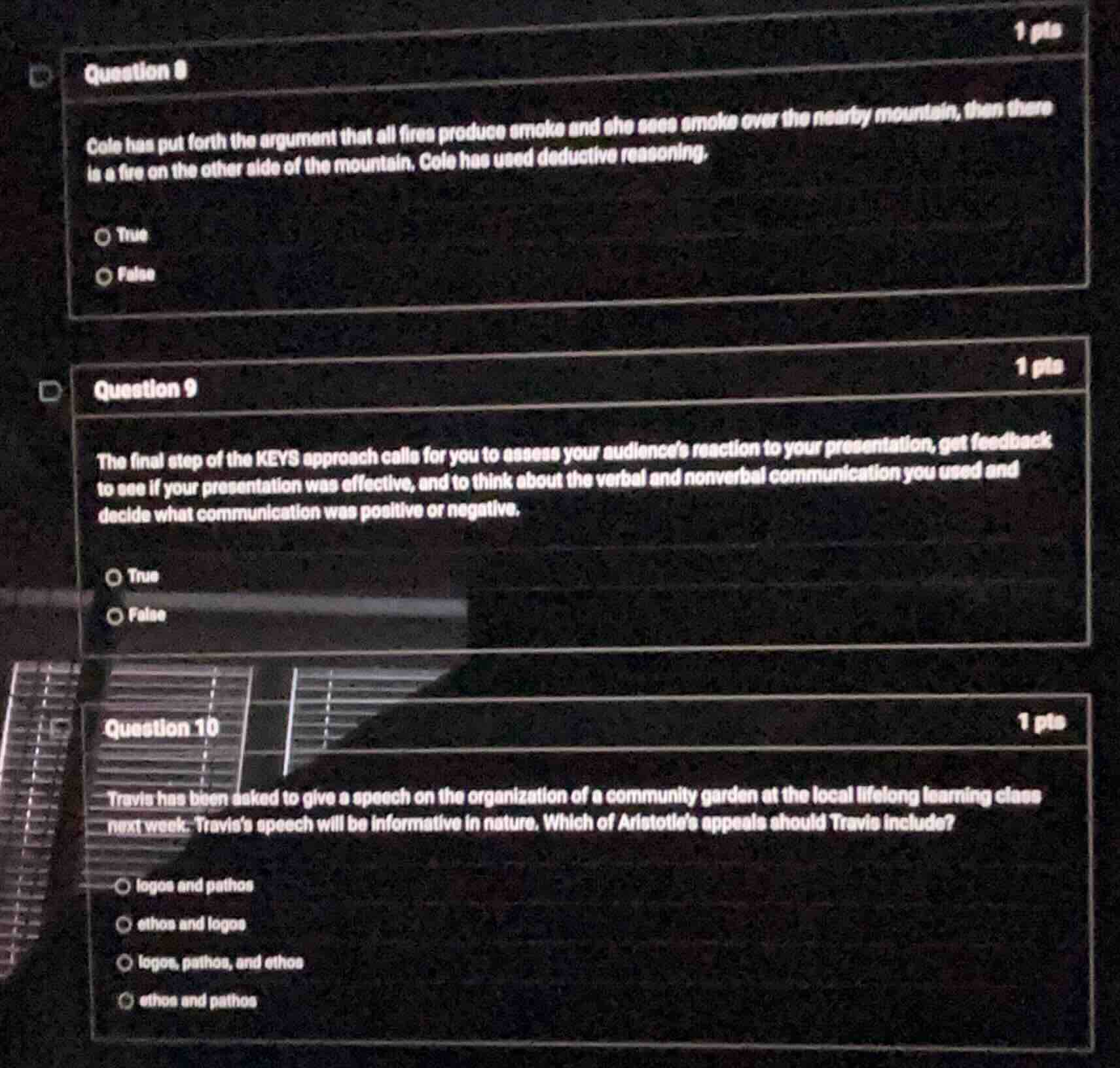
question 8
cole has put forth the argument that all fires produce smoke and she sees smoke over the nearby mountain, then there is a fire on the other side of the mountain. cole has used deductive reasoning.
true
false

question 9
the final step of the keys approach calls for you to assess your audiences reaction to your presentation, get feedback to see if your presentation was effective, and to think about the verbal and nonverbal communication you used and decide what communication was positive or negative.
true
false

question 10
travis has been asked to give a speech on the organization of a community garden at the local lifelong learning class next week. traviss speech will be informative in nature. which of aristotles appeals should travis include?
logos and pathos
ethos and logos
logos, pathos, and ethos
ethos and pathos

Explanation:

Response

<pre_analysis>
{
"quality": "clear",
"question_count": 3,
"skills_matched": [
"direct_cot",
"multiple_choice_formatter",
"explain_then_answer",
"tutor"
],
"needs_drawing": false,
"concepts_used": [
"Deductive Reasoning",
"Rhetorical Appeals"
],
"new_concepts": [
"KEYS Communication Approach"
],
"current_concepts": [
"Deductive Reasoning",
"KEYS Communication Approach",
"Rhetorical Appeals"
]
}
</pre_analysis>

<reasoning>

Analyze deductive reasoning in Question 8

In Deductive Reasoning, we start with a general premise and apply it to a specific case to reach a logically certain conclusion.

  • General premise: All fires produce smoke.
  • Specific observation: Cole sees smoke over the nearby mountain.
  • Conclusion: There is a fire on the other side of the mountain.

However, this argument commits a formal logical fallacy known as affirming the consequent:

  1. If \(P\) (fire), then \(Q\) (smoke).
  2. \(Q\) (smoke) is observed.
  3. Therefore, \(P\) (fire).

Because smoke can be produced by things other than fire (e.g., fog, dust, industrial emissions), the conclusion is not guaranteed by the premises. While it attempts a deductive structure, the reasoning is logically invalid. However, in many introductory communication contexts, this is classified as an attempt at deductive reasoning (moving from a general rule to a specific instance) rather than inductive reasoning (moving from specific observations to a general rule). Let's look closer: "Cole has used deductive reasoning." Since the structure goes from general ("all fires") to specific ("this mountain"), it is indeed categorized as deductive reasoning, making the statement True.

Analyze the KEYS approach in Question 9

The KEYS approach is a professional communication framework:

  • Know Yourself
  • Evaluate the Professional Context
  • Your Communication Code
  • Step Back and Reflect

The final step, Step Back and Reflect, focuses on assessing the effectiveness of your communication, analyzing feedback, and examining both verbal and nonverbal cues to improve future interactions. The description in the prompt matches this definition perfectly. Thus, the statement is True.

Analyze rhetorical appeals for an informative speech in Question 10

Travis is giving an informative speech about organizing a community garden.

  • Informative speeches focus on presenting objective facts, logical structures, and credible information.
  • Rhetorical Appeals include:
  • Ethos: Credibility and character of the speaker.
  • Logos: Logic, facts, and evidence.
  • Pathos: Emotional appeal.

For an informative speech, the primary focus must be on establishing the speaker's credibility (ethos) and presenting clear, logical information (logos). Emotional appeals (pathos) are primarily used in persuasive speaking to motivate action or change attitudes, and should be minimized in purely informative speaking to maintain objectivity. Therefore, Travis should primarily include ethos and logos.
</reasoning>

<answer>

Question 8

<mcq-correct>True</mcq-correct>
<mcq-option>False</mcq-option>

Question 9

<mcq-correct>True</mcq-correct>
<mcq-option>False</mcq-option>

Question 10

<mcq-option>logos and pathos</mcq-option>
<mcq-correct>ethos and logos</mcq-correct>
<mcq-option>logos, pathos, and ethos</mcq-option>
<mcq-option>ethos and pathos</mcq-option>
</answer>

<post_analysis>
{
"subject": "Social Science",
"question_type": "Multi-part",
"knowledge_point": [
"Social Science",
"Communi…

Answer:

<pre_analysis>
{
"quality": "clear",
"question_count": 3,
"skills_matched": [
"direct_cot",
"multiple_choice_formatter",
"explain_then_answer",
"tutor"
],
"needs_drawing": false,
"concepts_used": [
"Deductive Reasoning",
"Rhetorical Appeals"
],
"new_concepts": [
"KEYS Communication Approach"
],
"current_concepts": [
"Deductive Reasoning",
"KEYS Communication Approach",
"Rhetorical Appeals"
]
}
</pre_analysis>

<reasoning>

Analyze deductive reasoning in Question 8

In Deductive Reasoning, we start with a general premise and apply it to a specific case to reach a logically certain conclusion.

  • General premise: All fires produce smoke.
  • Specific observation: Cole sees smoke over the nearby mountain.
  • Conclusion: There is a fire on the other side of the mountain.

However, this argument commits a formal logical fallacy known as affirming the consequent:

  1. If \(P\) (fire), then \(Q\) (smoke).
  2. \(Q\) (smoke) is observed.
  3. Therefore, \(P\) (fire).

Because smoke can be produced by things other than fire (e.g., fog, dust, industrial emissions), the conclusion is not guaranteed by the premises. While it attempts a deductive structure, the reasoning is logically invalid. However, in many introductory communication contexts, this is classified as an attempt at deductive reasoning (moving from a general rule to a specific instance) rather than inductive reasoning (moving from specific observations to a general rule). Let's look closer: "Cole has used deductive reasoning." Since the structure goes from general ("all fires") to specific ("this mountain"), it is indeed categorized as deductive reasoning, making the statement True.

Analyze the KEYS approach in Question 9

The KEYS approach is a professional communication framework:

  • Know Yourself
  • Evaluate the Professional Context
  • Your Communication Code
  • Step Back and Reflect

The final step, Step Back and Reflect, focuses on assessing the effectiveness of your communication, analyzing feedback, and examining both verbal and nonverbal cues to improve future interactions. The description in the prompt matches this definition perfectly. Thus, the statement is True.

Analyze rhetorical appeals for an informative speech in Question 10

Travis is giving an informative speech about organizing a community garden.

  • Informative speeches focus on presenting objective facts, logical structures, and credible information.
  • Rhetorical Appeals include:
  • Ethos: Credibility and character of the speaker.
  • Logos: Logic, facts, and evidence.
  • Pathos: Emotional appeal.

For an informative speech, the primary focus must be on establishing the speaker's credibility (ethos) and presenting clear, logical information (logos). Emotional appeals (pathos) are primarily used in persuasive speaking to motivate action or change attitudes, and should be minimized in purely informative speaking to maintain objectivity. Therefore, Travis should primarily include ethos and logos.
</reasoning>

<answer>

Question 8

<mcq-correct>True</mcq-correct>
<mcq-option>False</mcq-option>

Question 9

<mcq-correct>True</mcq-correct>
<mcq-option>False</mcq-option>

Question 10

<mcq-option>logos and pathos</mcq-option>
<mcq-correct>ethos and logos</mcq-correct>
<mcq-option>logos, pathos, and ethos</mcq-option>
<mcq-option>ethos and pathos</mcq-option>
</answer>

<post_analysis>
{
"subject": "Social Science",
"question_type": "Multi-part",
"knowledge_point": [
"Social Science",
"Communication Studies",
"Rhetorical Appeals and Reasoning"
]
}
</post_analysis>