QUESTION IMAGE
Question
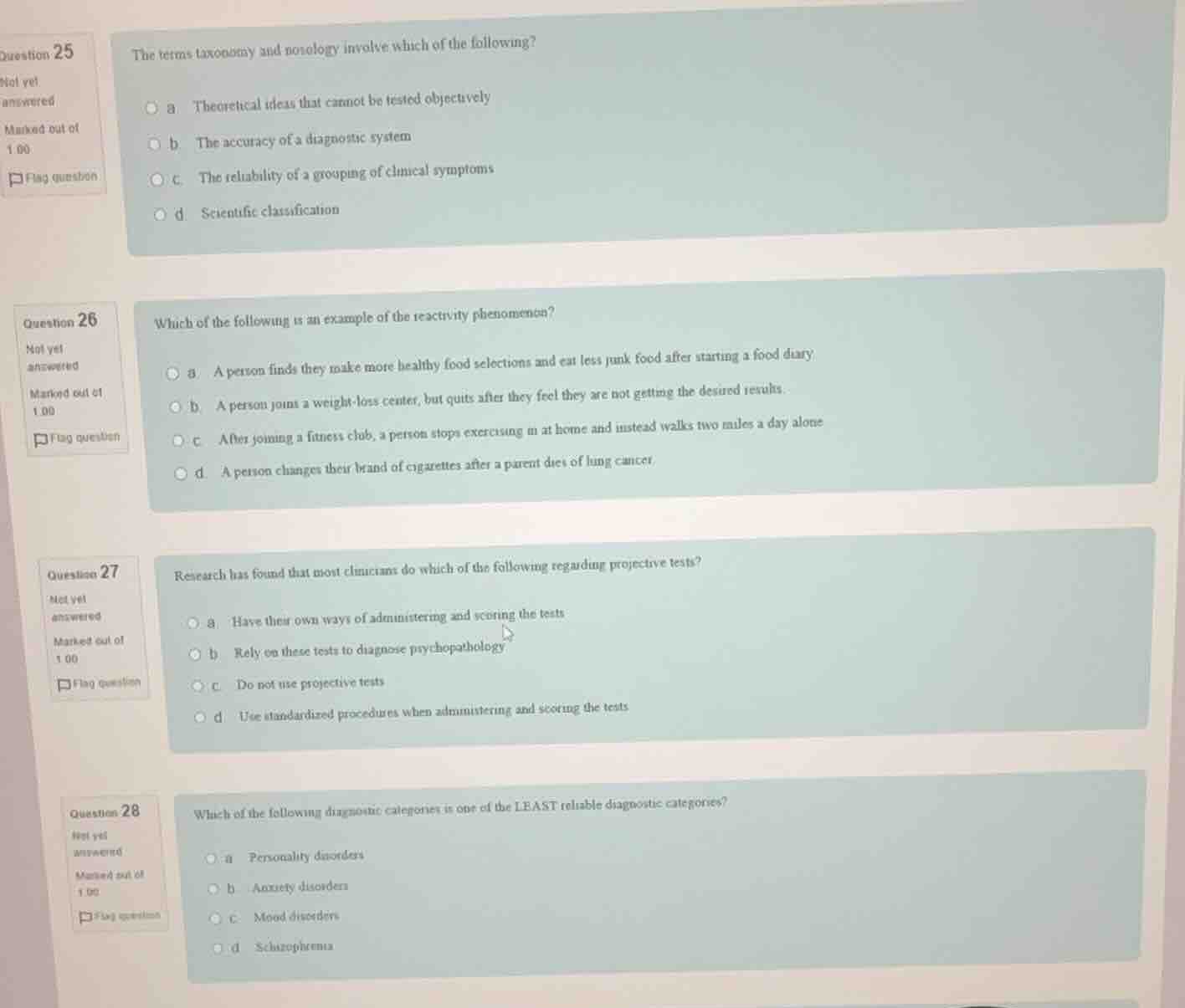
question 25
the terms taxonomy and nosology involve which of the following?
a. theoretical ideas that cannot be tested objectively
b. the accuracy of a diagnostic system
c. the reliability of a grouping of clinical symptoms
d. scientific classification
question 26
which of the following is an example of the reactivity phenomenon?
a. a person finds they make more healthy food selections and eat less junk food after starting a food diary
b. a person joins a weight-loss center, but quits after they feel they are not getting the desired results.
c. after joining a fitness club, a person stops exercising at home and instead walks two miles a day alone
d. a person changes their brand of cigarettes after a parent dies of lung cancer.
question 27
research has found that most clinicians do which of the following regarding projective tests?
a. have their own ways of administering and scoring the tests
b. rely on these tests to diagnose psychopathology
c. do not use projective tests
d. use standardized procedures when administering and scoring the tests
question 28
which of the following diagnostic categories is one of the least reliable diagnostic categories?
a. personality disorders
b. anxiety disorders
c. mood disorders
d. schizophrenia
<pre_analysis>
{
"quality": "clear",
"question_count": 4,
"skills_matched": [
"direct_cot",
"multiple_choice_formatter",
"explain_then_answer",
"quick"
],
"needs_drawing": false,
"concepts_used": [
"Psychiatric Nomenclature"
],
"new_concepts": [
"Reactivity Phenomenon",
"Projective Tests Clinical Use",
"Diagnostic Reliability"
],
"current_concepts": [
"Psychiatric Nomenclature",
"Reactivity Phenomenon",
"Projective Tests Clinical Use",
"Diagnostic Reliability"
]
}
</pre_analysis>
<reasoning>
Analyze Question 25
Taxonomy refers to the classification of entities, and nosology specifically refers to the systematic classification of diseases or medical/psychiatric disorders. Both terms fundamentally involve scientific classification.
Analyze Question 26
Reactivity is a phenomenon where individuals alter their behavior because they are aware that they are being observed or self-monitoring. Starting a food diary and subsequently eating healthier is a classic example of reactivity due to self-monitoring.
Analyze Question 27
Research indicates that despite standardized guidelines, many clinicians who use projective tests (like the Rorschach or TAT) rely on their own idiosyncratic ways of administering, scoring, and interpreting them rather than strictly adhering to standardized systems.
Analyze Question 28
Among the major diagnostic categories in DSM, personality disorders historically and consistently demonstrate some of the lowest inter-rater reliability compared to more distinct categories like schizophrenia, anxiety disorders, or mood disorders.
</reasoning>
<answer>
Question 25
<mcq-option>a. Theoretical ideas that cannot be tested objectively</mcq-option>
<mcq-option>b. The accuracy of a diagnostic system</mcq-option>
<mcq-option>c. The reliability of a grouping of clinical symptoms</mcq-option>
<mcq-correct>d. Scientific classification</mcq-correct>
Question 26
<mcq-correct>a. A person finds they make more healthy food selections and eat less junk food after starting a food diary</mcq-correct>
<mcq-option>b. A person joins a weight-loss center, but quits after they feel they are not getting the desired results.</mcq-option>
<mcq-option>c. After joining a fitness club, a person stops exercising at home and instead walks two miles a day alone</mcq-option>
<mcq-option>d. A person changes their brand of cigarettes after a parent dies of lung cancer.</mcq-option>
Question 27
<mcq-correct>a. Have their own ways of administering and scoring the tests</mcq-correct>
<mcq-option>b. Rely on these tests to diagnose psychopathology</mcq-option>
<mcq-option>c. Do not use projective tests</mcq-option>
<mcq-option>d. Use standardized procedures when administering and scoring the tests</mcq-option>
Question 28
<mcq-correct>a. Personality disorders</mcq-correct>
<mcq-option>b. Anxiety disorders</mcq-option>
<mcq-option>c. Mood disorders</mcq-option>
<mcq-option>d. Schizophrenia</mcq-option>
</answer>
<post_analysis>
{
"subject": "Social Science",
"question_type": "Multiple Choice",
"knowledge_point": [
"Social Science",
"Psychology",
"Clinical Assessment and Diagnosis"
]
}
</post_analysis>
Snap & solve any problem in the app
Get step-by-step solutions on Sovi AI
Photo-based solutions with guided steps
Explore more problems and detailed explanations
<pre_analysis>
{
"quality": "clear",
"question_count": 4,
"skills_matched": [
"direct_cot",
"multiple_choice_formatter",
"explain_then_answer",
"quick"
],
"needs_drawing": false,
"concepts_used": [
"Psychiatric Nomenclature"
],
"new_concepts": [
"Reactivity Phenomenon",
"Projective Tests Clinical Use",
"Diagnostic Reliability"
],
"current_concepts": [
"Psychiatric Nomenclature",
"Reactivity Phenomenon",
"Projective Tests Clinical Use",
"Diagnostic Reliability"
]
}
</pre_analysis>
<reasoning>
Analyze Question 25
Taxonomy refers to the classification of entities, and nosology specifically refers to the systematic classification of diseases or medical/psychiatric disorders. Both terms fundamentally involve scientific classification.
Analyze Question 26
Reactivity is a phenomenon where individuals alter their behavior because they are aware that they are being observed or self-monitoring. Starting a food diary and subsequently eating healthier is a classic example of reactivity due to self-monitoring.
Analyze Question 27
Research indicates that despite standardized guidelines, many clinicians who use projective tests (like the Rorschach or TAT) rely on their own idiosyncratic ways of administering, scoring, and interpreting them rather than strictly adhering to standardized systems.
Analyze Question 28
Among the major diagnostic categories in DSM, personality disorders historically and consistently demonstrate some of the lowest inter-rater reliability compared to more distinct categories like schizophrenia, anxiety disorders, or mood disorders.
</reasoning>
<answer>
Question 25
<mcq-option>a. Theoretical ideas that cannot be tested objectively</mcq-option>
<mcq-option>b. The accuracy of a diagnostic system</mcq-option>
<mcq-option>c. The reliability of a grouping of clinical symptoms</mcq-option>
<mcq-correct>d. Scientific classification</mcq-correct>
Question 26
<mcq-correct>a. A person finds they make more healthy food selections and eat less junk food after starting a food diary</mcq-correct>
<mcq-option>b. A person joins a weight-loss center, but quits after they feel they are not getting the desired results.</mcq-option>
<mcq-option>c. After joining a fitness club, a person stops exercising at home and instead walks two miles a day alone</mcq-option>
<mcq-option>d. A person changes their brand of cigarettes after a parent dies of lung cancer.</mcq-option>
Question 27
<mcq-correct>a. Have their own ways of administering and scoring the tests</mcq-correct>
<mcq-option>b. Rely on these tests to diagnose psychopathology</mcq-option>
<mcq-option>c. Do not use projective tests</mcq-option>
<mcq-option>d. Use standardized procedures when administering and scoring the tests</mcq-option>
Question 28
<mcq-correct>a. Personality disorders</mcq-correct>
<mcq-option>b. Anxiety disorders</mcq-option>
<mcq-option>c. Mood disorders</mcq-option>
<mcq-option>d. Schizophrenia</mcq-option>
</answer>
<post_analysis>
{
"subject": "Social Science",
"question_type": "Multiple Choice",
"knowledge_point": [
"Social Science",
"Psychology",
"Clinical Assessment and Diagnosis"
]
}
</post_analysis>