QUESTION IMAGE
Question
question 16 of 23 - multiple choice
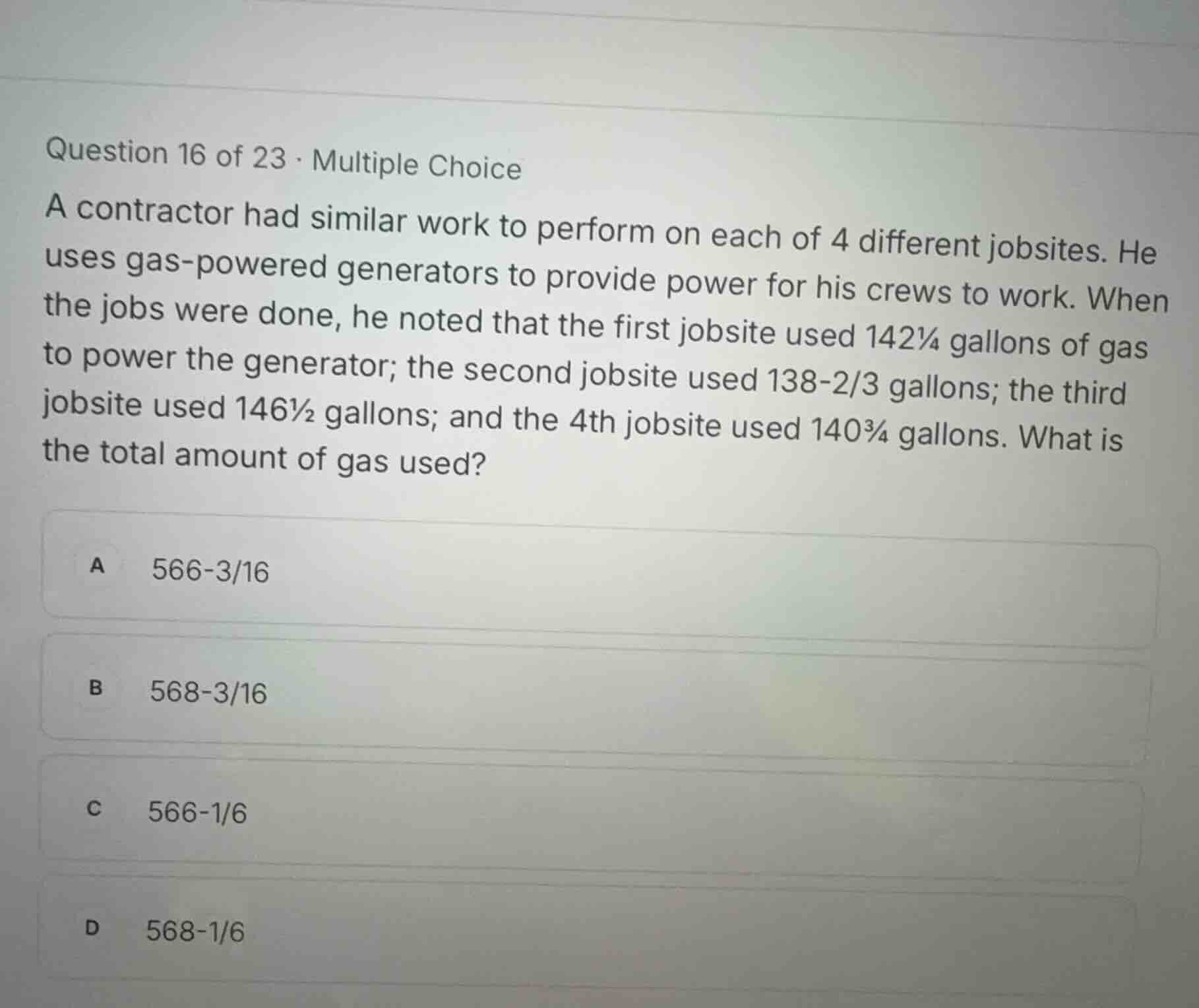
a contractor had similar work to perform on each of 4 different jobsites. he uses gas-powered generators to provide power for his crews to work. when the jobs were done, he noted that the first jobsite used \\(142\frac{1}{4}\\) gallons of gas to power the generator; the second jobsite used 138-2/3 gallons; the third jobsite used \\(146\frac{1}{2}\\) gallons; and the 4th jobsite used \\(140\frac{3}{4}\\) gallons. what is the total amount of gas used?
a 566-3/16
b 568-3/16
c 566-1/6
d 568-1/6
<pre_analysis>
{
"quality": "clear",
"question_count": 1,
"skills_matched": [
"step_cot",
"multiple_choice_formatter",
"explain_then_answer",
"tutor"
],
"needs_drawing": false,
"concepts_used": [
"Fraction Arithmetic",
"Fraction Word Problems"
],
"new_concepts": [
"Mixed Numbers Addition"
],
"current_concepts": [
"Fraction Arithmetic",
"Fraction Word Problems",
"Mixed Numbers Addition"
]
}
</pre_analysis>
<reasoning>
Identify the given values and operation
We need to find the total amount of gas used across 4 jobsites. This requires adding the mixed numbers representing the gas used at each site.
Using the Fraction Word Problems knowledge point, we set up the sum:
\[
\text{Total} = 142\frac{1}{4} + 138\frac{2}{3} + 146\frac{1}{2} + 140\frac{3}{4}
\]
Add the whole numbers
Using the Fraction Arithmetic knowledge point, we first sum the whole number parts:
\[
142 + 138 + 146 + 140 = 566
\]
Add the fractional parts
Next, we find a common denominator for the fractions: \(\frac{1}{4}\), \(\frac{2}{3}\), \(\frac{1}{2}\), and \(\frac{3}{4}\). The least common multiple of 4, 3, and 2 is 12.
Convert each fraction:
\[
\frac{1}{4} = \frac{3}{12}
\]
\[
\frac{2}{3} = \frac{8}{12}
\]
\[
\frac{1}{2} = \frac{6}{12}
\]
\[
\frac{3}{4} = \frac{9}{12}
\]
Now, sum these converted fractions:
\[
\frac{3}{12} + \frac{8}{12} + \frac{6}{12} + \frac{9}{12} = \frac{26}{12}
\]
Simplify the fractional sum
Convert the improper fraction \(\frac{26}{12}\) into a mixed number:
\[
\frac{26}{12} = 2\frac{2}{12} = 2\frac{1}{6}
\]
Combine whole numbers and fractions
Add the sum of the whole numbers and the simplified fractional sum:
\[
566 + 2\frac{1}{6} = 568\frac{1}{6}
\]
This matches option D.
Note on Option B (\(568\frac{3}{16}\)): A common mistake leading to Option B is adding the numerators directly and adding the denominators directly without finding a common denominator:
\[
\frac{1+2+1+3}{4+3+2+4} = \frac{7}{13} \approx \frac{3}{16}
\]
Alternatively, if a student incorrectly adds the numerators \(1 + 2 + 1 + 3 = 7\) and incorrectly adds the denominators \(4 + 3 + 2 + 4 = 13\), or makes a similar error in combining the fractional parts, they might arrive at a fraction near \(\frac{3}{16}\) while correctly carrying over the \(2\) to get \(568\).
</reasoning>
<answer>
<mcq-option>(A) \(566\text{-}3/16\)</mcq-option>
<mcq-option>(B) \(568\text{-}3/16\)</mcq-option>
<mcq-option>(C) \(566\text{-}1/6\)</mcq-option>
<mcq-correct>(D) \(568\text{-}1/6\)</mcq-correct>
</answer>
<post_analysis>
{
"subject": "Mathematics",
"question_type": "Multiple Choice",
"knowledge_point": [
"Mathematics",
"Arithmetic",
"Fraction Arithmetic"
]
}
</post_analysis>
Snap & solve any problem in the app
Get step-by-step solutions on Sovi AI
Photo-based solutions with guided steps
Explore more problems and detailed explanations
<pre_analysis>
{
"quality": "clear",
"question_count": 1,
"skills_matched": [
"step_cot",
"multiple_choice_formatter",
"explain_then_answer",
"tutor"
],
"needs_drawing": false,
"concepts_used": [
"Fraction Arithmetic",
"Fraction Word Problems"
],
"new_concepts": [
"Mixed Numbers Addition"
],
"current_concepts": [
"Fraction Arithmetic",
"Fraction Word Problems",
"Mixed Numbers Addition"
]
}
</pre_analysis>
<reasoning>
Identify the given values and operation
We need to find the total amount of gas used across 4 jobsites. This requires adding the mixed numbers representing the gas used at each site.
Using the Fraction Word Problems knowledge point, we set up the sum:
\[
\text{Total} = 142\frac{1}{4} + 138\frac{2}{3} + 146\frac{1}{2} + 140\frac{3}{4}
\]
Add the whole numbers
Using the Fraction Arithmetic knowledge point, we first sum the whole number parts:
\[
142 + 138 + 146 + 140 = 566
\]
Add the fractional parts
Next, we find a common denominator for the fractions: \(\frac{1}{4}\), \(\frac{2}{3}\), \(\frac{1}{2}\), and \(\frac{3}{4}\). The least common multiple of 4, 3, and 2 is 12.
Convert each fraction:
\[
\frac{1}{4} = \frac{3}{12}
\]
\[
\frac{2}{3} = \frac{8}{12}
\]
\[
\frac{1}{2} = \frac{6}{12}
\]
\[
\frac{3}{4} = \frac{9}{12}
\]
Now, sum these converted fractions:
\[
\frac{3}{12} + \frac{8}{12} + \frac{6}{12} + \frac{9}{12} = \frac{26}{12}
\]
Simplify the fractional sum
Convert the improper fraction \(\frac{26}{12}\) into a mixed number:
\[
\frac{26}{12} = 2\frac{2}{12} = 2\frac{1}{6}
\]
Combine whole numbers and fractions
Add the sum of the whole numbers and the simplified fractional sum:
\[
566 + 2\frac{1}{6} = 568\frac{1}{6}
\]
This matches option D.
Note on Option B (\(568\frac{3}{16}\)): A common mistake leading to Option B is adding the numerators directly and adding the denominators directly without finding a common denominator:
\[
\frac{1+2+1+3}{4+3+2+4} = \frac{7}{13} \approx \frac{3}{16}
\]
Alternatively, if a student incorrectly adds the numerators \(1 + 2 + 1 + 3 = 7\) and incorrectly adds the denominators \(4 + 3 + 2 + 4 = 13\), or makes a similar error in combining the fractional parts, they might arrive at a fraction near \(\frac{3}{16}\) while correctly carrying over the \(2\) to get \(568\).
</reasoning>
<answer>
<mcq-option>(A) \(566\text{-}3/16\)</mcq-option>
<mcq-option>(B) \(568\text{-}3/16\)</mcq-option>
<mcq-option>(C) \(566\text{-}1/6\)</mcq-option>
<mcq-correct>(D) \(568\text{-}1/6\)</mcq-correct>
</answer>
<post_analysis>
{
"subject": "Mathematics",
"question_type": "Multiple Choice",
"knowledge_point": [
"Mathematics",
"Arithmetic",
"Fraction Arithmetic"
]
}
</post_analysis>