QUESTION IMAGE
Question
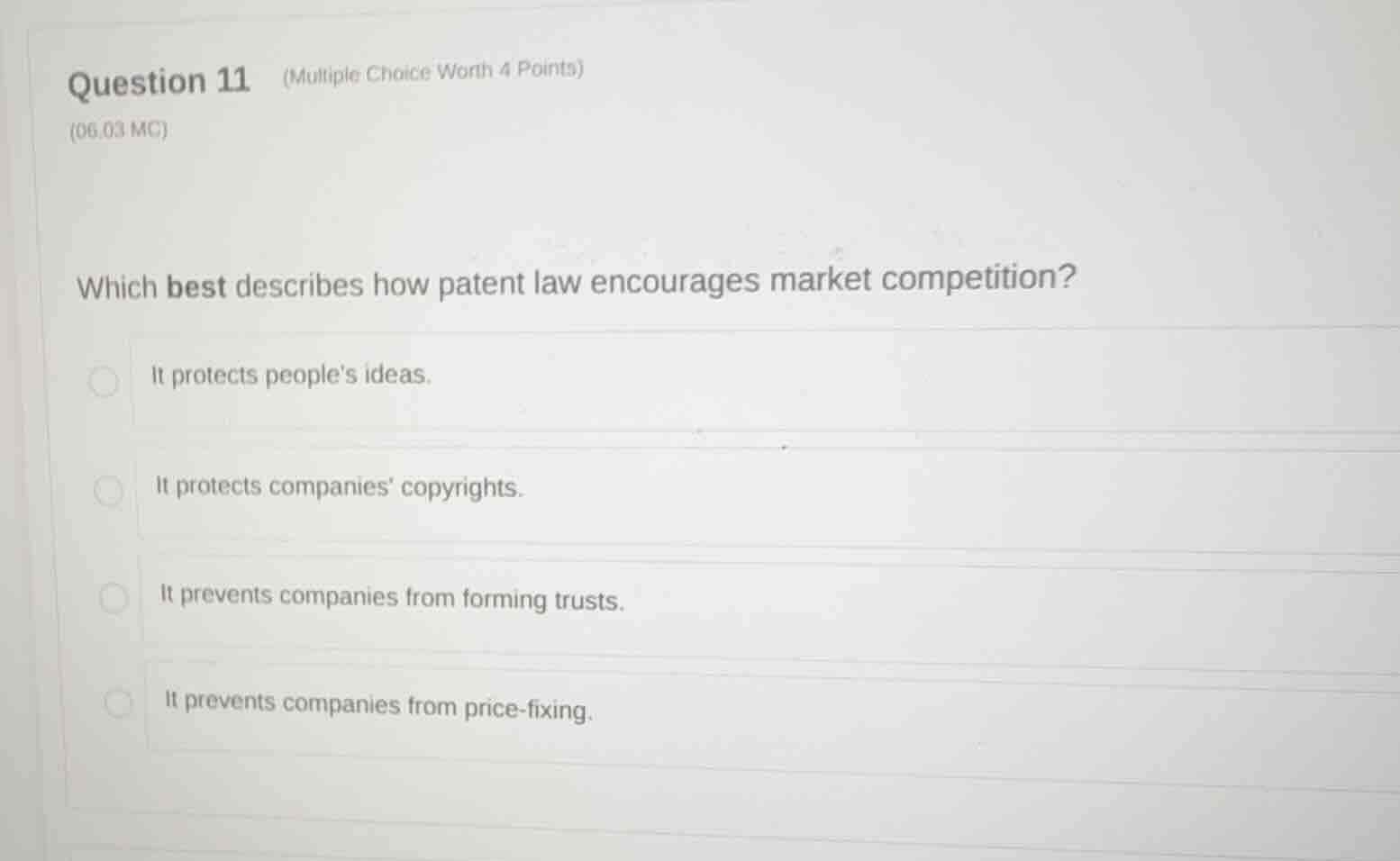
question 11 (multiple choice worth 4 points)
(06.03 mc)
which best describes how patent law encourages market competition?
it protects peoples ideas.
it protects companies copyrights.
it prevents companies from forming trusts.
it prevents companies from price-fixing.
<pre_analysis>
{
"quality": "clear",
"question_count": 1,
"skills_matched": [
"direct_cot",
"multiple_choice_formatter",
"explain_then_answer",
"tutor"
],
"needs_drawing": false,
"concepts_used": [],
"new_concepts": [
"Patent Law",
"Market Competition",
"Intellectual Property"
],
"current_concepts": [
"Patent Law",
"Market Competition",
"Intellectual Property"
]
}
</pre_analysis>
<reasoning>
Analyze the core question
The question asks how patent law encourages market competition. Patent law is a branch of intellectual property law that grants inventors exclusive rights to their inventions for a limited period.
Evaluate the first option
The first option states, "It protects people's ideas." Patents protect functional inventions, designs, and processes (intellectual property/ideas) from being copied without permission. By securing these property rights, individuals and companies are incentivized to invest in research and development, knowing their innovations are legally protected. This drives innovation and competitive development in the market.
Evaluate the second option
The second option states, "It protects companies' copyrights." Copyrights and patents are distinct forms of intellectual property protection. Copyrights protect original works of authorship (like literature, music, and art), whereas patent law specifically protects inventions and discoveries. Therefore, patent law does not protect copyrights.
Evaluate the third and fourth options
The third option ("It prevents companies from forming trusts") and the fourth option ("It prevents companies from price-fixing") describe functions of antitrust laws (such as the Sherman Antitrust Act), not patent laws. Patent laws actually grant a temporary legal monopoly over an invention, which is distinct from antitrust regulations that prevent anti-competitive behaviors like trusts and price-fixing.
Synthesize the final conclusion
The primary mechanism by which patent law fosters a competitive market is by protecting inventors' ideas and creations, which encourages continuous innovation and market entry by new competitors.
</reasoning>
<answer>
<mcq-correct>It protects people's ideas.</mcq-correct>
<mcq-option>It protects companies' copyrights.</mcq-option>
<mcq-option>It prevents companies from forming trusts.</mcq-option>
<mcq-option>It prevents companies from price-fixing.</mcq-option>
</answer>
<post_analysis>
{
"subject": "Social Science",
"question_type": "Multiple Choice",
"knowledge_point": [
"Social Science",
"Economics",
"Patent Law"
]
}
</post_analysis>
Snap & solve any problem in the app
Get step-by-step solutions on Sovi AI
Photo-based solutions with guided steps
Explore more problems and detailed explanations
<pre_analysis>
{
"quality": "clear",
"question_count": 1,
"skills_matched": [
"direct_cot",
"multiple_choice_formatter",
"explain_then_answer",
"tutor"
],
"needs_drawing": false,
"concepts_used": [],
"new_concepts": [
"Patent Law",
"Market Competition",
"Intellectual Property"
],
"current_concepts": [
"Patent Law",
"Market Competition",
"Intellectual Property"
]
}
</pre_analysis>
<reasoning>
Analyze the core question
The question asks how patent law encourages market competition. Patent law is a branch of intellectual property law that grants inventors exclusive rights to their inventions for a limited period.
Evaluate the first option
The first option states, "It protects people's ideas." Patents protect functional inventions, designs, and processes (intellectual property/ideas) from being copied without permission. By securing these property rights, individuals and companies are incentivized to invest in research and development, knowing their innovations are legally protected. This drives innovation and competitive development in the market.
Evaluate the second option
The second option states, "It protects companies' copyrights." Copyrights and patents are distinct forms of intellectual property protection. Copyrights protect original works of authorship (like literature, music, and art), whereas patent law specifically protects inventions and discoveries. Therefore, patent law does not protect copyrights.
Evaluate the third and fourth options
The third option ("It prevents companies from forming trusts") and the fourth option ("It prevents companies from price-fixing") describe functions of antitrust laws (such as the Sherman Antitrust Act), not patent laws. Patent laws actually grant a temporary legal monopoly over an invention, which is distinct from antitrust regulations that prevent anti-competitive behaviors like trusts and price-fixing.
Synthesize the final conclusion
The primary mechanism by which patent law fosters a competitive market is by protecting inventors' ideas and creations, which encourages continuous innovation and market entry by new competitors.
</reasoning>
<answer>
<mcq-correct>It protects people's ideas.</mcq-correct>
<mcq-option>It protects companies' copyrights.</mcq-option>
<mcq-option>It prevents companies from forming trusts.</mcq-option>
<mcq-option>It prevents companies from price-fixing.</mcq-option>
</answer>
<post_analysis>
{
"subject": "Social Science",
"question_type": "Multiple Choice",
"knowledge_point": [
"Social Science",
"Economics",
"Patent Law"
]
}
</post_analysis>