QUESTION IMAGE
Question
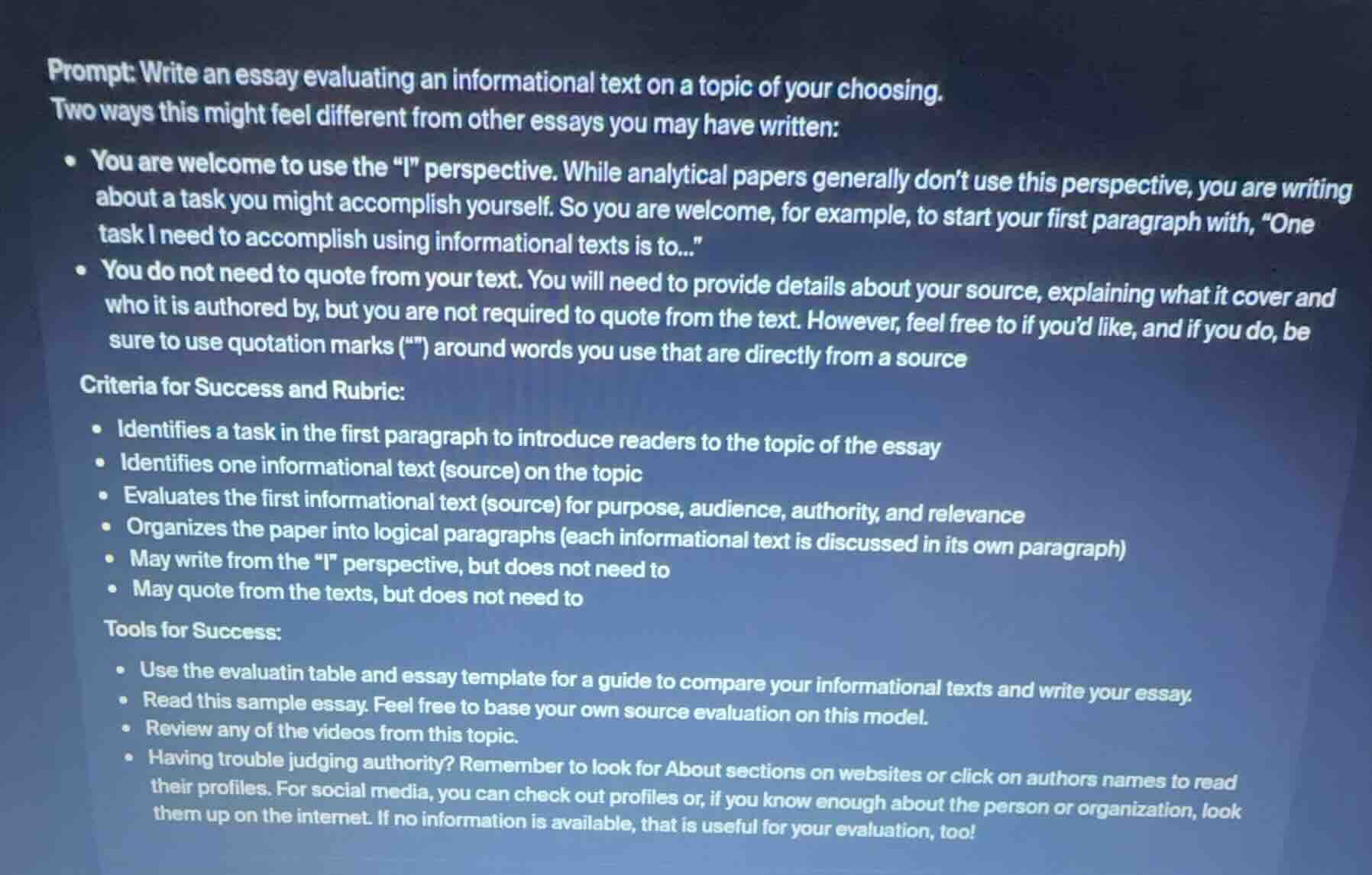
prompt: write an essay evaluating an informational text on a topic of your choosing.
two ways this might feel different from other essays you may have written:
- you are welcome to use the \i\ perspective. while analytical papers generally dont use this perspective, you are writing about a task you might accomplish yourself. so you are welcome, for example, to start your first paragraph with, \one task i need to accomplish using informational texts is to...\
- you do not need to quote from your text. you will need to provide details about your source, explaining what it cover and who it is authored by, but you are not required to quote from the text. however, feel free to if youd like, and if you do, be sure to use quotation marks (\\) around words you use that are directly from a source
criteria for success and rubric:
- identifies a task in the first paragraph to introduce readers to the topic of the essay
- identifies one informational text (source) on the topic
- evaluates the first informational text (source) for purpose, audience, authority, and relevance
- organizes the paper into logical paragraphs (each informational text is discussed in its own paragraph)
- may write from the \i\ perspective, but does not need to
- may quote from the texts, but does not need to
tools for success:
- use the evaluatin table and essay template for a guide to compare your informational texts and write your essay.
- read this sample essay. feel free to base your own source evaluation on this model.
- review any of the videos from this topic.
- having trouble judging authority? remember to look for about sections on websites or click on authors names to read their profiles. for social media, you can check out profiles or, if you know enough about the person or organization, look them up on the internet. if no information is available, that is useful for your evaluation, too!
Analyze the essay prompt requirements
The prompt asks you to write an essay evaluating an informational text on a topic of your choosing. It highlights two unique aspects:
- You can use the first-person ("I") perspective to describe a task you want to accomplish.
- Direct quotes are optional, but you must provide specific details about the source (its coverage and authorship).
Break down the success criteria
To succeed, your essay must meet these key rubric points:
- First Paragraph: Introduce the topic by identifying a personal task you need to accomplish.
- Source Identification: Name one specific informational text (source) on that topic.
- Evaluation: Assess the source's purpose, audience, authority, and relevance.
- Organization: Structure the paper logically, using separate paragraphs for distinct discussions.
Select a sample topic and source
To provide a concrete, practical guide, we will use a common high school research scenario:
- Task: Learning how to identify reliable scientific information online.
- Source: "How to Read and Understand a Scientific Paper: A Guide for Non-Scientists" by Jennifer Raff.
- Evaluation Elements:
- Purpose: To demystify scientific literature for laypeople.
- Audience: Non-scientists, students, and educators.
- Authority: Written by an anthropologist and university professor.
- Relevance: Highly relevant for building academic research skills.
Draft the introductory paragraph
Start with the "I" perspective to introduce the task:
"One task I need to accomplish using informational texts is to learn how to effectively evaluate scientific claims made in popular media. Because online articles often sensationalize research, I want to develop a systematic method to read original scientific studies myself."
Draft the evaluation paragraph
Identify and evaluate the source based on the rubric:
"To help with this task, I read 'How to Read and Understand a Scientific Paper: A Guide for Non-Scientists' by Dr. Jennifer Raff. The purpose of Raff's text is to provide a step-by-step guide for laypeople to comprehend dense academic studies without being misled by media summaries. Her target audience is students and curious non-specialists who lack formal scientific training. Dr. Raff possesses strong authority on this topic, as she is an Associate Professor of Anthropology at the University of Kansas and an active researcher. This source is highly relevant to my goal because it outlines practical strategies—such as reading the introduction and methodology before looking at the results—which directly helps me accomplish my task of analyzing scientific claims independently."

Snap & solve any problem in the app
Get step-by-step solutions on Sovi AI
Photo-based solutions with guided steps
Explore more problems and detailed explanations
Here is a complete sample essay written in strict accordance with the provided prompt, rubric, and guidelines:
Sample Essay: Evaluating an Informational Source
One task I need to accomplish using informational texts is to learn how to effectively evaluate scientific claims made in popular media. Because online articles often sensationalize or misinterpret research findings, I want to develop a systematic method to read and analyze original scientific studies myself so that I can make informed decisions about health and technology.
To help with this task, I read the informational guide "How to Read and Understand a Scientific Paper: A Guide for Non-Scientists" by Dr. Jennifer Raff. The primary purpose of Raff's text is to demystify academic literature by providing a clear, step-by-step reading strategy for laypeople. Her target audience includes high school and college students, educators, and curious citizens who lack formal scientific training but want to engage with primary sources. Dr. Raff possesses excellent authority to write on this topic; she is an Associate Professor of Anthropology at the University of Kansas and a practicing scientist who regularly publishes peer-reviewed research. This source is highly relevant to my goal because it outlines practical, actionable strategies—such as reading the methodology section before looking at the authors' conclusions—which directly helps me accomplish my task of analyzing scientific claims independently.