QUESTION IMAGE
Question
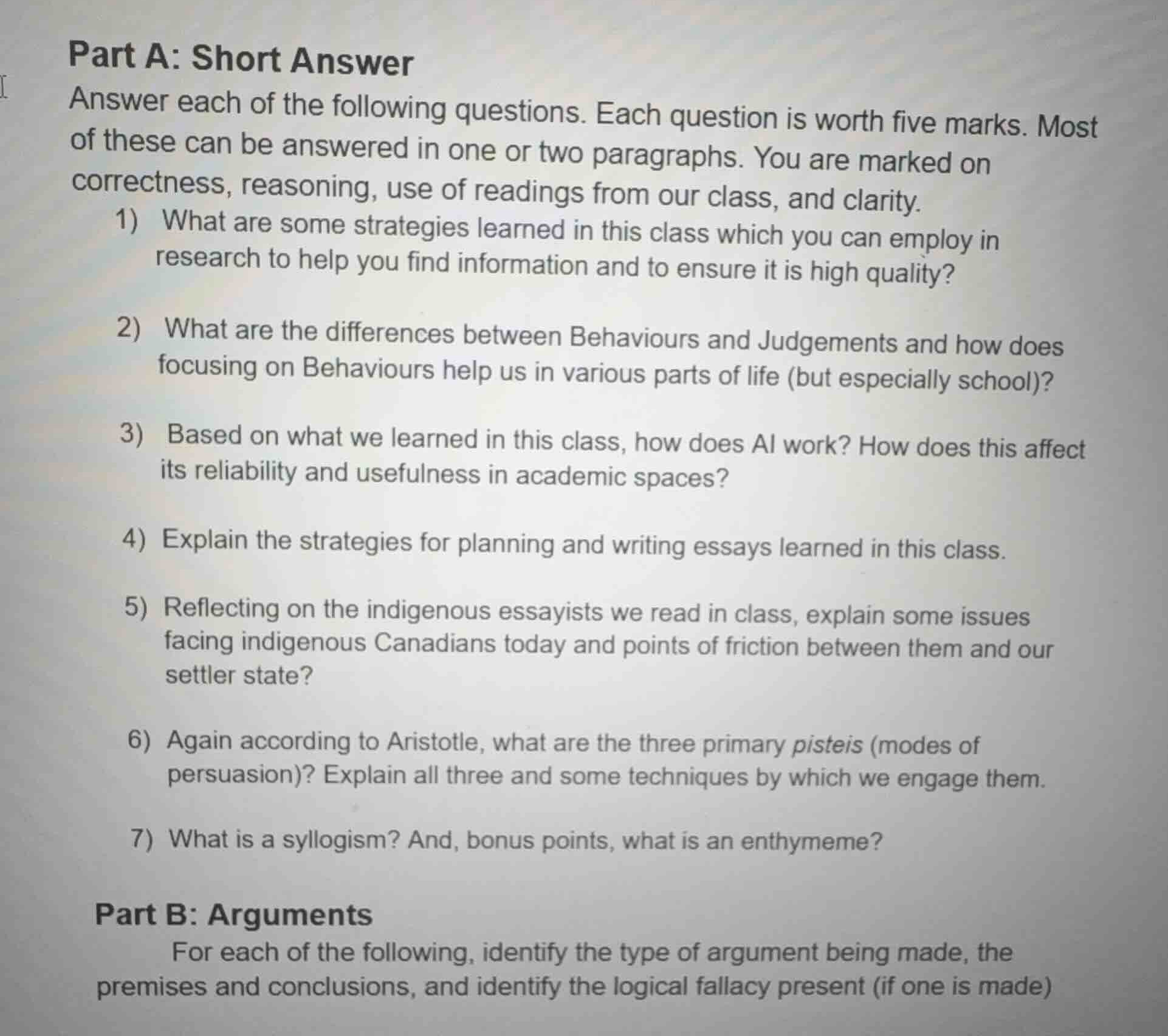
part a: short answer
answer each of the following questions. each question is worth five marks. most of these can be answered in one or two paragraphs. you are marked on correctness, reasoning, use of readings from our class, and clarity.
- what are some strategies learned in this class which you can employ in research to help you find information and to ensure it is high quality?
- what are the differences between behaviours and judgements and how does focusing on behaviours help us in various parts of life (but especially school)?
- based on what we learned in this class, how does ai work? how does this affect its reliability and usefulness in academic spaces?
- explain the strategies for planning and writing essays learned in this class.
- reflecting on the indigenous essayists we read in class, explain some issues facing indigenous canadians today and points of friction between them and our settler state?
- again according to aristotle, what are the three primary pisteis (modes of persuasion)? explain all three and some techniques by which we engage them.
- what is a syllogism? and, bonus points, what is an enthymeme?
part b: arguments
for each of the following, identify the type of argument being made, the premises and conclusions, and identify the logical fallacy present (if one is made)
Academic Research and Quality Evaluation
To find high-quality academic information, researchers employ systematic search strategies and evaluation frameworks. Key strategies include:
- Database Filtering: Utilizing academic databases (such as Google Scholar, JSTOR, or university library catalogs) and applying boolean operators (AND, OR, NOT) to refine search results.
- The CRAAP Test: Evaluating sources based on Currency (timeliness), Relevance (importance to your needs), Authority (source of the information), Accuracy (reliability and truthfulness), and Purpose (reason the information exists).
- Peer Review Verification: Prioritizing articles published in peer-reviewed journals, ensuring the research has been vetted by independent experts in the field.
Behaviours vs. Judgements
Understanding the distinction between objective behaviors and subjective judgments is crucial for personal development and academic success:
- Differences: Behaviours are observable, measurable, and objective actions (e.g., "arrived 10 minutes after the class started"). Judgements are subjective interpretations, evaluations, or labels applied to those actions (e.g., "lazy" or "unprofessional").
- Application in Life and School: Focusing on behaviors allows for constructive, actionable feedback. In school, instead of judging oneself as "bad at writing," focusing on the behavior ("I need to spend two hours outlining my essay") leads to concrete improvement, reduces emotional defensiveness, and fosters a growth mindset.
AI Mechanics and Academic Reliability
Artificial Intelligence, particularly Large Language Models (LLMs), operates on specific computational principles that impact its academic utility:
- How AI Works: Modern generative AI works by identifying statistical patterns in massive datasets of human language. It predicts the most probable next word or sequence of words based on the prompt provided, rather than "understanding" or "knowing" facts in a human sense.
- Academic Reliability and Usefulness: Because AI predicts probability rather than verifying truth, it is prone to "hallucinations" (generating plausible-sounding but entirely fabricated facts, citations, or sources). While highly useful for brainstorming, structuring, or proofreading, its lack of factual verification makes it unreliable as a primary source of academic truth without rigorous cross-referencing.
Essay Planning and Writing Strategies
A structured approach to essay writing ensures clarity, logical flow, and academic rigor:
- Planning Phase:
- Deconstructing the Prompt: Identifying key task words (e.g., analyze, compare, evaluate).
- Brainstorming and Outlining: Creating a thesis statement and mapping out a structural outline (e.g., introduction, body paragraphs with evidence, conclusion) before writing.
- Writing Phase:
- The MEAL/TEEL Structure: Structuring body paragraphs around a Main/Topic sentence, Evidence/Explanation, Analysis, and a Link back to the thesis.
- Drafting and Revision: Writing a messy first dr…

Snap & solve any problem in the app
Get step-by-step solutions on Sovi AI
Photo-based solutions with guided steps
Explore more problems and detailed explanations
Question 1
To find high-quality information, employ strategies such as searching academic databases using boolean operators, applying the CRAAP Test (evaluating Currency, Relevance, Authority, Accuracy, and Purpose), and prioritizing peer-reviewed scholarly sources.
Question 2
Behaviours are objective, observable actions, whereas judgements are subjective evaluations or labels. Focusing on behaviors in school helps reduce emotional defensiveness and provides clear, actionable steps for academic improvement (e.g., focusing on study hours rather than labeling oneself "bad at studying").
Question 3
Generative AI works by predicting the most statistically probable next word based on patterns in its training data, rather than understanding facts. This limits its academic reliability because it can generate plausible-sounding but false information ("hallucinations"), making it useful for brainstorming but unreliable as a primary source without independent verification.
Question 4
Effective essay strategies include a planning phase (deconstructing the prompt, formulating a clear thesis, and outlining the structure) and a writing phase (using structured body paragraphs like the TEEL/MEAL framework, drafting freely, and revising in separate stages for structure and grammar).
Question 5
Key issues facing Indigenous Canadians include systemic inequalities, intergenerational trauma, and lack of clean drinking water on reserves. Points of friction with the settler state center on land sovereignty, resource extraction on unceded territories, and the slow pace of implementing the Truth and Reconciliation Commission's Calls to Action.
Question 6
The three primary pisteis are:
- Ethos (Credibility): Engaged by demonstrating expertise, using professional tone, and citing reliable sources.
- Pathos (Emotion): Engaged by using vivid narratives, metaphors, and emotional appeals.
- Logos (Logic): Engaged by presenting data, facts, and structured deductive or inductive arguments.
Question 7
A syllogism is a formal three-part deductive argument consisting of a major premise, a minor premise, and a necessary conclusion (e.g., "All men are mortal; Socrates is a man; therefore, Socrates is mortal").
An enthymeme is an informal rhetorical syllogism in which one of the premises is left unstated because it is assumed to be implicitly understood by the audience (e.g., "Socrates is mortal because he is human").