Sovi.AI - AI Math Tutor

Scan to solve math questions

QUESTION IMAGE

part a according to \seven steps to surviving a disaster,\ which step i…

Question

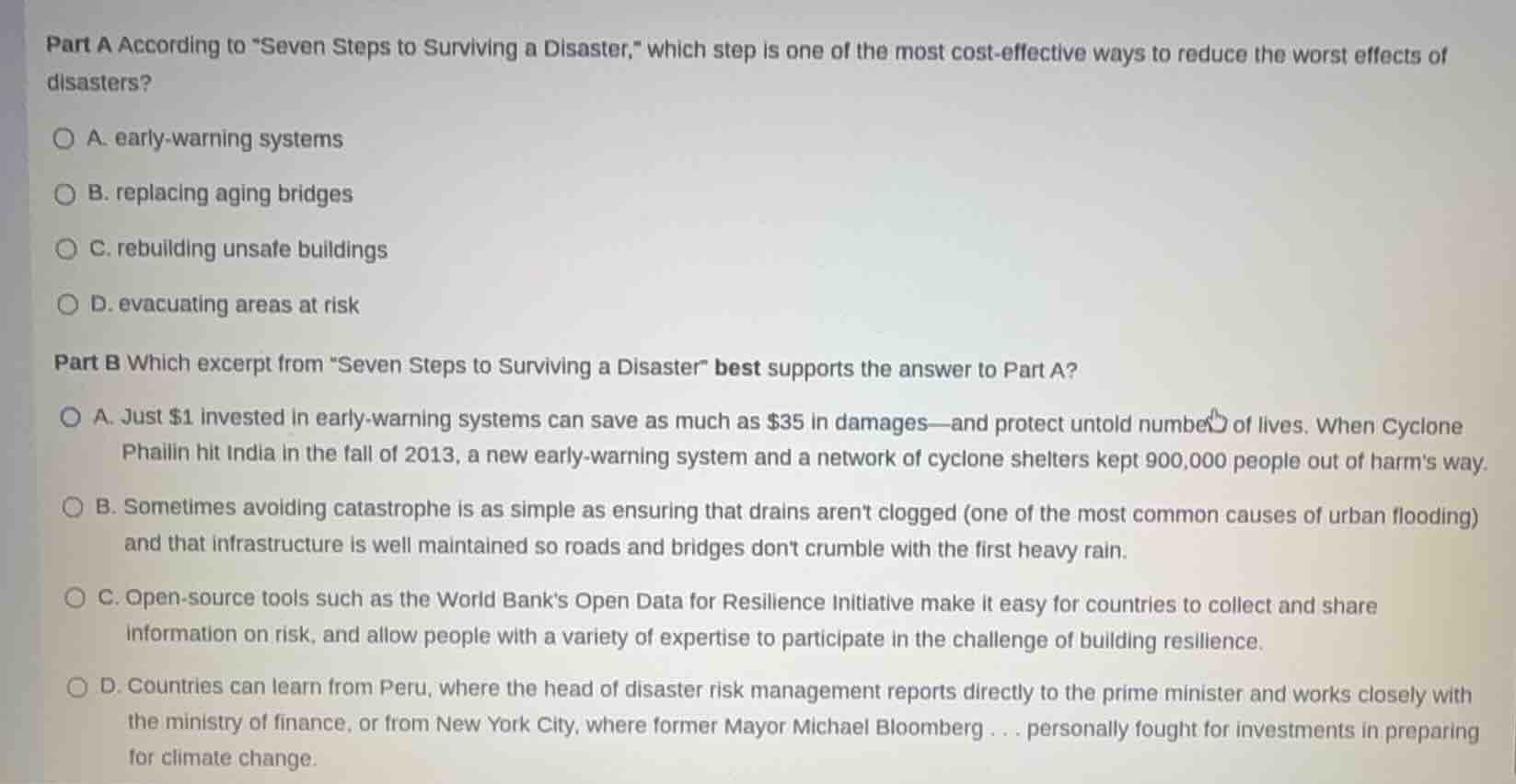
part a according to \seven steps to surviving a disaster,\ which step is one of the most cost-effective ways to reduce the worst effects of disasters?

a. early-warning systems
b. replacing aging bridges
c. rebuilding unsafe buildings
d. evacuating areas at risk

part b which excerpt from \seven steps to surviving a disaster\ best supports the answer to part a?

a. just \\$1 invested in early-warning systems can save as much as \\$35 in damages—and protect untold numbers of lives. when cyclone phailin hit india in the fall of 2013, a new early-warning system and a network of cyclone shelters kept 900,000 people out of harms way.
b. sometimes avoiding catastrophe is as simple as ensuring that drains arent clogged (one of the most common causes of urban flooding) and that infrastructure is well maintained so roads and bridges dont crumble with the first heavy rain.
c. open-source tools such as the world banks open data for resilience initiative make it easy for countries to collect and share information on risk, and allow people with a variety of expertise to participate in the challenge of building resilience.
d. countries can learn from peru, where the head of disaster risk management reports directly to the prime minister and works closely with the ministry of finance, or from new york city, where former mayor michael bloomberg... personally fought for investments in preparing for climate change.

Explanation:

Response

<pre_analysis>
{
"quality": "clear",
"question_count": 2,
"skills_matched": [
"direct_cot",
"multiple_choice_formatter",
"explain_then_answer",
"tutor",
"mastery_adaptive_brevity"
],
"needs_drawing": false,
"concepts_used": [
"Reading Comprehension",
"Textual Evidence",
"Disaster Preparedness"
],
"new_concepts": [],
"current_concepts": [
"Reading Comprehension",
"Textual Evidence",
"Disaster Preparedness"
]
}
</pre_analysis>

<reasoning>

Analyze Part A

Using the Reading Comprehension and Disaster Preparedness knowledge points, we look for the most cost-effective way to reduce disaster effects. Option A mentions early-warning systems, which directly corresponds to high financial returns on investment.

Analyze Part B

Using the Textual Evidence knowledge point, we find the quote that explicitly demonstrates cost-effectiveness. Option A states: "Just $1 invested in early-warning systems can save as much as $35 in damages," directly proving the cost-effectiveness of early-warning systems.
</reasoning>

<answer>

Question 1

<mcq-correct>A. early-warning systems</mcq-correct>
<mcq-option>B. replacing aging bridges</mcq-option>
<mcq-option>C. rebuilding unsafe buildings</mcq-option>
<mcq-option>D. evacuating areas at risk</mcq-option>

Question 2

<mcq-correct>A. Just $1 invested in early-warning systems can save as much as $35 in damages—and protect untold numbers of lives. When Cyclone Phailin hit India in the fall of 2013, a new early-warning system and a network of cyclone shelters kept 900,000 people out of harm's way.</mcq-correct>
<mcq-option>B. Sometimes avoiding catastrophe is as simple as ensuring that drains aren't clogged (one of the most common causes of urban flooding) and that infrastructure is well maintained so roads and bridges don't crumble with the first heavy rain.</mcq-option>
<mcq-option>C. Open-source tools such as the World Bank's Open Data for Resilience Initiative make it easy for countries to collect and share information on risk, and allow people with a variety of expertise to participate in the challenge of building resilience.</mcq-option>
<mcq-option>D. Countries can learn from Peru, where the head of disaster risk management reports directly to the prime minister and works closely with the ministry of finance, or from New York City, where former Mayor Michael Bloomberg . . . personally fought for investments in preparing for climate change.</mcq-option>
</answer>

<post_analysis>
{
"subject": "Social Science",
"question_type": "Multiple Choice",
"knowledge_point": [
"Social Science",
"Geography",
"Disaster Preparedness"
]
}
</post_analysis>

Answer:

<pre_analysis>
{
"quality": "clear",
"question_count": 2,
"skills_matched": [
"direct_cot",
"multiple_choice_formatter",
"explain_then_answer",
"tutor",
"mastery_adaptive_brevity"
],
"needs_drawing": false,
"concepts_used": [
"Reading Comprehension",
"Textual Evidence",
"Disaster Preparedness"
],
"new_concepts": [],
"current_concepts": [
"Reading Comprehension",
"Textual Evidence",
"Disaster Preparedness"
]
}
</pre_analysis>

<reasoning>

Analyze Part A

Using the Reading Comprehension and Disaster Preparedness knowledge points, we look for the most cost-effective way to reduce disaster effects. Option A mentions early-warning systems, which directly corresponds to high financial returns on investment.

Analyze Part B

Using the Textual Evidence knowledge point, we find the quote that explicitly demonstrates cost-effectiveness. Option A states: "Just $1 invested in early-warning systems can save as much as $35 in damages," directly proving the cost-effectiveness of early-warning systems.
</reasoning>

<answer>

Question 1

<mcq-correct>A. early-warning systems</mcq-correct>
<mcq-option>B. replacing aging bridges</mcq-option>
<mcq-option>C. rebuilding unsafe buildings</mcq-option>
<mcq-option>D. evacuating areas at risk</mcq-option>

Question 2

<mcq-correct>A. Just $1 invested in early-warning systems can save as much as $35 in damages—and protect untold numbers of lives. When Cyclone Phailin hit India in the fall of 2013, a new early-warning system and a network of cyclone shelters kept 900,000 people out of harm's way.</mcq-correct>
<mcq-option>B. Sometimes avoiding catastrophe is as simple as ensuring that drains aren't clogged (one of the most common causes of urban flooding) and that infrastructure is well maintained so roads and bridges don't crumble with the first heavy rain.</mcq-option>
<mcq-option>C. Open-source tools such as the World Bank's Open Data for Resilience Initiative make it easy for countries to collect and share information on risk, and allow people with a variety of expertise to participate in the challenge of building resilience.</mcq-option>
<mcq-option>D. Countries can learn from Peru, where the head of disaster risk management reports directly to the prime minister and works closely with the ministry of finance, or from New York City, where former Mayor Michael Bloomberg . . . personally fought for investments in preparing for climate change.</mcq-option>
</answer>

<post_analysis>
{
"subject": "Social Science",
"question_type": "Multiple Choice",
"knowledge_point": [
"Social Science",
"Geography",
"Disaster Preparedness"
]
}
</post_analysis>