QUESTION IMAGE
Question
multiple choice question
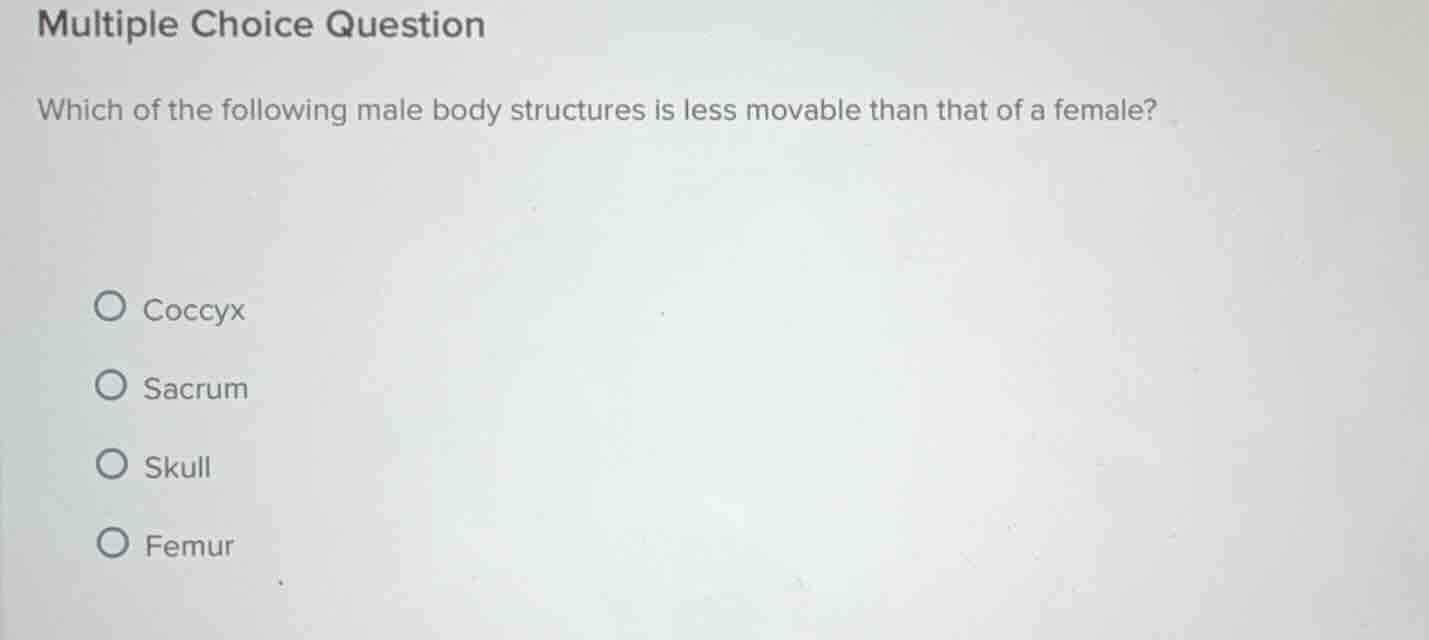
which of the following male body structures is less movable than that of a female?
coccyx
sacrum
skull
femur
<pre_analysis>
{
"quality": "clear",
"question_count": 1,
"skills_matched": [
"direct_cot",
"multiple_choice_formatter",
"explain_then_answer",
"tutor",
"mastery_adaptive_brevity"
],
"needs_drawing": false,
"concepts_used": [
"Pelvic Sexual Dimorphism",
"Male Pelvis Anatomy"
],
"new_concepts": [],
"current_concepts": [
"Pelvic Sexual Dimorphism",
"Male Pelvis Anatomy",
"Skeletal Anatomy"
]
}
</pre_analysis>
<reasoning>
Analyze skeletal differences between sexes
Using the Pelvic Sexual Dimorphism and Male Pelvis Anatomy knowledge points
- The female pelvis is adapted for childbirth, requiring a wider and more flexible birth canal.
- The female coccyx is more movable and tilts posteriorly during parturition to increase the pelvic outlet.
- In males, the coccyx is less movable, more rigid, and curves more anteriorly into the pelvic cavity.
Evaluate the given options
Using the Pelvic Sexual Dimorphism knowledge point
- Coccyx: Less movable in males than in females to accommodate childbirth in females.
- Sacrum: While shaped differently (narrower and more curved in males), mobility differences primarily affect the coccyx.
- Skull: Immovable fibrous joints (sutures) in both sexes.
- Femur: Synovial joint mobility at the hip is comparable, not structurally restricted by sex in this manner.
</reasoning>
<answer>
<mcq-correct>Coccyx</mcq-correct>
<mcq-option>Sacrum</mcq-option>
<mcq-option>Skull</mcq-option>
<mcq-option>Femur</mcq-option>
</answer>
<post_analysis>
{
"subject": "Natural Science",
"question_type": "Multiple Choice",
"knowledge_point": [
"Natural Science",
"Anatomy",
"Pelvic Sexual Dimorphism"
]
}
</post_analysis>
Snap & solve any problem in the app
Get step-by-step solutions on Sovi AI
Photo-based solutions with guided steps
Explore more problems and detailed explanations
<pre_analysis>
{
"quality": "clear",
"question_count": 1,
"skills_matched": [
"direct_cot",
"multiple_choice_formatter",
"explain_then_answer",
"tutor",
"mastery_adaptive_brevity"
],
"needs_drawing": false,
"concepts_used": [
"Pelvic Sexual Dimorphism",
"Male Pelvis Anatomy"
],
"new_concepts": [],
"current_concepts": [
"Pelvic Sexual Dimorphism",
"Male Pelvis Anatomy",
"Skeletal Anatomy"
]
}
</pre_analysis>
<reasoning>
Analyze skeletal differences between sexes
Using the Pelvic Sexual Dimorphism and Male Pelvis Anatomy knowledge points
- The female pelvis is adapted for childbirth, requiring a wider and more flexible birth canal.
- The female coccyx is more movable and tilts posteriorly during parturition to increase the pelvic outlet.
- In males, the coccyx is less movable, more rigid, and curves more anteriorly into the pelvic cavity.
Evaluate the given options
Using the Pelvic Sexual Dimorphism knowledge point
- Coccyx: Less movable in males than in females to accommodate childbirth in females.
- Sacrum: While shaped differently (narrower and more curved in males), mobility differences primarily affect the coccyx.
- Skull: Immovable fibrous joints (sutures) in both sexes.
- Femur: Synovial joint mobility at the hip is comparable, not structurally restricted by sex in this manner.
</reasoning>
<answer>
<mcq-correct>Coccyx</mcq-correct>
<mcq-option>Sacrum</mcq-option>
<mcq-option>Skull</mcq-option>
<mcq-option>Femur</mcq-option>
</answer>
<post_analysis>
{
"subject": "Natural Science",
"question_type": "Multiple Choice",
"knowledge_point": [
"Natural Science",
"Anatomy",
"Pelvic Sexual Dimorphism"
]
}
</post_analysis>