Sovi.AI - AI Math Tutor

Scan to solve math questions

QUESTION IMAGE

multiple choice question which of the following male body structures is…

Question

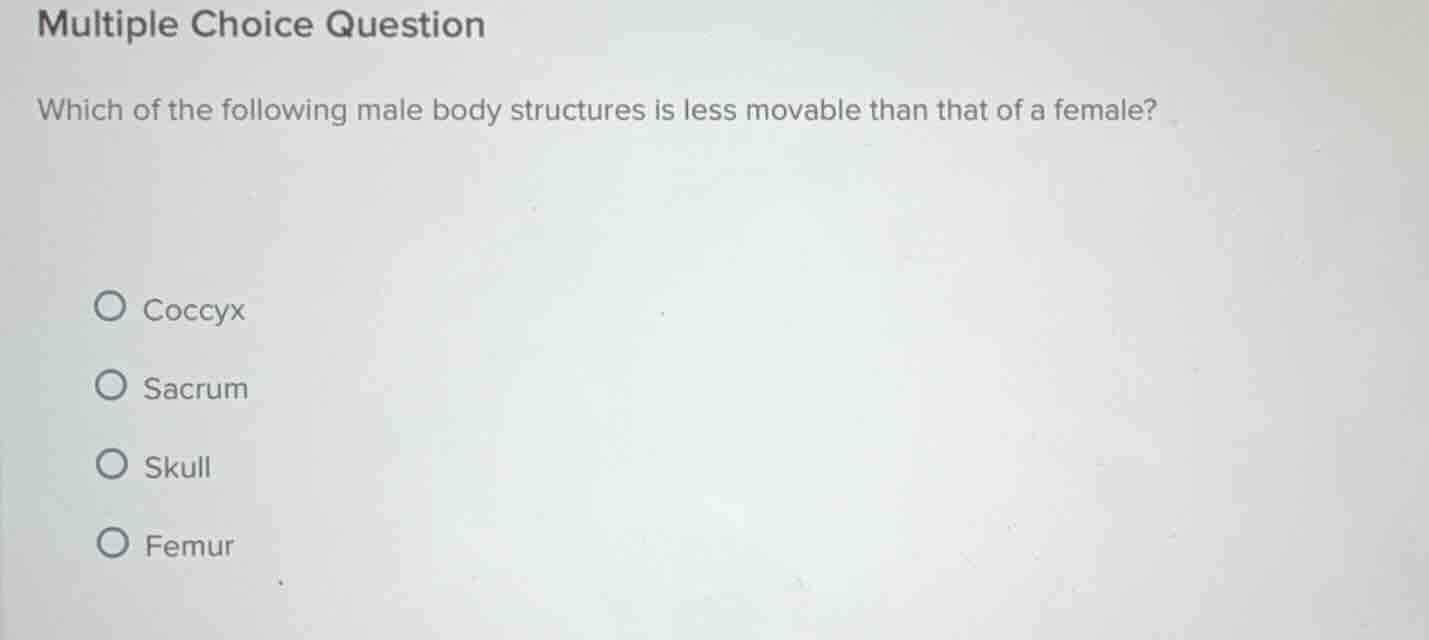
multiple choice question

which of the following male body structures is less movable than that of a female?

coccyx
sacrum
skull
femur

Explanation:

Response

<pre_analysis>
{
"quality": "clear",
"question_count": 1,
"skills_matched": [
"direct_cot",
"multiple_choice_formatter",
"explain_then_answer",
"tutor",
"mastery_adaptive_brevity"
],
"needs_drawing": false,
"concepts_used": [
"Pelvic Sexual Dimorphism",
"Male Pelvis Anatomy"
],
"new_concepts": [],
"current_concepts": [
"Pelvic Sexual Dimorphism",
"Male Pelvis Anatomy",
"Skeletal Anatomy"
]
}
</pre_analysis>

<reasoning>

Analyze skeletal differences between sexes

Using the Pelvic Sexual Dimorphism and Male Pelvis Anatomy knowledge points

  • The female pelvis is adapted for childbirth, requiring a wider and more flexible birth canal.
  • The female coccyx is more movable and tilts posteriorly during parturition to increase the pelvic outlet.
  • In males, the coccyx is less movable, more rigid, and curves more anteriorly into the pelvic cavity.

Evaluate the given options

Using the Pelvic Sexual Dimorphism knowledge point

  • Coccyx: Less movable in males than in females to accommodate childbirth in females.
  • Sacrum: While shaped differently (narrower and more curved in males), mobility differences primarily affect the coccyx.
  • Skull: Immovable fibrous joints (sutures) in both sexes.
  • Femur: Synovial joint mobility at the hip is comparable, not structurally restricted by sex in this manner.

</reasoning>

<answer>
<mcq-correct>Coccyx</mcq-correct>
<mcq-option>Sacrum</mcq-option>
<mcq-option>Skull</mcq-option>
<mcq-option>Femur</mcq-option>
</answer>

<post_analysis>
{
"subject": "Natural Science",
"question_type": "Multiple Choice",
"knowledge_point": [
"Natural Science",
"Anatomy",
"Pelvic Sexual Dimorphism"
]
}
</post_analysis>

Answer:

<pre_analysis>
{
"quality": "clear",
"question_count": 1,
"skills_matched": [
"direct_cot",
"multiple_choice_formatter",
"explain_then_answer",
"tutor",
"mastery_adaptive_brevity"
],
"needs_drawing": false,
"concepts_used": [
"Pelvic Sexual Dimorphism",
"Male Pelvis Anatomy"
],
"new_concepts": [],
"current_concepts": [
"Pelvic Sexual Dimorphism",
"Male Pelvis Anatomy",
"Skeletal Anatomy"
]
}
</pre_analysis>

<reasoning>

Analyze skeletal differences between sexes

Using the Pelvic Sexual Dimorphism and Male Pelvis Anatomy knowledge points

  • The female pelvis is adapted for childbirth, requiring a wider and more flexible birth canal.
  • The female coccyx is more movable and tilts posteriorly during parturition to increase the pelvic outlet.
  • In males, the coccyx is less movable, more rigid, and curves more anteriorly into the pelvic cavity.

Evaluate the given options

Using the Pelvic Sexual Dimorphism knowledge point

  • Coccyx: Less movable in males than in females to accommodate childbirth in females.
  • Sacrum: While shaped differently (narrower and more curved in males), mobility differences primarily affect the coccyx.
  • Skull: Immovable fibrous joints (sutures) in both sexes.
  • Femur: Synovial joint mobility at the hip is comparable, not structurally restricted by sex in this manner.

</reasoning>

<answer>
<mcq-correct>Coccyx</mcq-correct>
<mcq-option>Sacrum</mcq-option>
<mcq-option>Skull</mcq-option>
<mcq-option>Femur</mcq-option>
</answer>

<post_analysis>
{
"subject": "Natural Science",
"question_type": "Multiple Choice",
"knowledge_point": [
"Natural Science",
"Anatomy",
"Pelvic Sexual Dimorphism"
]
}
</post_analysis>