Sovi.AI - AI Math Tutor

Scan to solve math questions

QUESTION IMAGE

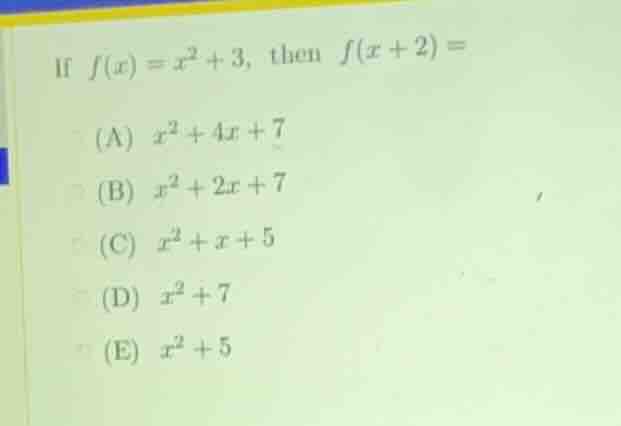
if \\(f(x) = x^2 + 3\\), then \\(f(x + 2) =\\) (a) \\(x^2 + 4x + 7\\) (…

Question

if \\(f(x) = x^2 + 3\\), then \\(f(x + 2) =\\)

(a) \\(x^2 + 4x + 7\\)
(b) \\(x^2 + 2x + 7\\)
(c) \\(x^2 + x + 5\\)
(d) \\(x^2 + 7\\)
(e) \\(x^2 + 5\\)

Explanation:

Response

<pre_analysis>
{
"quality": "clear",
"question_count": 1,
"skills_matched": [
"step_cot",
"multiple_choice_formatter",
"explain_then_answer",
"tutor"
],
"needs_drawing": false,
"concepts_used": [],
"new_concepts": [
"Function Composition",
"Algebraic Substitution"
],
"current_concepts": [
"Function Composition",
"Algebraic Substitution",
"Polynomial Expansion"
]
}
</pre_analysis>

<reasoning>

Identify the given function

We are given the function:
\[f(x) = x^2 + 3\]

Substitute the new input

To find \(f(x+2)\), we replace every instance of \(x\) in the original function definition with the expression \((x+2)\):
\[f(x+2) = (x+2)^2 + 3\]

Expand the squared binomial

We expand the squared term \((x+2)^2\) using the perfect square trinomial formula:
\[(x+2)^2 = x^2 + 4x + 4\]

Simplify the expression

Now, we add the constant term \(3\) to our expanded expression:
\[f(x+2) = (x^2 + 4x + 4) + 3\]
\[f(x+2) = x^2 + 4x + 7\]
</reasoning>

<answer>
<mcq-correct>(A) \(x^2+4x+7\)</mcq-correct>
<mcq-option>(B) \(x^2+2x+7\)</mcq-option>
<mcq-option>(C) \(x^2+x+5\)</mcq-option>
<mcq-option>(D) \(x^2+7\)</mcq-option>
<mcq-option>(E) \(x^2+5\)</mcq-option>
</answer>

<post_analysis>
{
"subject": "Mathematics",
"question_type": "Multiple Choice",
"knowledge_point": [
"Mathematics",
"Algebra",
"Function Composition"
]
}
</post_analysis>

Answer:

<pre_analysis>
{
"quality": "clear",
"question_count": 1,
"skills_matched": [
"step_cot",
"multiple_choice_formatter",
"explain_then_answer",
"tutor"
],
"needs_drawing": false,
"concepts_used": [],
"new_concepts": [
"Function Composition",
"Algebraic Substitution"
],
"current_concepts": [
"Function Composition",
"Algebraic Substitution",
"Polynomial Expansion"
]
}
</pre_analysis>

<reasoning>

Identify the given function

We are given the function:
\[f(x) = x^2 + 3\]

Substitute the new input

To find \(f(x+2)\), we replace every instance of \(x\) in the original function definition with the expression \((x+2)\):
\[f(x+2) = (x+2)^2 + 3\]

Expand the squared binomial

We expand the squared term \((x+2)^2\) using the perfect square trinomial formula:
\[(x+2)^2 = x^2 + 4x + 4\]

Simplify the expression

Now, we add the constant term \(3\) to our expanded expression:
\[f(x+2) = (x^2 + 4x + 4) + 3\]
\[f(x+2) = x^2 + 4x + 7\]
</reasoning>

<answer>
<mcq-correct>(A) \(x^2+4x+7\)</mcq-correct>
<mcq-option>(B) \(x^2+2x+7\)</mcq-option>
<mcq-option>(C) \(x^2+x+5\)</mcq-option>
<mcq-option>(D) \(x^2+7\)</mcq-option>
<mcq-option>(E) \(x^2+5\)</mcq-option>
</answer>

<post_analysis>
{
"subject": "Mathematics",
"question_type": "Multiple Choice",
"knowledge_point": [
"Mathematics",
"Algebra",
"Function Composition"
]
}
</post_analysis>