QUESTION IMAGE
Question
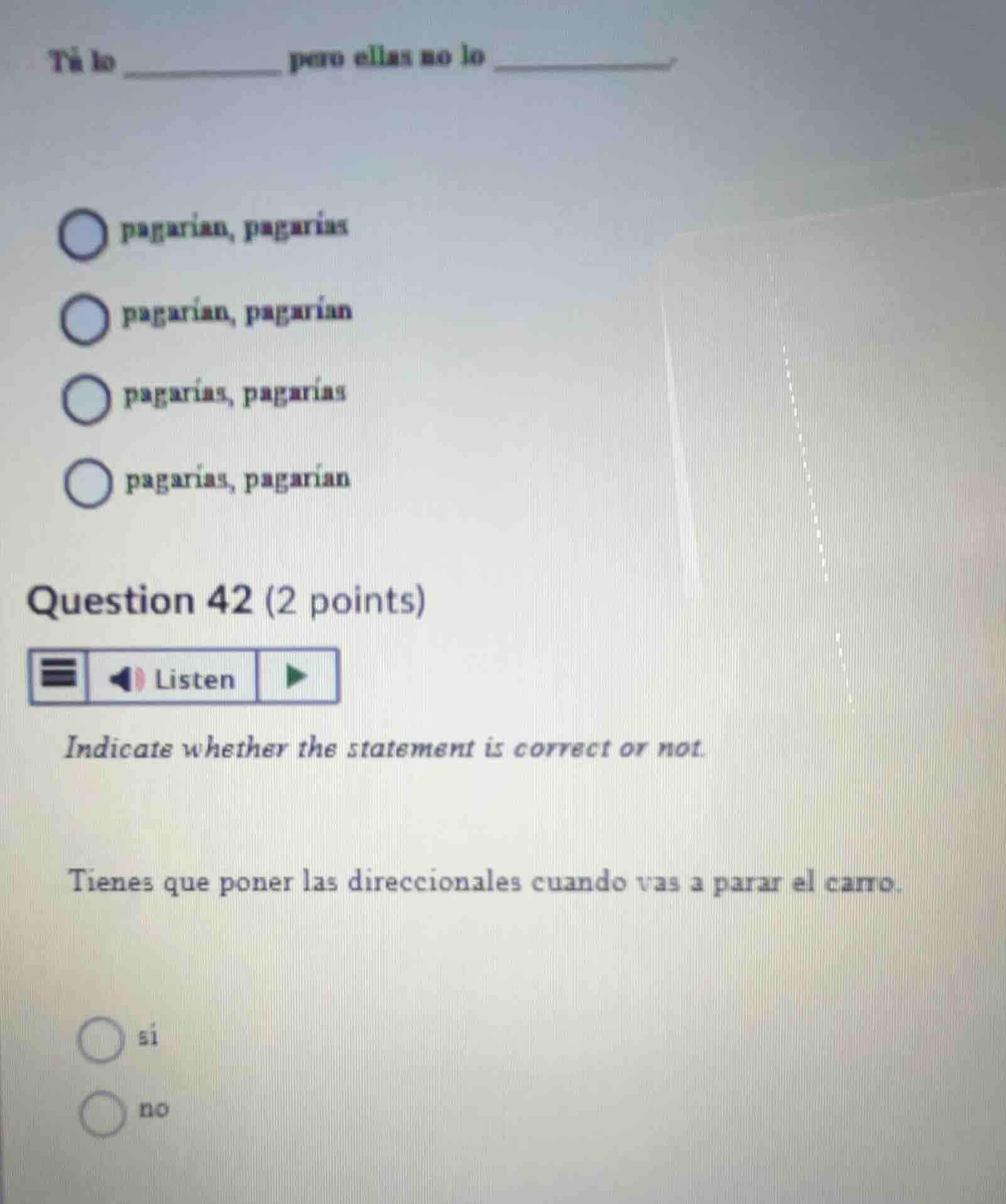
tú lo ______ pero ellas no lo ______
pagarían, pagarías
pagarían, pagarían
pagarías, pagarías
pagarías, pagarían
question 42 (2 points)
indicate whether the statement is correct or not.
tienes que poner las direccionales cuando vas a parar el carro.
sí
no
<pre_analysis>
{
"quality": "clear",
"question_count": 2,
"skills_matched": [
"direct_cot",
"multiple_choice_formatter",
"explain_then_answer",
"tutor"
],
"needs_drawing": false,
"concepts_used": [
"Spanish Subject Verb Agreement"
],
"new_concepts": [
"Spanish Conditional Tense",
"Spanish Driving Vocabulary"
],
"current_concepts": [
"Spanish Subject Verb Agreement",
"Spanish Conditional Tense",
"Spanish Driving Vocabulary"
]
}
</pre_analysis>
<reasoning>
Analyze the first question's subjects
The first sentence is: "Tú lo ______ pero ellas no lo ______".
We need to identify the grammatical subjects for each blank to ensure proper Spanish Subject Verb Agreement.
- The subject for the first blank is "Tú" (second-person singular).
- The subject for the second blank is "ellas" (third-person plural).
Conjugate the verb "pagar" in the conditional tense
The options use forms of the verb pagar (to pay) in the conditional tense.
- For the subject "Tú", the conditional ending is -ías. Therefore, pagar becomes pagarías.
- For the subject "ellas", the conditional ending is -ían. Therefore, pagar becomes pagarían.
Match with the correct option
We look for the option that lists "pagarías" first and "pagarían" second.
- Option 1: "pagarían, pagarías" (Incorrect)
- Option 2: "pagarían, pagarían" (Incorrect)
- Option 3: "pagarías, pagarías" (Incorrect)
- Option 4: "pagarías, pagarían" (Correct)
Analyze the second statement
The statement is: "Tienes que poner las direccionales cuando vas a parar el carro."
Let's translate and evaluate this statement:
- "Tienes que poner las direccionales" means "You have to put on the turn signals / blinkers".
- "cuando vas a parar el carro" means "when you are going to stop the car".
In standard driving safety and regulations, you use turn signals (direccionales) to indicate turning or changing lanes, not simply when bringing the vehicle to a stop (where brake lights automatically signal deceleration, or hazard lights are used for emergency stops). Therefore, as a general rule of driving, this statement is incorrect ("no").
</reasoning>
<answer>
Question 1
<mcq-option>(A) pagarían, pagarías</mcq-option>
<mcq-option>(B) pagarían, pagarían</mcq-option>
<mcq-option>(C) pagarías, pagarías</mcq-option>
<mcq-correct>(D) pagarías, pagarían</mcq-correct>
Question 2
<mcq-option>(A) sí</mcq-option>
<mcq-correct>(B) no</mcq-correct>
</answer>
<post_analysis>
{
"subject": "Others",
"question_type": "Multiple Choice",
"knowledge_point": [
"Others",
"Spanish",
"Spanish Grammar and Vocabulary"
]
}
</post_analysis>
Snap & solve any problem in the app
Get step-by-step solutions on Sovi AI
Photo-based solutions with guided steps
Explore more problems and detailed explanations
<pre_analysis>
{
"quality": "clear",
"question_count": 2,
"skills_matched": [
"direct_cot",
"multiple_choice_formatter",
"explain_then_answer",
"tutor"
],
"needs_drawing": false,
"concepts_used": [
"Spanish Subject Verb Agreement"
],
"new_concepts": [
"Spanish Conditional Tense",
"Spanish Driving Vocabulary"
],
"current_concepts": [
"Spanish Subject Verb Agreement",
"Spanish Conditional Tense",
"Spanish Driving Vocabulary"
]
}
</pre_analysis>
<reasoning>
Analyze the first question's subjects
The first sentence is: "Tú lo ______ pero ellas no lo ______".
We need to identify the grammatical subjects for each blank to ensure proper Spanish Subject Verb Agreement.
- The subject for the first blank is "Tú" (second-person singular).
- The subject for the second blank is "ellas" (third-person plural).
Conjugate the verb "pagar" in the conditional tense
The options use forms of the verb pagar (to pay) in the conditional tense.
- For the subject "Tú", the conditional ending is -ías. Therefore, pagar becomes pagarías.
- For the subject "ellas", the conditional ending is -ían. Therefore, pagar becomes pagarían.
Match with the correct option
We look for the option that lists "pagarías" first and "pagarían" second.
- Option 1: "pagarían, pagarías" (Incorrect)
- Option 2: "pagarían, pagarían" (Incorrect)
- Option 3: "pagarías, pagarías" (Incorrect)
- Option 4: "pagarías, pagarían" (Correct)
Analyze the second statement
The statement is: "Tienes que poner las direccionales cuando vas a parar el carro."
Let's translate and evaluate this statement:
- "Tienes que poner las direccionales" means "You have to put on the turn signals / blinkers".
- "cuando vas a parar el carro" means "when you are going to stop the car".
In standard driving safety and regulations, you use turn signals (direccionales) to indicate turning or changing lanes, not simply when bringing the vehicle to a stop (where brake lights automatically signal deceleration, or hazard lights are used for emergency stops). Therefore, as a general rule of driving, this statement is incorrect ("no").
</reasoning>
<answer>
Question 1
<mcq-option>(A) pagarían, pagarías</mcq-option>
<mcq-option>(B) pagarían, pagarían</mcq-option>
<mcq-option>(C) pagarías, pagarías</mcq-option>
<mcq-correct>(D) pagarías, pagarían</mcq-correct>
Question 2
<mcq-option>(A) sí</mcq-option>
<mcq-correct>(B) no</mcq-correct>
</answer>
<post_analysis>
{
"subject": "Others",
"question_type": "Multiple Choice",
"knowledge_point": [
"Others",
"Spanish",
"Spanish Grammar and Vocabulary"
]
}
</post_analysis>