QUESTION IMAGE
Question
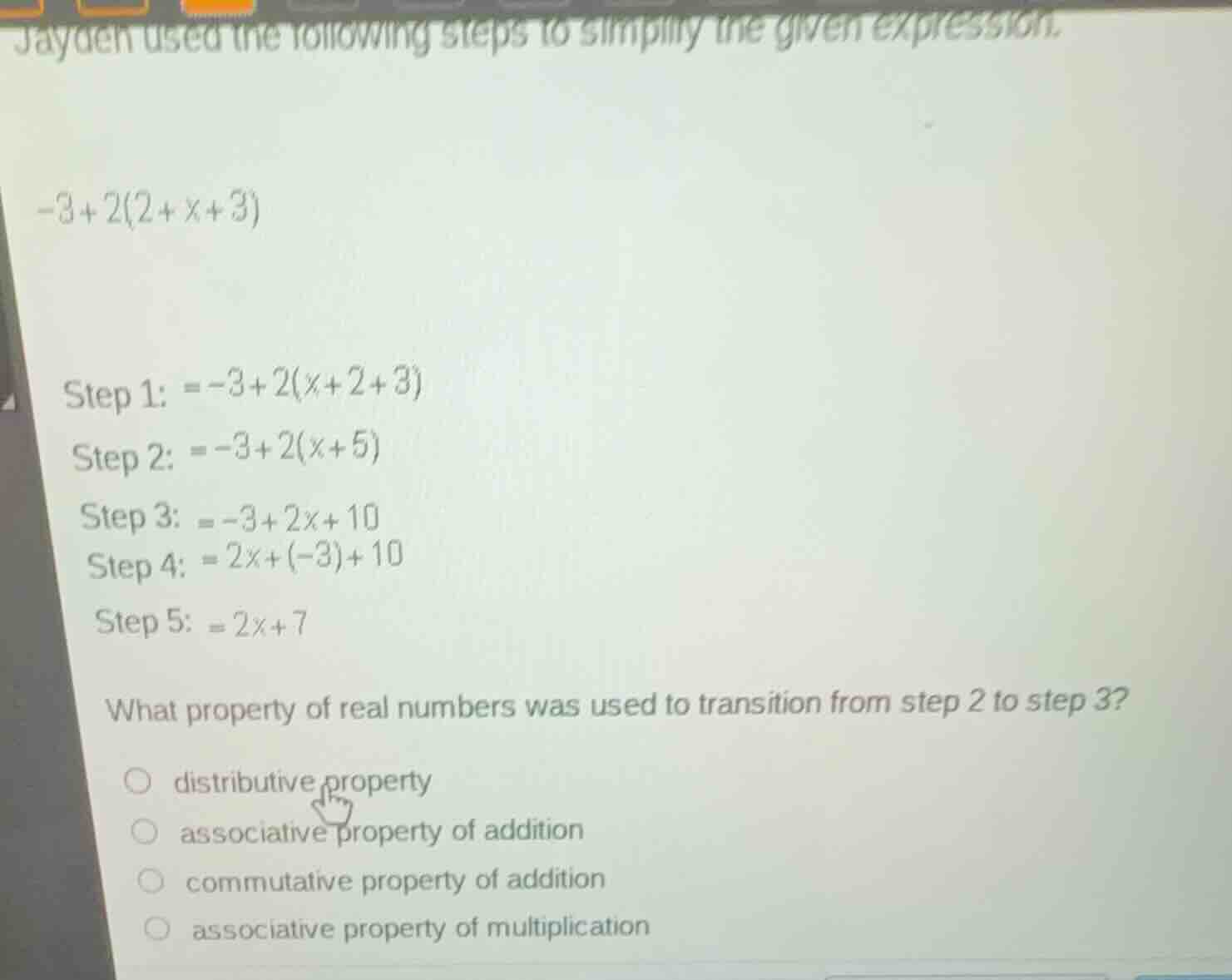
jayden used the following steps to simplify the given expression.
(-3 + 2(2 + x + 3))
step 1: (= -3 + 2(x + 2 + 3))
step 2: (= -3 + 2(x + 5))
step 3: (= -3 + 2x + 10)
step 4: (= 2x + (-3) + 10)
step 5: (= 2x + 7)
what property of real numbers was used to transition from step 2 to step 3?
distributive property
associative property of addition
commutative property of addition
associative property of multiplication
Analyze the transition from Step 2 to Step 3
The expression in Step 2 is:
The expression in Step 3 is:
Identify the mathematical property applied
To transition from \(2(x + 5)\) to \(2x + 10\), the factor of \(2\) outside the parentheses is multiplied by each term inside the parentheses:
This operation represents the distributive property of multiplication over addition, commonly referred to as the distributive property.

Snap & solve any problem in the app
Get step-by-step solutions on Sovi AI
Photo-based solutions with guided steps
Explore more problems and detailed explanations
- distributive property (Correct answer)
- associative property of addition
- commutative property of addition
- associative property of multiplication