Sovi.AI - AI Math Tutor

Scan to solve math questions

QUESTION IMAGE

jayden used the following steps to simplify the given expression. (-3 +…

Question

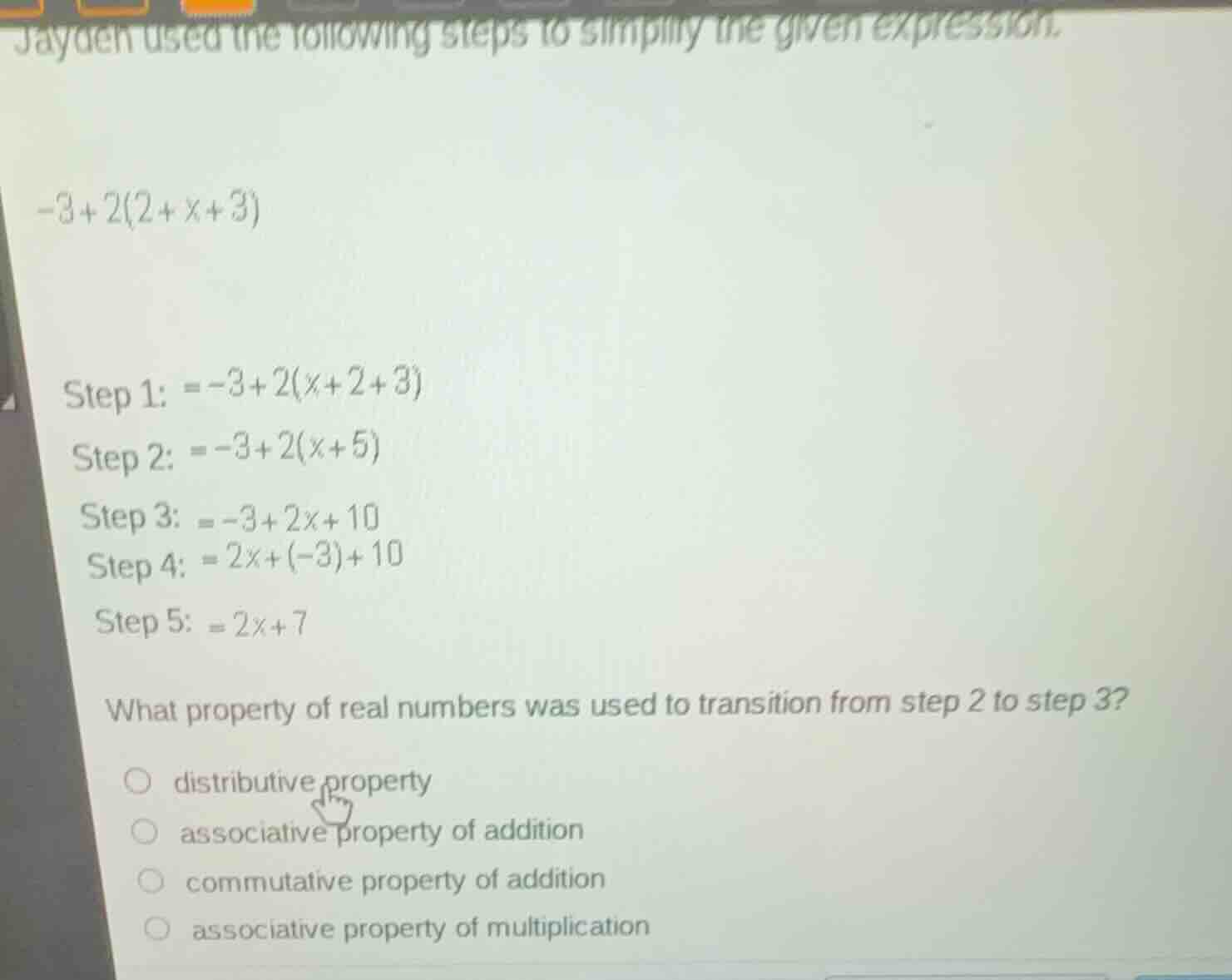
jayden used the following steps to simplify the given expression.

(-3 + 2(2 + x + 3))

step 1: (= -3 + 2(x + 2 + 3))
step 2: (= -3 + 2(x + 5))
step 3: (= -3 + 2x + 10)
step 4: (= 2x + (-3) + 10)
step 5: (= 2x + 7)

what property of real numbers was used to transition from step 2 to step 3?

distributive property
associative property of addition
commutative property of addition
associative property of multiplication

Explanation:

Response

<pre_analysis>
{
"quality": "clear",
"question_count": 1,
"skills_matched": [
"direct_cot",
"multiple_choice_formatter",
"explain_then_answer",
"quick"
],
"needs_drawing": false,
"concepts_used": [],
"new_concepts": [
"Distributive Property",
"Properties of Real Numbers"
],
"current_concepts": [
"Distributive Property",
"Properties of Real Numbers"
]
}
</pre_analysis>

<reasoning>

Analyze the transition from Step 2 to Step 3

The expression in Step 2 is:
\[-3 + 2(x + 5)\]

The expression in Step 3 is:
\[-3 + 2x + 10\]

Identify the mathematical property applied

To transition from \(2(x + 5)\) to \(2x + 10\), the factor of \(2\) outside the parentheses is multiplied by each term inside the parentheses:
\[2 \cdot x + 2 \cdot 5 = 2x + 10\]

This operation represents the distributive property of multiplication over addition, commonly referred to as the distributive property.
</reasoning>

<answer>
<mcq-correct>distributive property</mcq-correct>
<mcq-option>associative property of addition</mcq-option>
<mcq-option>commutative property of addition</mcq-option>
<mcq-option>associative property of multiplication</mcq-option>
</answer>

<post_analysis>
{
"subject": "Mathematics",
"question_type": "Multiple Choice",
"knowledge_point": [
"Mathematics",
"Algebra",
"Properties of Real Numbers"
]
}
</post_analysis>

Answer:

<pre_analysis>
{
"quality": "clear",
"question_count": 1,
"skills_matched": [
"direct_cot",
"multiple_choice_formatter",
"explain_then_answer",
"quick"
],
"needs_drawing": false,
"concepts_used": [],
"new_concepts": [
"Distributive Property",
"Properties of Real Numbers"
],
"current_concepts": [
"Distributive Property",
"Properties of Real Numbers"
]
}
</pre_analysis>

<reasoning>

Analyze the transition from Step 2 to Step 3

The expression in Step 2 is:
\[-3 + 2(x + 5)\]

The expression in Step 3 is:
\[-3 + 2x + 10\]

Identify the mathematical property applied

To transition from \(2(x + 5)\) to \(2x + 10\), the factor of \(2\) outside the parentheses is multiplied by each term inside the parentheses:
\[2 \cdot x + 2 \cdot 5 = 2x + 10\]

This operation represents the distributive property of multiplication over addition, commonly referred to as the distributive property.
</reasoning>

<answer>
<mcq-correct>distributive property</mcq-correct>
<mcq-option>associative property of addition</mcq-option>
<mcq-option>commutative property of addition</mcq-option>
<mcq-option>associative property of multiplication</mcq-option>
</answer>

<post_analysis>
{
"subject": "Mathematics",
"question_type": "Multiple Choice",
"knowledge_point": [
"Mathematics",
"Algebra",
"Properties of Real Numbers"
]
}
</post_analysis>