QUESTION IMAGE
Question
instructions:
- read each question carefully.
- answer each question, showing all your work for any calculations.
- answer questions using full sentences unless instructed otherwise
answer the following questions in the space provided.
curriculum expectation b2. investigate organic compounds and organic chemical reactions, and use various methods to represent the compounds.
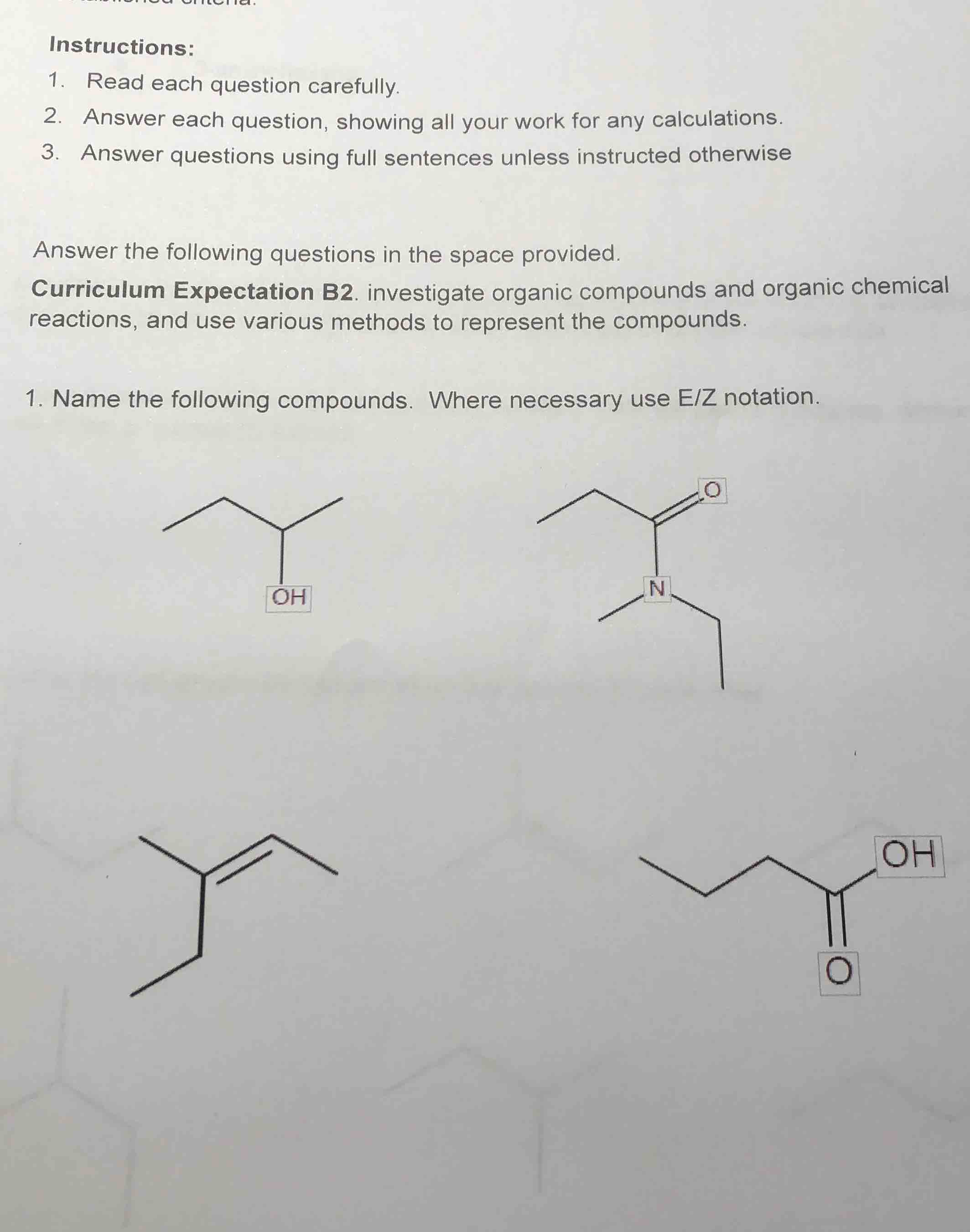
- name the following compounds. where necessary use e/z notation.
Identify the first compound (top-left)
Using the Organic Chemistry knowledge point
- The longest carbon chain containing the hydroxyl group \(\text{-OH}\) has 5 carbons (pentane).
- Numbering from the right gives the \(\text{-OH}\) group the lowest locant: carbon-2.
- The IUPAC name is pentan-2-ol.
Identify the second compound (top-right)
Using the Amide Nomenclature and Organic Chemistry knowledge points
- The carbonyl group is attached to a nitrogen atom, indicating an amide.
- The acyl chain (carbonyl side) has 4 carbons (butanamide).
- The nitrogen atom is substituted with a methyl group and an ethyl group.
- Alphabetical order for substituents: \(N\)-ethyl-\(N\)-methylbutanamide.
Identify the third compound (bottom-left)
Using the Alkene Stereochemistry and Organic Chemistry knowledge points
- The longest carbon chain containing the double bond has 6 carbons (hex-2-ene).
- Numbering from the right gives the double bond the lowest locant: carbon-2.
- There is a methyl substituent at carbon-3: 3-methylhex-2-ene.
- Determine stereochemistry (\(E/Z\)) at C2=C3:
- At C2: \(\text{-H}\) (low priority, 2) vs \(\text{-CH}_3\) (high priority, 1).
- At C3: \(\text{-CH(CH}_3)_2\) (isopropyl, high priority, 1) vs \(\text{-CH}_2\text{CH}_3\) (ethyl, low priority, 2).
- The high-priority groups (\(\text{-CH}_3\) on C2 and isopropyl on C3) are on opposite sides of the double bond, which corresponds to the \((E)\) configuration.
- The IUPAC name is (E)-3-methyl-3-propylpent-2-ene? Let's re-verify the longest chain:
- C1: rightmost methyl \(\text{-CH}_3\).
- C2: CH.
- C3: C attached to isopropyl and ethyl.
- If we go down: \(\text{-CH}_2\text{-CH}_3\) (ethyl, 2 carbons).
- If we go left: \(\text{-CH(CH}_3)_2\) (isopropyl, 3 carbons, but chain-wise it's 2 carbons: \(\text{-CH-CH}_3\) with a methyl branch).
- Let's trace the longest continuous chain containing the double bond:
- Start at right: C1 (\(\text{-CH}_3\)) - C2 (\(=\text{CH}-\)) - C3 (\(=\text{C}-\)) - C4 (\(\text{-CH}_2-\)) - C5 (\(\text{-CH}_3\)) [ethyl path]. This chain has 5 carbons (pent-2-ene).
- At C3, we have an isopropyl group \(\text{-CH(CH}_3)_2\).
- Let's check the other path: C1 (\(\text{-CH}_3\)) - C2 (\(=\text{CH}-\)) - C3 (\(=\text{C}-\)) - C4 (\(\text{-CH(CH}_3)-\)) - C5 (\(\text{-CH}_3\)) [isopropyl path]. This chain also has 5 carbons.
- Choosing the chain with more substituents: the pent-2-ene chain with an isopropyl group at C3 has 1 substituent (isopropyl). The other path also has 1 substituent (ethyl and methyls).
- Let's name it as a pent-2-ene derivative: 3-isopropylpent-2-ene.
- Let's determine \(E/Z\) for 3-isopropylpent-2-ene:
- C2: \(\text{-CH}_3\) (high) vs \(\text{-H}\) (low).
- C3: \(\text{-CH(CH}_3)_2\) (high, C attached to 2 C's) vs \(\text{-CH}_2\text{CH}_3\) (low, C attached to 1 C).
- The high priority gr…

Snap & solve any problem in the app
Get step-by-step solutions on Sovi AI
Photo-based solutions with guided steps
Explore more problems and detailed explanations
Question 1
- Top-Left Compound: pentan-2-ol
- Top-Right Compound: \(N\)-ethyl-\(N\)-methylbutanamide
- Bottom-Left Compound: (E)-3-isopropylpent-2-ene
- Bottom-Right Compound: pentanoic acid