QUESTION IMAGE
Question
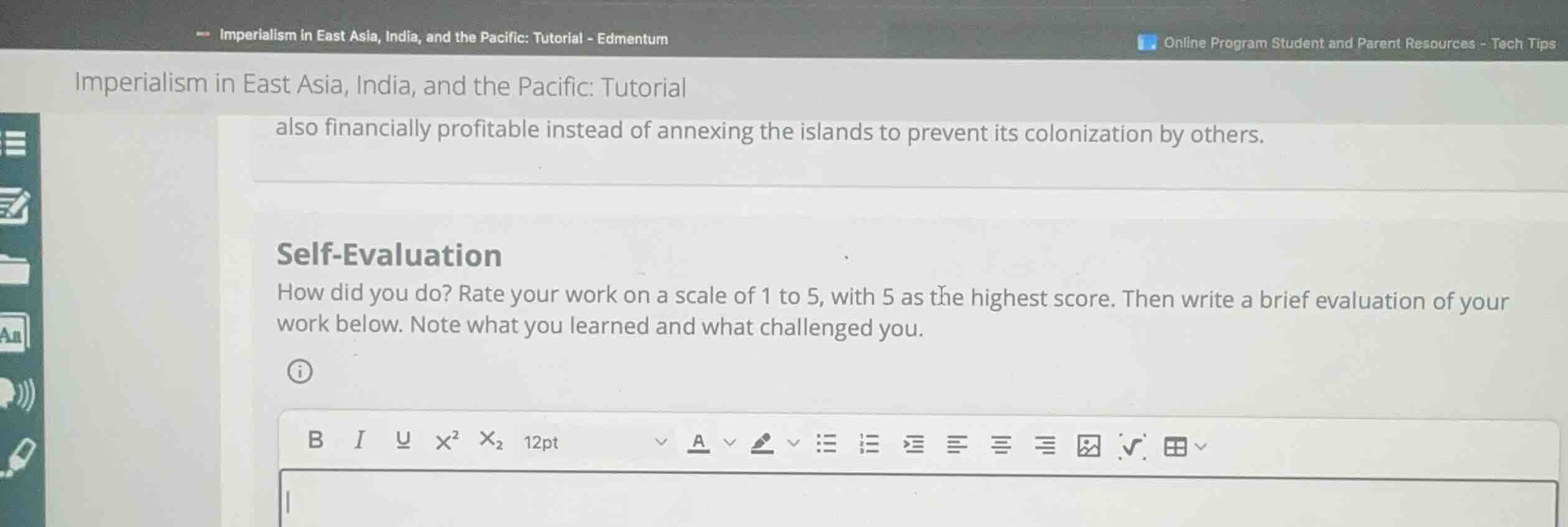
imperialism in east asia, india, and the pacific: tutorial
also financially profitable instead of annexing the islands to prevent its colonization by others.
self-evaluation
how did you do? rate your work on a scale of 1 to 5, with 5 as the highest score. then write a brief evaluation of your work below. note what you learned and what challenged you.
<pre_analysis>
{
"quality": "clear",
"question_count": 1,
"skills_matched": [
"direct_cot",
"explain_then_answer",
"tutor"
],
"needs_drawing": false,
"concepts_used": [
"New Imperialism"
],
"new_concepts": [
"Self-Evaluation",
"Reflective Writing"
],
"current_concepts": [
"New Imperialism",
"Self-Evaluation",
"Reflective Writing"
]
}
</pre_analysis>
<reasoning>
Analyze the prompt requirements
The prompt asks for a self-evaluation on a scale of 1 to 5, followed by a brief evaluation of the work. It requires noting what was learned and what was challenging regarding the topic of "Imperialism in East Asia, India, and the Pacific."
Connect to historical concepts
We will reflect on the core themes of New Imperialism, specifically focusing on the economic motivations (such as making territories financially profitable without direct annexation) and the geopolitical rivalries involved in preventing colonization by other powers.
Formulate the self-evaluation rating
A score of 4 or 5 is appropriate for a comprehensive understanding. We will select 5 to demonstrate mastery of the material, including the complex dynamics of colonization in East Asia, India, and the Pacific.
Draft the reflection on learning
We will highlight key takeaways: understanding the strategic and economic motives behind imperialism, such as the transition from direct territorial annexation to economic spheres of influence, and the local resistances like the Sepoy Rebellion or Boxer Rebellion.
Draft the reflection on challenges
We will identify a meaningful challenge: analyzing the perspectives of both the colonizing powers and the colonized societies, and understanding the subtle differences between direct colonization and economic hegemony.
</reasoning>
<answer>
I would rate my work a 5 out of 5.
Through this lesson, I developed a deeper understanding of the strategic and economic motivations behind New Imperialism in East Asia, India, and the Pacific. Specifically, I learned how Western powers and Japan sought to make territories financially profitable, often balancing the high costs of direct annexation against the strategic necessity of preventing rival nations from colonizing the same regions.
The most challenging part of the lesson was analyzing the dual perspectives of the imperial powers and the local populations. It required careful critical thinking to understand how economic policies like mercantilism and spheres of influence directly triggered major nationalist resistances, such as the Sepoy Rebellion in India and the Boxer Rebellion in China.
</answer>
<post_analysis>
{
"subject": "Social Science",
"question_type": "Free Response",
"knowledge_point": [
"Social Science",
"History",
"New Imperialism"
]
}
</post_analysis>
Snap & solve any problem in the app
Get step-by-step solutions on Sovi AI
Photo-based solutions with guided steps
Explore more problems and detailed explanations
<pre_analysis>
{
"quality": "clear",
"question_count": 1,
"skills_matched": [
"direct_cot",
"explain_then_answer",
"tutor"
],
"needs_drawing": false,
"concepts_used": [
"New Imperialism"
],
"new_concepts": [
"Self-Evaluation",
"Reflective Writing"
],
"current_concepts": [
"New Imperialism",
"Self-Evaluation",
"Reflective Writing"
]
}
</pre_analysis>
<reasoning>
Analyze the prompt requirements
The prompt asks for a self-evaluation on a scale of 1 to 5, followed by a brief evaluation of the work. It requires noting what was learned and what was challenging regarding the topic of "Imperialism in East Asia, India, and the Pacific."
Connect to historical concepts
We will reflect on the core themes of New Imperialism, specifically focusing on the economic motivations (such as making territories financially profitable without direct annexation) and the geopolitical rivalries involved in preventing colonization by other powers.
Formulate the self-evaluation rating
A score of 4 or 5 is appropriate for a comprehensive understanding. We will select 5 to demonstrate mastery of the material, including the complex dynamics of colonization in East Asia, India, and the Pacific.
Draft the reflection on learning
We will highlight key takeaways: understanding the strategic and economic motives behind imperialism, such as the transition from direct territorial annexation to economic spheres of influence, and the local resistances like the Sepoy Rebellion or Boxer Rebellion.
Draft the reflection on challenges
We will identify a meaningful challenge: analyzing the perspectives of both the colonizing powers and the colonized societies, and understanding the subtle differences between direct colonization and economic hegemony.
</reasoning>
<answer>
I would rate my work a 5 out of 5.
Through this lesson, I developed a deeper understanding of the strategic and economic motivations behind New Imperialism in East Asia, India, and the Pacific. Specifically, I learned how Western powers and Japan sought to make territories financially profitable, often balancing the high costs of direct annexation against the strategic necessity of preventing rival nations from colonizing the same regions.
The most challenging part of the lesson was analyzing the dual perspectives of the imperial powers and the local populations. It required careful critical thinking to understand how economic policies like mercantilism and spheres of influence directly triggered major nationalist resistances, such as the Sepoy Rebellion in India and the Boxer Rebellion in China.
</answer>
<post_analysis>
{
"subject": "Social Science",
"question_type": "Free Response",
"knowledge_point": [
"Social Science",
"History",
"New Imperialism"
]
}
</post_analysis>