QUESTION IMAGE
Question
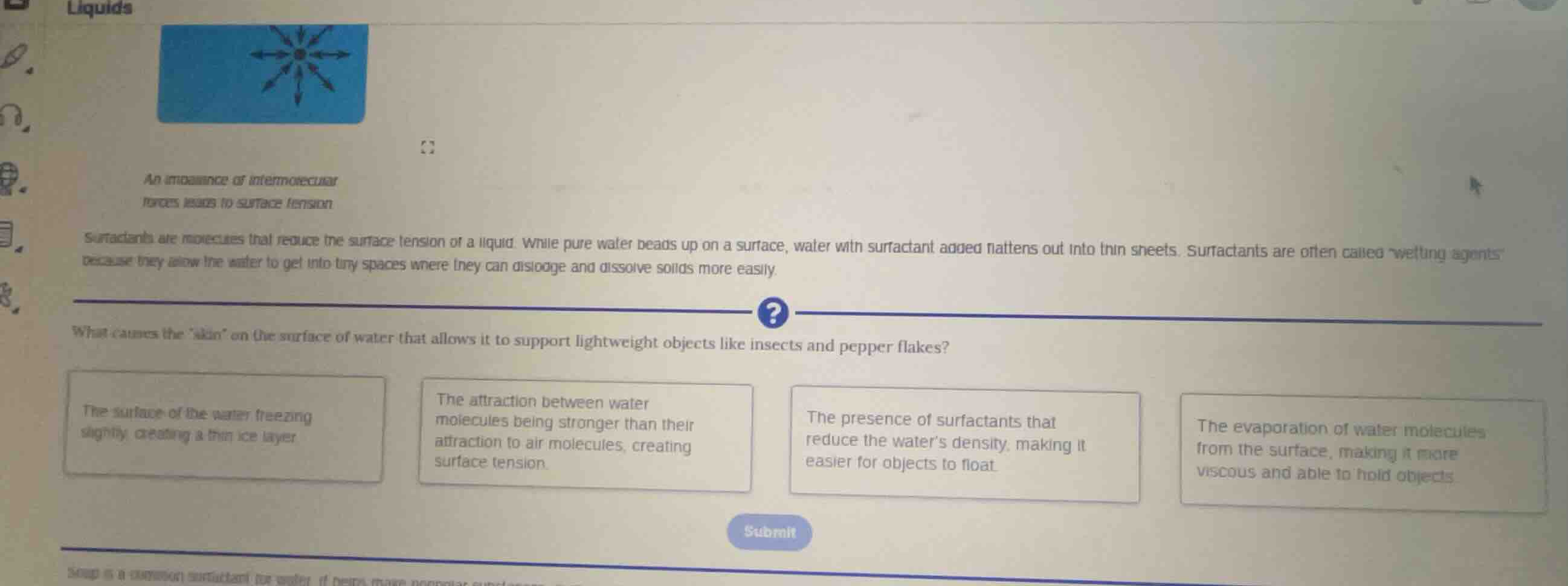
an imbalance of intermolecular forces leads to surface tension
surfactants are molecules that reduce the surface tension of a liquid. while pure water beads up on a surface, water with surfactant added flattens out into thin sheets. surfactants are often called \wetting agents\ because they allow the water to get into tiny spaces where they can dislodge and dissolve solids more easily.
what causes the \skin\ on the surface of water that allows it to support lightweight objects like insects and pepper flakes?
- the surface of the water freezing slightly, creating a thin ice layer
- the attraction between water molecules being stronger than their attraction to air molecules, creating surface tension
- the presence of surfactants that reduce the waters density, making it easier for objects to float
- the evaporation of water molecules from the surface, making it more viscous and able to hold objects
Identify the core question
The question asks what causes the "skin" on the surface of water that allows it to support lightweight objects like insects and pepper flakes.
Analyze the physical phenomenon
Using the Properties of Fluids concept, we know that the "skin" effect is called surface tension. This phenomenon is driven by cohesive forces.
Evaluate intermolecular interactions
Using the Intermolecular Forces concept, molecules inside a liquid are pulled equally in all directions by neighboring molecules. However, molecules at the surface do not have neighboring liquid molecules above them. They experience a net inward cohesive pull. This makes the attraction between water molecules stronger than their attraction to air molecules, minimizing surface area and creating surface tension.
Compare with the options
- Option 1 suggests freezing, which is incorrect as the water remains liquid.
- Option 2 states that the attraction between water molecules is stronger than their attraction to air molecules, creating surface tension. This matches our physical analysis.
- Option 3 suggests surfactants, which actually reduce surface tension rather than causing it.
- Option 4 suggests evaporation increases viscosity, which is incorrect.

Snap & solve any problem in the app
Get step-by-step solutions on Sovi AI
Photo-based solutions with guided steps
Explore more problems and detailed explanations
- The surface of the water freezing slightly, creating a thin ice layer.
- The attraction between water molecules being stronger than their attraction to air molecules, creating surface tension. (Correct answer)
- The presence of surfactants that reduce the water's density, making it easier for objects to float.
- The evaporation of water molecules from the surface, making it more viscous and able to hold objects.