QUESTION IMAGE
Question
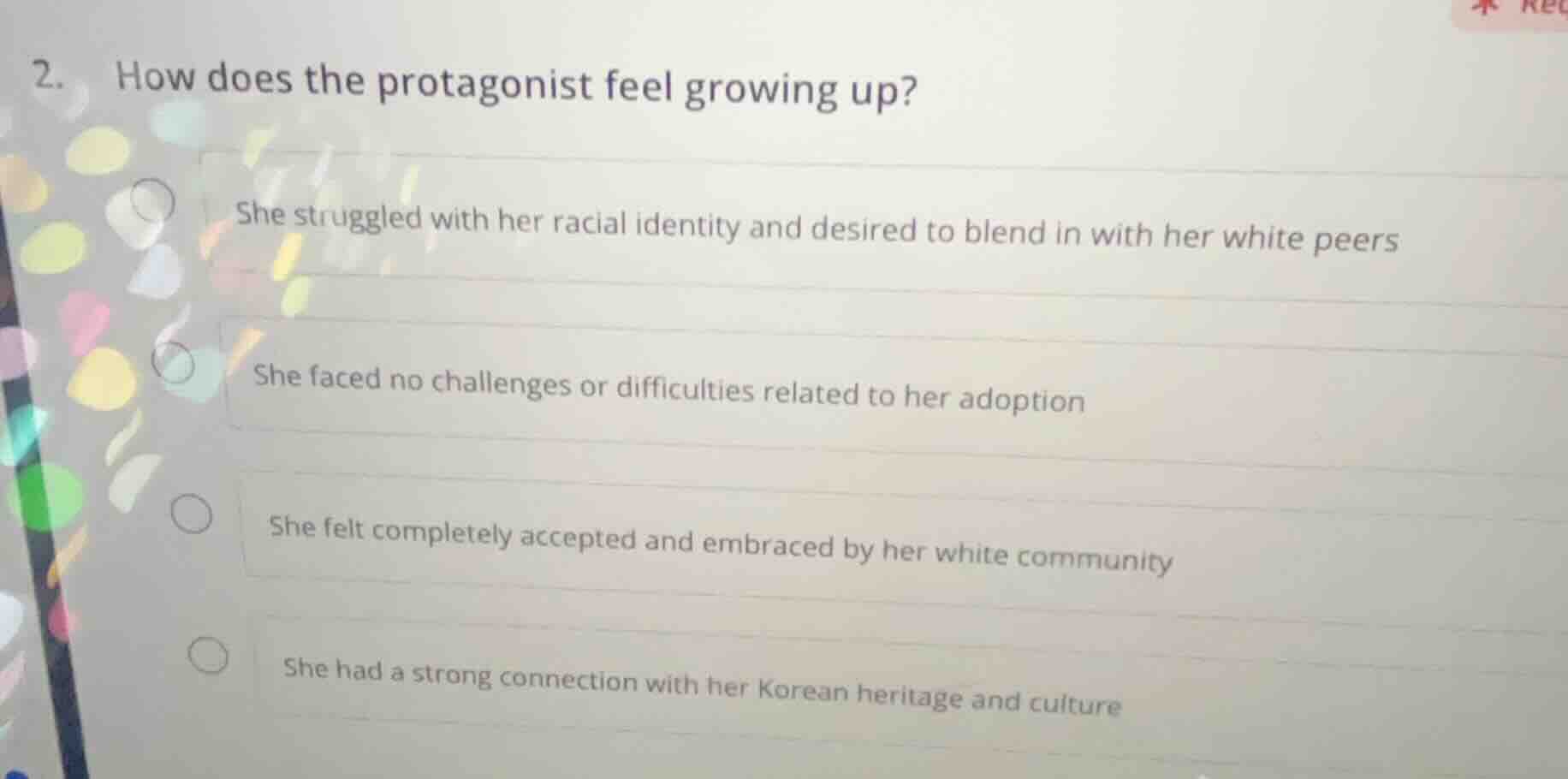
- how does the protagonist feel growing up?
she struggled with her racial identity and desired to blend in with her white peers
she faced no challenges or difficulties related to her adoption
she felt completely accepted and embraced by her white community
she had a strong connection with her korean heritage and culture
<pre_analysis>
{
"quality": "clear",
"question_count": 1,
"skills_matched": [
"direct_cot",
"multiple_choice_formatter",
"explain_then_answer",
"quick"
],
"needs_drawing": false,
"concepts_used": [],
"new_concepts": [
"Korean-American Literature",
"Transracial Adoption Narrative"
],
"current_concepts": [
"Korean-American Literature",
"Transracial Adoption Narrative",
"Protagonist",
"Reading Comprehension"
]
}
</pre_analysis>
<reasoning>
Analyze the question and options
The question asks how the protagonist feels growing up. The options focus on themes of transracial adoption, racial identity, and cultural connection, specifically mentioning a white community and Korean heritage.
Evaluate the options based on literary themes
- Option 1: "She struggled with her racial identity and desired to blend in with her white peers" aligns with common themes in transracial adoption narratives (specifically Korean-American adoptees raised in white families/communities).
- Option 2: "She faced no challenges..." is highly unlikely for a narrative exploring these identity themes.
- Option 3: "She felt completely accepted..." contradicts the typical conflict of feeling like an outsider or struggling to fit in.
- Option 4: "She had a strong connection with her Korean heritage..." is contradicted by the context of struggling to connect or wanting to blend in with white peers during her upbringing.
Determine the correct choice
The first option represents the central internal conflict of the protagonist's upbringing in this narrative context.
</reasoning>
<answer>
<mcq-correct>(A) She struggled with her racial identity and desired to blend in with her white peers</mcq-correct>
<mcq-option>(B) She faced no challenges or difficulties related to her adoption</mcq-option>
<mcq-option>(C) She felt completely accepted and embraced by her white community</mcq-option>
<mcq-option>(D) She had a strong connection with her Korean heritage and culture</mcq-option>
</answer>
<post_analysis>
{
"subject": "Arts",
"question_type": "Multiple Choice",
"knowledge_point": [
"Arts",
"Others",
"Korean-American Literature"
]
}
</post_analysis>
Snap & solve any problem in the app
Get step-by-step solutions on Sovi AI
Photo-based solutions with guided steps
Explore more problems and detailed explanations
<pre_analysis>
{
"quality": "clear",
"question_count": 1,
"skills_matched": [
"direct_cot",
"multiple_choice_formatter",
"explain_then_answer",
"quick"
],
"needs_drawing": false,
"concepts_used": [],
"new_concepts": [
"Korean-American Literature",
"Transracial Adoption Narrative"
],
"current_concepts": [
"Korean-American Literature",
"Transracial Adoption Narrative",
"Protagonist",
"Reading Comprehension"
]
}
</pre_analysis>
<reasoning>
Analyze the question and options
The question asks how the protagonist feels growing up. The options focus on themes of transracial adoption, racial identity, and cultural connection, specifically mentioning a white community and Korean heritage.
Evaluate the options based on literary themes
- Option 1: "She struggled with her racial identity and desired to blend in with her white peers" aligns with common themes in transracial adoption narratives (specifically Korean-American adoptees raised in white families/communities).
- Option 2: "She faced no challenges..." is highly unlikely for a narrative exploring these identity themes.
- Option 3: "She felt completely accepted..." contradicts the typical conflict of feeling like an outsider or struggling to fit in.
- Option 4: "She had a strong connection with her Korean heritage..." is contradicted by the context of struggling to connect or wanting to blend in with white peers during her upbringing.
Determine the correct choice
The first option represents the central internal conflict of the protagonist's upbringing in this narrative context.
</reasoning>
<answer>
<mcq-correct>(A) She struggled with her racial identity and desired to blend in with her white peers</mcq-correct>
<mcq-option>(B) She faced no challenges or difficulties related to her adoption</mcq-option>
<mcq-option>(C) She felt completely accepted and embraced by her white community</mcq-option>
<mcq-option>(D) She had a strong connection with her Korean heritage and culture</mcq-option>
</answer>
<post_analysis>
{
"subject": "Arts",
"question_type": "Multiple Choice",
"knowledge_point": [
"Arts",
"Others",
"Korean-American Literature"
]
}
</post_analysis>