QUESTION IMAGE
Question
heat
melting
boiling
solid
liquid
gas
freezing
condensation
cooling
Identify the diagram components
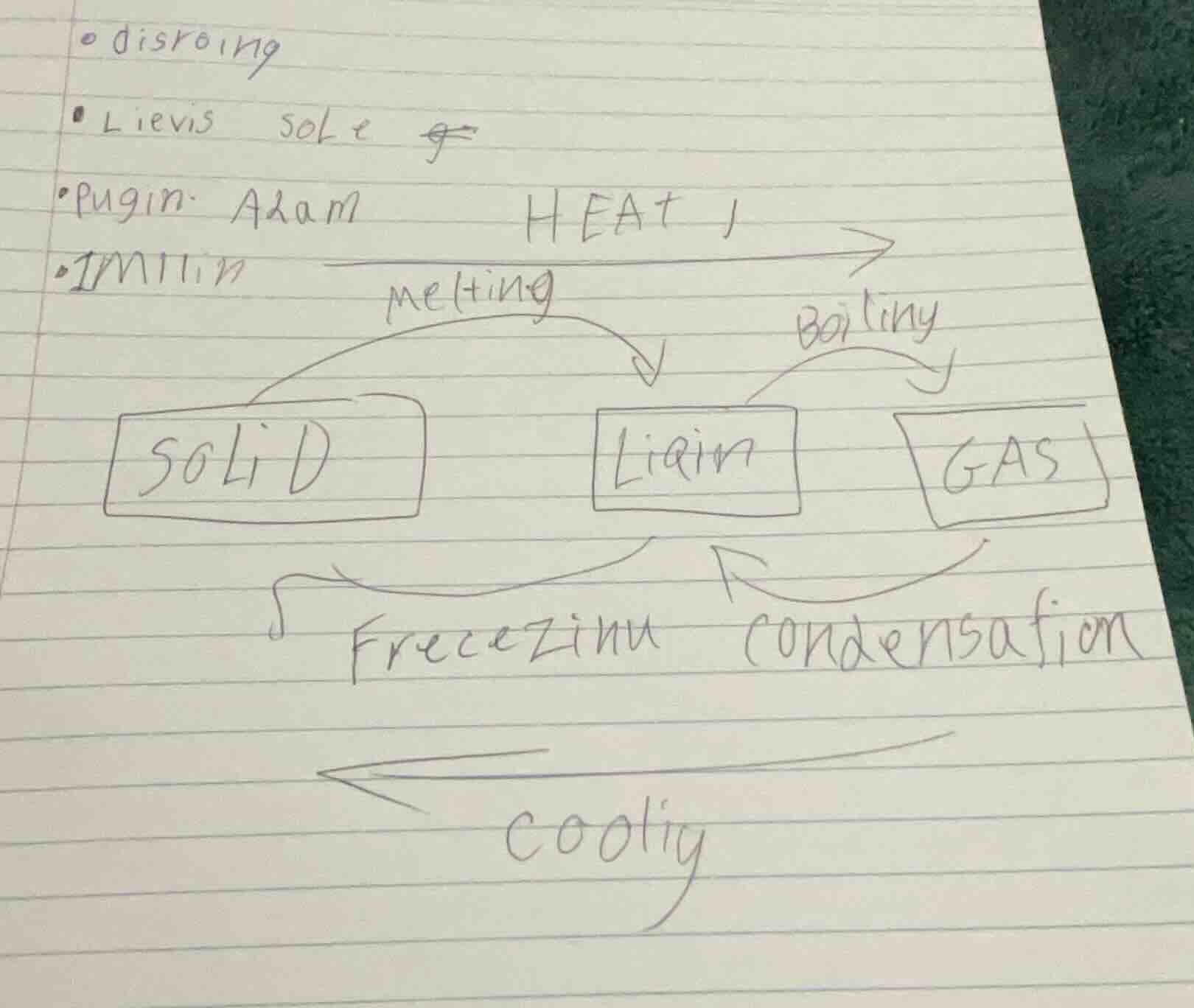
The diagram illustrates the three primary states of matter: Solid, Liquid (written as "Liqin"), and Gas. It shows how matter transitions between these states when thermal energy is added or removed.
Analyze the heating processes
Adding heat (moving from left to right) drives phase changes that absorb energy:
- Transitioning from Solid to Liquid is labeled melting.
- Transitioning from Liquid to Gas is labeled boiling (or vaporization).
Analyze the cooling processes
Removing heat (cooling, moving from right to left) drives phase changes that release energy:
- Transitioning from Gas to Liquid is labeled condensation.
- Transitioning from Liquid to Solid is labeled freezing (written as "freezinu").
Summarize the phase changes
The diagram serves as a conceptual map of phase transitions:
- Melting: Solid $
ightarrow$ Liquid (Heat added)
- Boiling: Liquid $
ightarrow$ Gas (Heat added)
- Condensation: Gas $
ightarrow$ Liquid (Heat removed)
- Freezing: Liquid $
ightarrow$ Solid (Heat removed)

Snap & solve any problem in the app
Get step-by-step solutions on Sovi AI
Photo-based solutions with guided steps
Explore more problems and detailed explanations
This diagram illustrates the States of Matter and their Phase Transitions under the influence of heating and cooling:
- Heating (Adding Thermal Energy):
- Melting: The transition from a Solid to a Liquid.
- Boiling (Vaporization): The transition from a Liquid to a Gas.
- Cooling (Removing Thermal Energy):
- Condensation: The transition from a Gas to a Liquid.
- Freezing: The transition from a Liquid to a Solid.