QUESTION IMAGE
Question
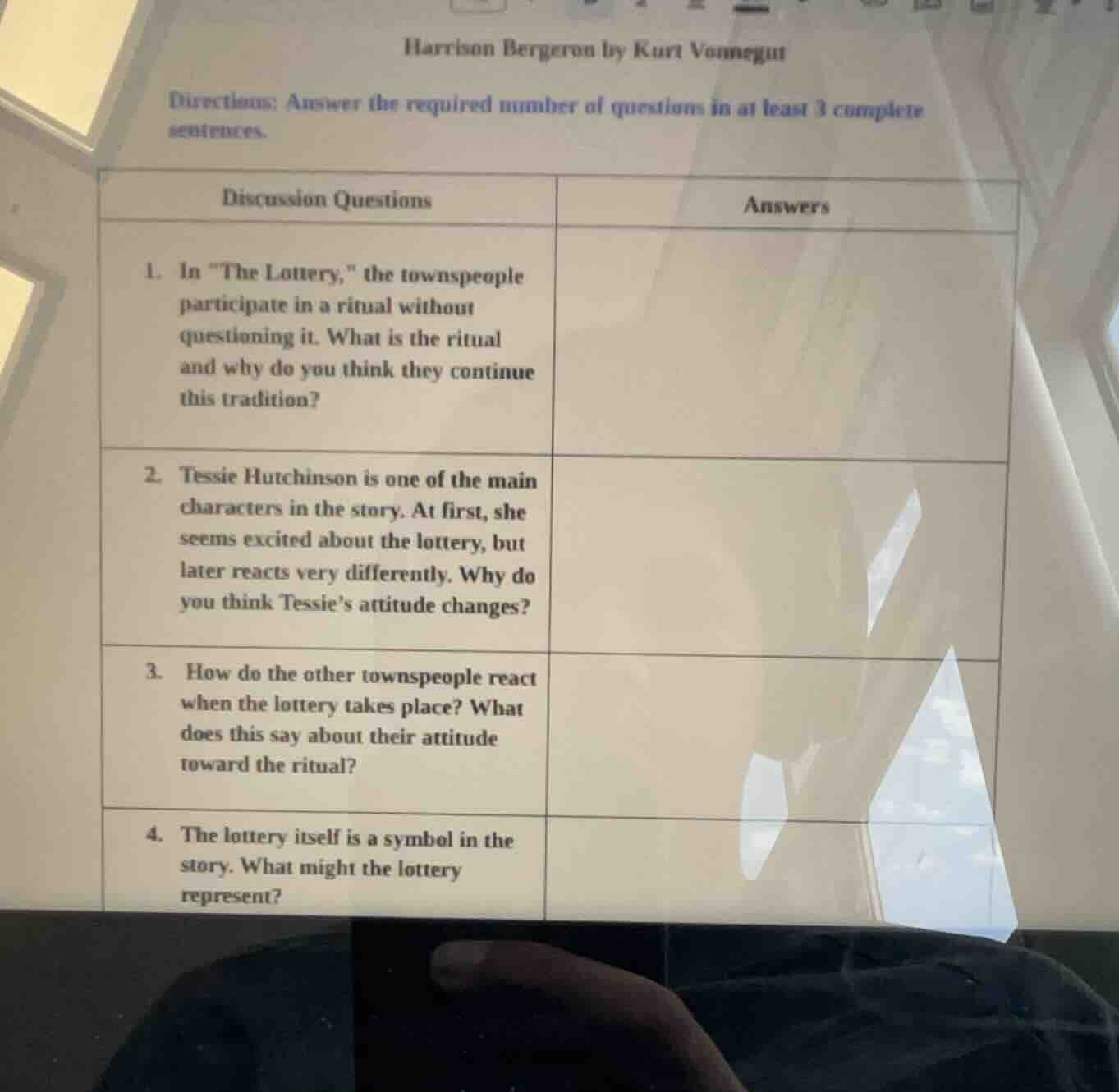
harrison bergeron by kurt vonnegut
directions: answer the required number of questions in at least 3 complete sentences.
discussion questions
- in \the lottery,\ the townspeople participate in a ritual without questioning it. what is the ritual and why do you think they continue this tradition?
- tessie hutchinson is one of the main characters in the story. at first, she seems excited about the lottery, but later reacts very differently. why do you think tessies attitude changes?
- how do the other townspeople react when the lottery takes place? what does this say about their attitude toward the ritual?
- the lottery itself is a symbol in the story. what might the lottery represent?
Analyze the ritual and conformity
Using the Literary Analysis knowledge point, we examine the central ritual in Shirley Jackson's "The Lottery." The ritual is an annual event where a townsperson is selected by chance to be stoned to death by the community. The townspeople continue this tradition due to deep-seated social conformity, fear of change, and a superstitious belief that the sacrifice ensures a good harvest, as hinted by the old saying, "Lottery in June, corn be heavy soon."
Analyze Tessie's attitude change
Using the Character Development knowledge point, we trace Tessie Hutchinson's shift in perspective. Initially, Tessie is lighthearted and fully participates in the social gathering, even joking about her lateness. However, her attitude changes instantly to panic and outrage when her family draws the marked paper, realizing that she is now the victim. This shift highlights how individuals often support harmful systems until they are personally affected by them.
Analyze the townspeople's reaction
Using the Thematic Interpretation knowledge point, we evaluate the community's behavior during the stoning. The townspeople react with a sense of routine, urgency, and emotional detachment, quickly gathering stones to complete the task. This reaction demonstrates their complete desensitization to violence and shows that they view the brutal murder not as a moral crime, but as a necessary civic duty.
Analyze the symbolism of the lottery
Using the Thematic Interpretation knowledge point, we decode the symbolic meaning of the lottery. The lottery represents the dangers of blindly following outdated traditions and the cruelty of mob psychology. It serves as a metaphor for how societies can normalize horrific acts of violence and injustice under the guise of tradition, order, or common good.

Snap & solve any problem in the app
Get step-by-step solutions on Sovi AI
Photo-based solutions with guided steps
Explore more problems and detailed explanations
Question 1
In "The Lottery," the annual ritual is a blind draw where one townsperson is selected by chance to be stoned to death by the rest of the community. The townspeople continue this tradition primarily out of a blind adherence to custom and a fear of abandoning the past. Additionally, older members of the community perpetuate the superstition that the sacrifice is necessary to guarantee a successful harvest for their crops.
Question 2
Tessie Hutchinson's attitude changes dramatically because she goes from being a passive observer to the designated victim of the ritual. At first, she treats the lottery casually and jokes with her neighbors because she assumes her family is safe. Once her husband draws the marked slip, she immediately protests that the drawing was unfair, revealing her hypocrisy in only questioning the system when it directly threatens her survival.
Question 3
When the lottery takes place, the townspeople react with businesslike efficiency, quickly gathering stones and moving in to attack Tessie without hesitation. Even young children and Tessie's close friends participate in the violence as if it were a routine chore. This reaction shows that their attitude toward the ritual is one of complete desensitization, where conformity and tradition have entirely overridden their personal morality and empathy.
Question 4
The lottery itself serves as a powerful symbol representing the dangers of unquestioned tradition and social conformity. It illustrates how easily ordinary people can commit atrocities when they surrender their individual conscience to mob mentality. Ultimately, the lottery represents the arbitrary nature of societal victimization and the human tendency to perpetuate cruelty under the guise of preserving social order.