QUESTION IMAGE
Question
graphing polynomial functions: practice
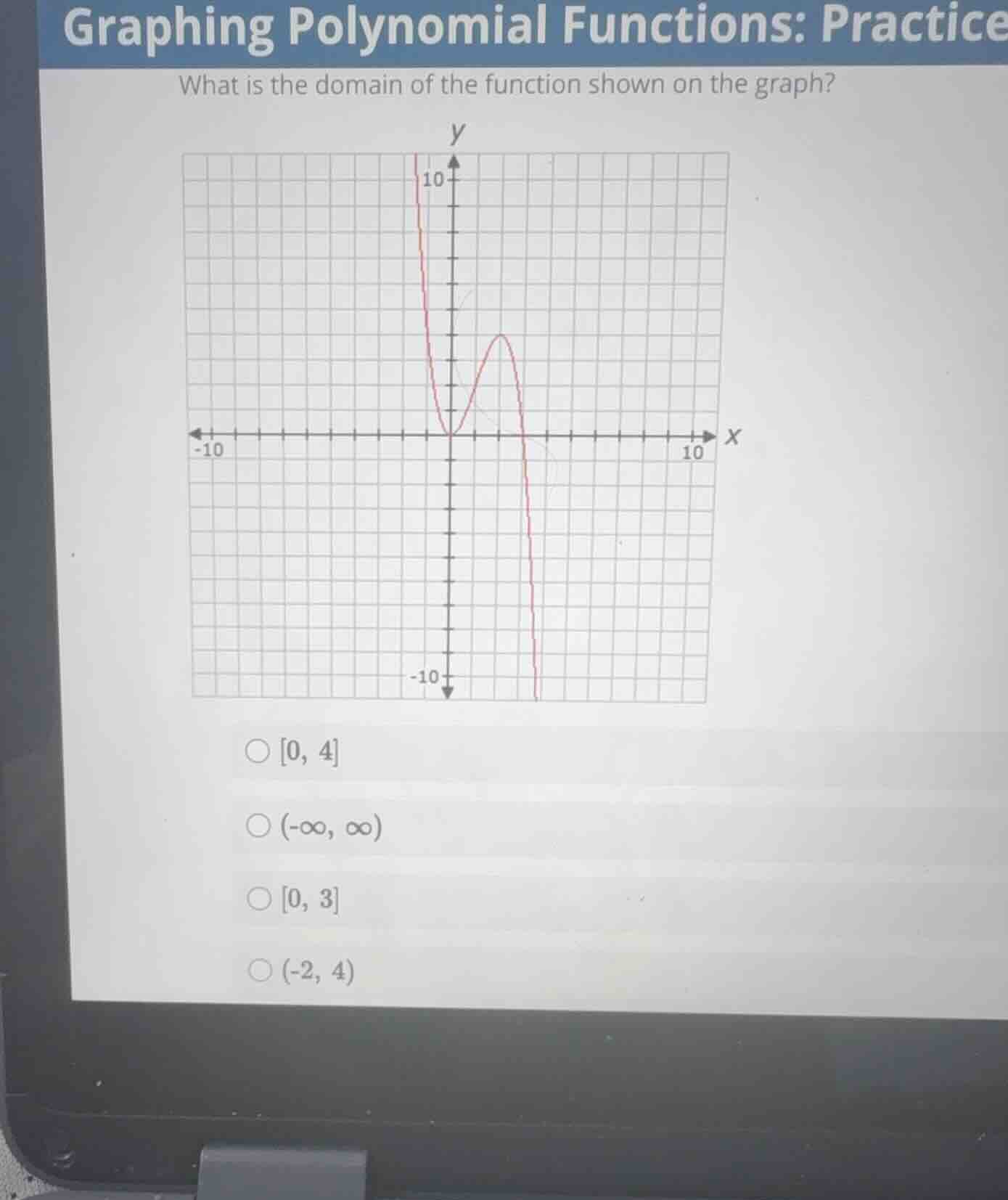
what is the domain of the function shown on the graph?
\\(0, 4\\)
\\((-\infty, \infty)\\)
\\(0, 3\\)
\\((-2, 4)\\)
<pre_analysis>
{
"quality": "clear",
"question_count": 1,
"skills_matched": [
"step_cot",
"multiple_choice_formatter",
"explain_then_answer",
"quick"
],
"needs_drawing": false,
"concepts_used": [],
"new_concepts": [
"Domain of Polynomials",
"Interval Notation"
],
"current_concepts": [
"Domain of Polynomials",
"Interval Notation",
"Polynomial Graph Analysis"
]
}
</pre_analysis>
<reasoning>
Identify the type of function from the graph
The graph shows a continuous polynomial function with arrows on both ends, extending infinitely.
Determine the domain of the function
The graph extends infinitely to the left (\(x \to -\infty\)) and infinitely to the right (\(x \to \infty\)) without any breaks, holes, or vertical asymptotes.
\[
\text{Domain} = (-\infty, \infty)
\]
</reasoning>
<answer>
<mcq-option>(A) \([0, 4]\)</mcq-option>
<mcq-correct>(B) \((-\infty, \infty)\)</mcq-correct>
<mcq-option>(C) \([0, 3]\)</mcq-option>
<mcq-option>(D) \((-2, 4)\)</mcq-option>
</answer>
<post_analysis>
{
"subject": "Mathematics",
"question_type": "Multiple Choice",
"knowledge_point": [
"Mathematics",
"Algebra",
"Domain of Polynomials"
]
}
</post_analysis>
Snap & solve any problem in the app
Get step-by-step solutions on Sovi AI
Photo-based solutions with guided steps
Explore more problems and detailed explanations
<pre_analysis>
{
"quality": "clear",
"question_count": 1,
"skills_matched": [
"step_cot",
"multiple_choice_formatter",
"explain_then_answer",
"quick"
],
"needs_drawing": false,
"concepts_used": [],
"new_concepts": [
"Domain of Polynomials",
"Interval Notation"
],
"current_concepts": [
"Domain of Polynomials",
"Interval Notation",
"Polynomial Graph Analysis"
]
}
</pre_analysis>
<reasoning>
Identify the type of function from the graph
The graph shows a continuous polynomial function with arrows on both ends, extending infinitely.
Determine the domain of the function
The graph extends infinitely to the left (\(x \to -\infty\)) and infinitely to the right (\(x \to \infty\)) without any breaks, holes, or vertical asymptotes.
\[
\text{Domain} = (-\infty, \infty)
\]
</reasoning>
<answer>
<mcq-option>(A) \([0, 4]\)</mcq-option>
<mcq-correct>(B) \((-\infty, \infty)\)</mcq-correct>
<mcq-option>(C) \([0, 3]\)</mcq-option>
<mcq-option>(D) \((-2, 4)\)</mcq-option>
</answer>
<post_analysis>
{
"subject": "Mathematics",
"question_type": "Multiple Choice",
"knowledge_point": [
"Mathematics",
"Algebra",
"Domain of Polynomials"
]
}
</post_analysis>